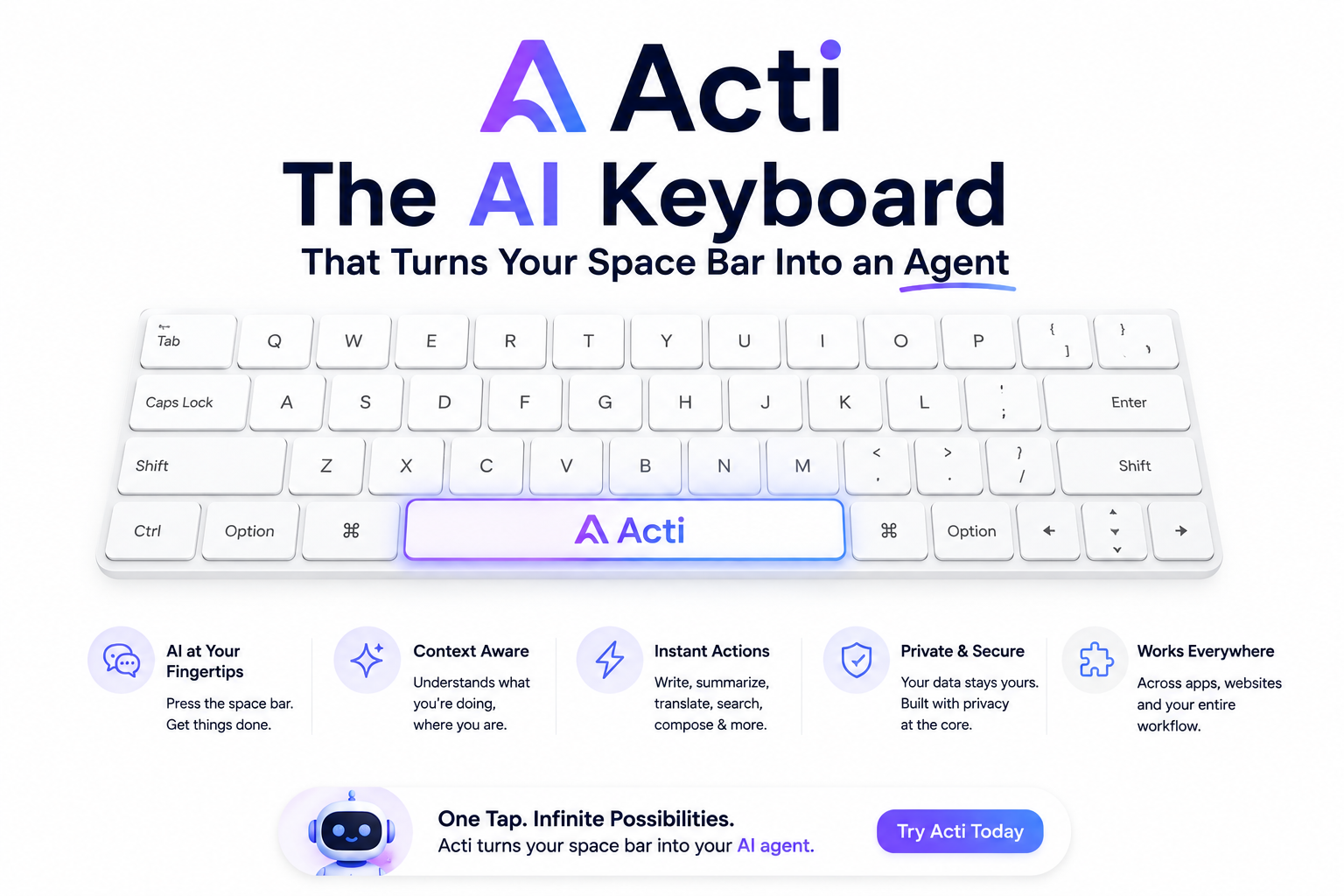
Acti: The AI Keyboard That Turns Your Space Bar Into an Agent
Acti is a Singapore startup that launched the world's first agentic keyboard for iOS and Android. Instead of asking you to open a separate app to talk to an AI assistant, it lives inside the keyboard you already use and turns the space bar into an action trigger. Press it normally to type, or hold it to translate a message, look up a location, or run a multistep automation you built yourself.
The space bar becomes an action trigger
Acti replaces your keyboard's space bar with what it calls the ActiBar. Press it and it works like a normal space bar. Hold it and it triggers an action inside whatever app you're already typing in—Messages, Gmail, Instagram DMs, or a group chat. Ask it to find an address someone mentioned earlier in the thread and it drops the location straight into the message box. No copy-paste, no switching apps, no losing your place.
Skills you build by describing them in plain language
Acti calls its automations Skills—small, repeatable actions bound to a single key press. A Skill can translate an incoming message, summarize a long thread, or fire off a meeting link the moment someone asks "you free this week?" You build one by describing what you want in plain language; Acti assembles the automation for you. No code required.
In the two weeks before launch, early access testers had already built over 1,000 Skills. They can stay private or get published to a public marketplace, turning the keyboard into a small platform rather than a single feature.
Gemini under the hood, local-first by design
Acti runs on Google's Gemini models. The company chose them for the balance of intelligence, latency, multilingual support, and cost that a keyboard-embedded assistant needs—it has to respond inside a text field without making you wait.
Privacy is handled with a local-first approach: personal context stays on-device by default, and the app says it does not access or store private messages and conversations unless a feature explicitly requires sending something out for processing.
Why a keyboard, and why now
- Zero app-switching. Every other agent still costs you a context switch. A keyboard-level agent works inside the app you're already in, removing the biggest source of friction in "just ask the AI to do it."
- No-code automation for non-developers. Skills built from a plain-language description put agent-building in front of people who would never touch Zapier or a prompt library, let alone write a script.
- A marketplace, not just a feature. Public Skills mean the best automations can spread the way a good keyboard shortcut or template already does—by someone else building it first.
Who Acti is for
Anyone who spends their day moving between messaging apps, email, and social DMs is the obvious first user. The keyboard already sees everything they type, so it can act on all of it without new integrations per app. It's also a preview of a broader shift: instead of one giant assistant app trying to be everywhere, the agent quietly rides along inside the interface you never close.
Bottom line
Acti isn't trying to out-reason frontier labs on benchmarks. It's making a narrower bet: that the highest-leverage place to put an AI agent isn't a new app, it's the keyboard you're already using a thousand times a day. And that turning automation-building into a plain-language conversation is what finally gets non-developers to build their own.