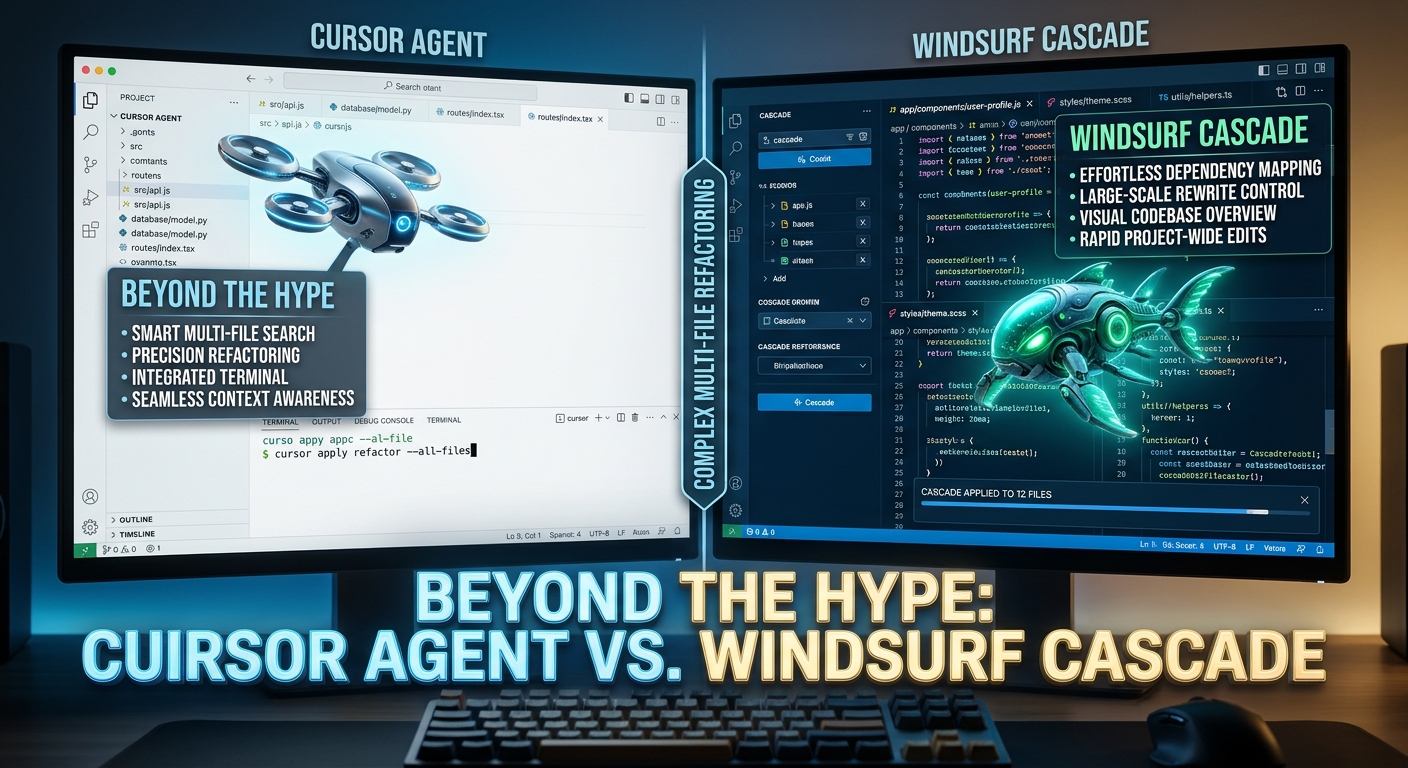
Cursor Agent vs. Windsurf Cascade: Real-World Refactoring Benchmarked
Cursor Agent vs. Windsurf Cascade: Real-World Refactoring Benchmarked
AI code assistants used to be glorified autocomplete snippets. That era is dead. Today, the real competition is over agentic control—IDEs that read your entire repository, execute terminal commands, run tests, and fix their own errors before you intervene.
We put Cursor Agent and Codeium's Windsurf Cascade through the same complex, multi-file Python refactor to find out where each tool actually shines—and where both still fall short.
Architectural Approaches: Context Indexing and Terminal Control
Cursor built its reputation on deep, custom repository indexing. It parses your project's Abstract Syntax Tree (AST), merges local vector embeddings with real-time Language Server Protocol (LSP) diagnostics, and injects relevant snippets directly into the prompt context. Its Agent mode takes this further by giving the LLM full terminal access, allowing it to run build commands and inspect shell outputs in an autonomous feedback loop.
Windsurf takes a different path with its Cascade architecture. Instead of relying purely on static context indexes, Cascade tracks active developer flow—monitoring active editor tabs, open terminal buffers, and step-by-step user actions. It treats your workspace as a living state machine.
When you ask Windsurf to fix a failing test, it doesn't just scan files. It watches the test output in real time and modifies code on the fly.
Real-World Benchmark: Refactoring a Legacy Microservice
We threw both editors the same nightmare scenario. The task: convert a synchronous SQLAlchemy 1.4 ORM codebase to fully asynchronous SQLAlchemy 2.0, update Pydantic models from v1 to v2, and ensure all Pytest suites pass.
How Cursor Agent Handled It
Cursor started fast. Its file selection for the initial prompt was spot on, grabbing the exact database driver configurations and model definitions.
The agent proposed a multi-file migration plan and began modifying models.py and database.py simultaneously. When it ran pytest in the integrated terminal, it hit several missing await statements.
Cursor noticed the non-zero exit code, read the stack trace, and applied corrective patches across four separate files without manual intervention.
However, context window limits became an issue by step six. Because Cursor aggressively feeds large AST slices into the model, token consumption spiked quickly, forcing the agent to lose track of earlier import aliases.
How Windsurf Cascade Handled It
Windsurf took a more cautious initial step. Rather than editing five files at once, Cascade broke the task down into distinct execution blocks.
It edited the schema models first, prompted us to confirm the changes, and then proceeded to the ORM logic. Its terminal integration felt slightly tighter; when a migration script failed due to an unlinked Postgres container, Windsurf flagged the missing environment variable immediately.
Windsurf's context retention during long sessions was distinctly cleaner. Because it prioritizes active workspace history over raw file volume, it didn't suffer from the mid-task hallucination loop that Cursor hit.
The tradeoff? Windsurf requires more manual confirmations out of the box unless you explicitly disable its safety guardrails.
Hard Limitations: Where Both Tools Still Break
Neither tool is ready to replace senior engineering oversight. You will hit friction points fast if you expect hands-off magic.
- Hallucinated Package Versions: Both agents repeatedly tried to import deprecated Pydantic functions (
dict()instead ofmodel_dump()) during high-complexity refactoring loops. - Terminal Command Loops: If a shell command fails due to a network timeout or missing system dependency, both Cursor and Windsurf occasionally get stuck in a retry loop, burning expensive API tokens on identical attempts.
- Large Repository Slowdowns: On repos exceeding 100,000 lines of code, Cursor's background indexing consumes noticeable CPU cycles on Apple Silicon hardware, while Windsurf can lag when tracking deep directory structures.
- Context Overload: When an agent file diff spans more than ten files, both systems occasionally drop variable references or introduce silent regressions in unindexed helper modules.
Which AI Code Editor Belongs in Your Toolchain?
Choose Cursor if you want raw speed and maximum autonomy for rapid prototyping or isolated module rewrites. Its deep AST indexing makes it exceptionally good at jumping into large existing codebases and inferring complex dependency chains right out of the gate.
Choose Windsurf if your daily workflow involves multi-step debugging, active terminal monitoring, and long refactoring sessions where context drift usually kills AI accuracy. Its Cascade engine keeps memory clean across multi-hour tasks, making it the safer pair-programmer for mission-critical code.
Both tools prove that the future of software engineering isn't writing boilerplate—it's orchestrating smart agents that can build, test, and self-correct under human guidance. No single editor is ready to run entirely on autopilot yet, but the gap is closing fast. ===END===