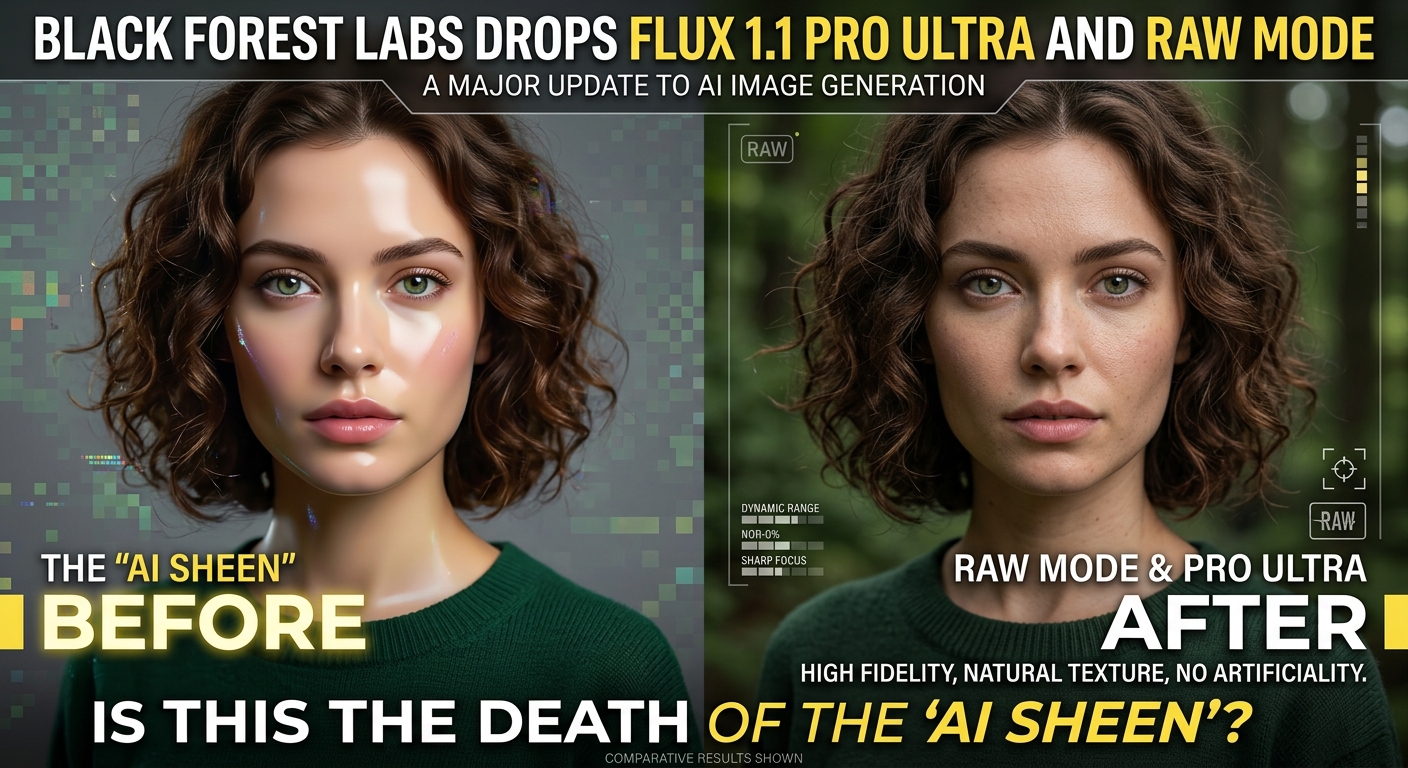
Flux 1.1 Pro Ultra and RAW Mode: End of the AI Sheen?
Flux 1.1 Pro Ultra and RAW Mode: End of the AI Sheen?
Black Forest Labs has launched Flux 1.1 [pro] Ultra and a new RAW Mode, addressing two of the biggest complaints in AI image generation: low native resolution and the artificial "AI plastic" sheen. The update offers up to 4MP native generation and realistic photographic imperfections, though it remains locked behind paid APIs.
---
What's New: Ultra Resolution and RAW Fidelity
Black Forest Labs didn't just tweak a few weights; they re-architected how their premium tier handles scaling and style guidance.
Flux 1.1 [pro] Ultra (The 4K Beast)
Previously, generating high-res images with Flux meant dealing with nasty artifacts or employing complex, multi-stage upscaling workflows. The new Ultra model native-generates up to 4 Megapixels (specifically up to 2K resolution per side, preserving aspect ratios) without losing compositional integrity.
We tested it on classic multi-subject prompts. Usually, wide shots of three people talking in a coffee shop turn into a nightmare of extra limbs and warped faces at high resolutions. Ultra holds the geometry together. It is roughly twice as fast as the original Flux 1.1 [pro] while delivering quadruple the pixels.
RAW Mode: Goodbye, Over-processed Prompting
AI images have a look. You know it, your users know it, and your clients definitely hate it. It's that overly contrasty, hyper-smooth, perfectly lit aesthetic that screams "synthetic."
The new RAW Mode acts as a giant bypass switch for the model's built-in aesthetic bias. When toggled on via their API partners (like fal.ai, Replicate, or BFL's own console), it stops forcing "optimal" lighting. Instead, it mimics genuine digital SLR noise, organic lens flare, and slightly imperfect focus.
---
Real-World Use Cases for Developers
This isn't just for making pretty pictures on Twitter. Here is where the new updates fit into production stacks:
- Dynamic E-commerce Mockups: E-commerce platforms can use RAW Mode to generate lifestyle product shots that look like they were shot on a Canon 5D, rather than a 3D rendering engine.
- High-Res Print and OOH Advertising: Before today, a 4-megapixel native output required heavy upscaling before it could go near print. The Ultra model outputs print-ready assets out of the box.
- Local UI / Asset Generation: For game devs needing rapid asset generation, the native adherence to odd aspect ratios in Ultra means less cropping and less post-processing.
---
The Reality Check: Hard Limitations
Let's be honest about where this still falls short.
- Text Rendering is Still a Coin Toss: While Flux is miles ahead of Stable Diffusion XL at spelling, the Ultra model still occasionally scrambles letters when you push the aspect ratio to extreme widescreen formats.
- API Cost Accumulation: Running Ultra isn't cheap. If you are running thousands of batch generations for a user-facing app, the per-image cost on Fal or Replicate will eat your margins quickly compared to self-hosting the standard dev model.
- No Local Ultra Option: Unlike the base Flux.1 [dev] or [schnell] models, Ultra and the official RAW Mode API remain closed-source behind BFL's API walls. If you have a strict data privacy requirement, you're locked out of these improvements.
---
The Verdict
If your product relies on users believing the images they see are real, RAW Mode is a mandatory upgrade. The loss of the "AI sheen" alone justifies the API switch. However, for indie developers on a shoe-string budget, self-hosting Flux [dev] with a custom LoRA remains the more economical path forward. Black Forest Labs is proving they aren't a one-hit wonder, but they are clearly steering their best tech toward a paid, enterprise-focused API model.