Claude 3.5 Sonnet vs GPT-4o: Developer Coding Benchmark
Claude 3.5 Sonnet vs GPT-4o: The Real Developer Benchmark in 2026
If you spent any time on developer Twitter or Hacker News this week, you probably saw the endless stream of benchmarks. Anthropic and OpenAI are locked in a relentless arm-wrestling match for the hearts, minds, and API keys of software engineers. But synthetic benchmark scores like HumanEval don't tell you what happens when your build breaks at 2 AM or when an LLM hallucination silently corrupts a Postgres migration script.
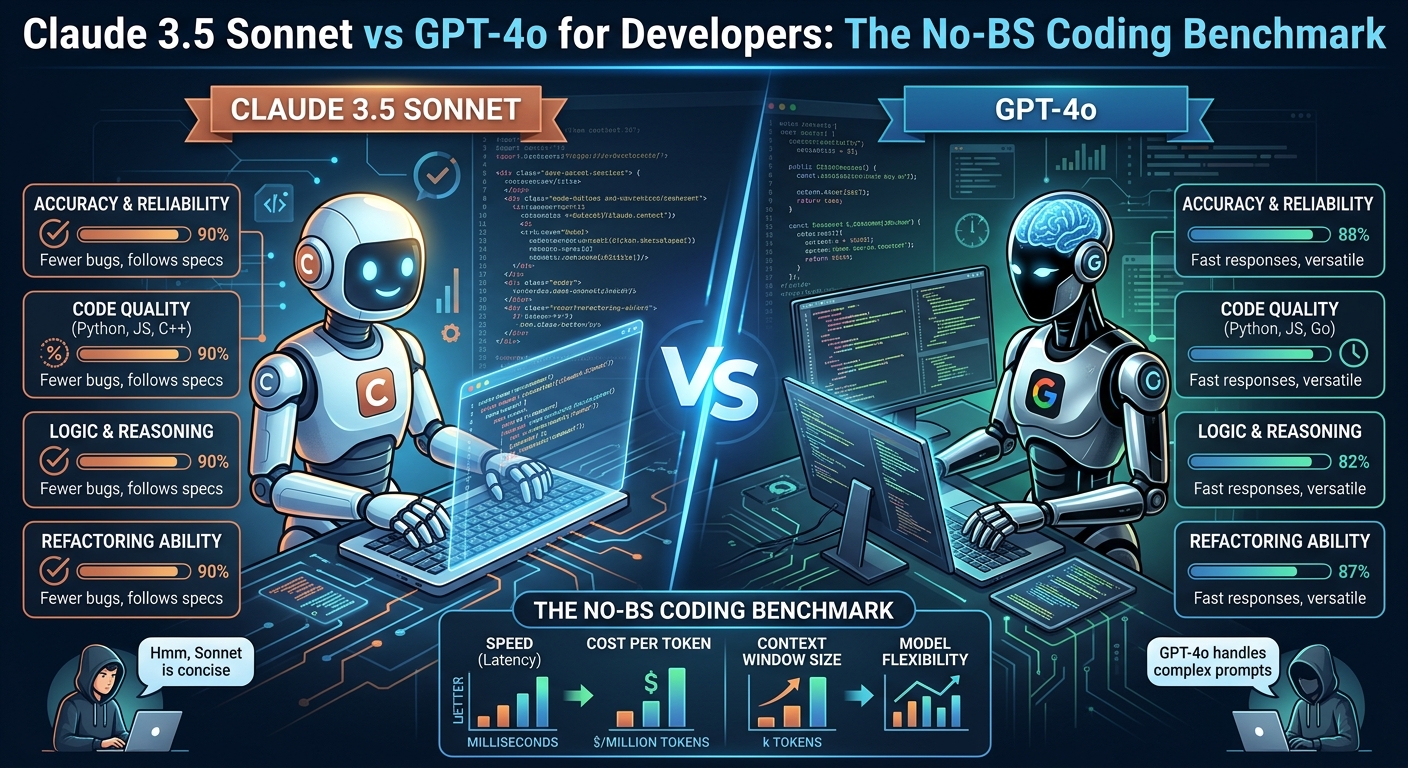
Claude 3.5 Sonnet currently outperforms GPT-4o for serious coding work, especially on multi-file refactoring and deep logical reasoning. GPT-4o pulls ahead on speed and multimodal tasks. We tested both side by side, and the results go beyond what the marketing pages claim.
Code Architecture and Multi-File Context
Anthropic’s Claude 3.5 Sonnet handles sprawling context windows with uncanny precision. When tasked with refactoring a monolithic Express.js app into a clean modular architecture, Sonnet tracked dependencies across twelve files without dropping state or dropping imports.
GPT-4o handles high-level architectural questions fast. Its initial response speed outpaces Claude noticeably. However, as file counts scale, GPT-4o tends to lazily drop implementation details, leaving placeholders like // implement logic here right in the middle of critical handler functions.
- Claude 3.5 Sonnet: Refactors complex codebases without trimming essential boilerplate.
- GPT-4o: Rapid iteration and quick prototyping, but requires strict prompt guardrails to prevent lazy outputs.
Live Debugging and Edge-Case Reasoning
Debugging subtle race conditions is where the gap widens. We fed both models a tricky Go concurrency bug involving unbuffered channels and deadlocks under heavy load.
Claude pinpointed the deadlock source on its first pass, explaining the goroutine lifecycle cleanly and providing an idiomatic fix using sync.WaitGroup. GPT-4o identified the general area of failure but suggested an over-engineered mutex workaround that introduced extra latency without completely resolving the underlying memory leak.
For sheer logical rigor in complex stack traces, Sonnet maintains a clear edge.
Real-World Use Cases: Which Tool Fits Your Stack?
Choose Claude 3.5 Sonnet if:
- You rely on AI for heavy coding, refactoring multi-file repositories, or writing precise infrastructure-as-code scripts.
- You need Artifacts-style UI previews to rapidly test rendered frontend code side-by-side.
- Your workflow demands zero hand-waving or stubbed code in responses.
Choose GPT-4o if:
- Your application demands multimodal inputs like analyzing complex UI mockups, architectural diagrams, and voice streams concurrently.
- You need deep integration with custom GPTs, web searching tools, and Python data analysis environments natively in one chat session.
- Your priority is maximum API speed and high throughput for high-volume batch tasks.
Hard Limitations You Need to Know
Neither model is magic. Expect real friction points if you push them hard:
- Claude 3.5 Sonnet Usage Limits: Even on paid tiers, Sonnet's message caps hit fast during heavy refactoring sessions. You will run into rate-limiting walls right when you're in deep flow state.
- GPT-4o Code Drift: OpenAI's flag model still suffers from code laziness on long prompts. You'll spend unnecessary cycles prompting it to "write the full function without skipping code."
- Context Degradation: Both models degrade in reasoning performance when context windows approach maximum capacity. Large context windows exist, but performance at 150k+ tokens remains noticeably worse than under 30k tokens.
The Bottom Line
For pure code output, deep logical reasoning, and refactoring accuracy, Claude 3.5 Sonnet is currently the superior daily driver for developers. OpenAI’s GPT-4o remains the ultimate generalist workhorse—faster and better equipped for multimodal tasks, but prone to taking shortcuts when the code gets tough. Pick the right tool for your specific workload, and don't blindly trust benchmark charts.