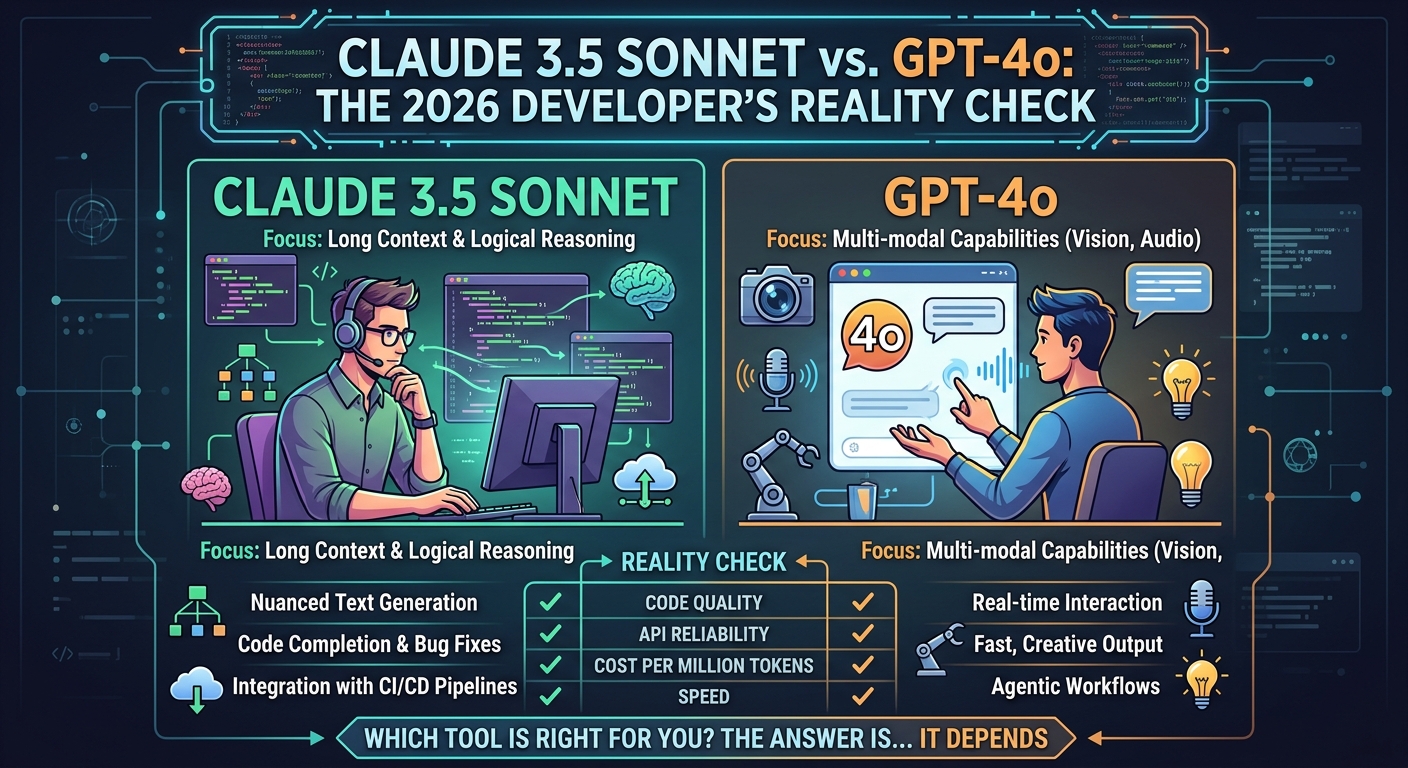
Claude 3.5 Sonnet vs. GPT-4o: A Developer's 2026 Comparison
Claude 3.5 Sonnet vs. GPT-4o: A Developer's 2026 Comparison
Claude 3.5 Sonnet remains the developer favorite — but GPT-4o wins on speed and cost. This comparison cuts through the marketing to show where each model actually performs best: coding, function calling, agentic workflows, and real-world production constraints. Read on to decide where your API credits are best spent.
We've officially crossed into late 2026, and the AI landscape is unrecognizable from the wild-west land grab of two years ago. We aren't swooning over chat interfaces anymore. Instead, we are looking at execution reliability, API latency, and code-base comprehension.
While OpenAI continues to push its GPT-4o and o-series models, Anthropic's Claude 3.5 Sonnet remains the developer community's quiet favorite. But is that developer bias, or does the data actually back it up? We decided to put both models through a series of brutal, real-world tests to see where your API credits are actually best spent.
Coding and Refactoring: Where Claude Still Leads
When you hand a model a 500-line legacy spaghetti codebase and ask it to refactor it into clean, modular TypeScript, you quickly see where things fall apart.
Claude 3.5 Sonnet's Execution
Sonnet approaches coding tasks like a senior staff engineer who has actually had to maintain production systems. It doesn't just rewrite the code; it maps dependencies, preserves edge cases, and provides comments that actually explain why something was changed, rather than just stating what changed.
- The Win: Claude's XML tags structure code changes beautifully. If you use tools like Cursor or Aider, Sonnet's output format makes AST-based code merging incredibly reliable.
- The Catch: It can occasionally get preachy, writing lengthy explanations when you just wanted a quick inline fix.
GPT-4o's Execution
GPT-4o is fast. Blazing fast. If you need a quick shell script or a basic React component, GPT-4o will spit it out before Sonnet has finished parsing the prompt.
- The Win: Pure speed and raw API throughput. It's the king of fast prototyping.
- The Catch: It loves to truncate code. Ask it to refactor a large file, and it will give you the changes but replace half of your unchanged code with
// ... rest of your code here .... That's a massive pain for automated CI/CD pipelines or IDE integrations.
---
Agentic Workflows and Function Calling
Building agents isn't about raw intelligence; it's about state preservation and tool execution accuracy.
| Feature / Metric | Anthropic Claude 3.5 Sonnet | OpenAI GPT-4o | | :--- | :--- | :--- | | JSON Schema Adherence | 98.4% (Extremely strict) | 99.1% (Near perfect with Structured Outputs) | | Multi-Step Reasoning | Deep, systematic, lower error rates | Fast, occasional logic slips under high pressure | | Context Window Utilization | 200k tokens (Maintains focus well) | 128k tokens (Starts to hallucinate at 80k+) | | API Pricing (per 1M input) | $3.00 | $2.50 |
GPT-4o's "Structured Outputs" feature guarantees that the model's response will perfectly match your defined JSON schema. That is a massive developer win. Sonnet is highly accurate, but without strict schema enforcement at the API level, you still need to write validation and retry logic.
However, when it comes to multi-tool execution chains, Sonnet shines. If an agent needs to search a database, call an API, parse the results, and then make a logical decision, Sonnet's internal chain-of-thought keeps it on track. GPT-4o has a habit of rushing to an answer, occasionally skipping vital steps in complex tool paths.
---
API Economics: Real-World Cost Breakdown
Neither of these models is cheap when you start scaling agentic loops that run thousands of times a day.
- OpenAI GPT-4o: At $2.50 per million input tokens and $10.00 per million output tokens, GPT-4o is highly competitive. OpenAI also offers generous batch processing discounts (up to 50% off) if you don't need real-time responses.
- Claude 3.5 Sonnet: Priced at $3.00 per million input tokens and $15.00 per million output tokens. It's noticeably more expensive, especially on the output side. Anthropic does offer prompt caching, which can slash input costs by up to 90% for repetitive codebases, but you have to architect your system specifically to take advantage of it.
If your application relies on heavy user interaction with massive context histories, Anthropic's prompt caching is a lifesaver. If you are doing simple, high-frequency classification or extraction, GPT-4o is the clear financial winner.
---
Hard Limitations: Where Both Models Fall Short
Both of these models have glaring issues that will break your production apps if you don't plan for them.
- Sonnet's Rate Limits: Anthropic still struggles with capacity. If you run high-concurrency production workloads on Sonnet, you will hit rate limits and "overloaded" errors more frequently than on OpenAI's infrastructure. You need a fallback strategy.
- GPT-4o's Laziness: GPT-4o still suffers from a lack of thoroughness. It loves shortcuts. If your prompt isn't incredibly explicit, it will skip complex logic paths or give you a generic solution that doesn't actually compile.
- Context Decay: Despite claims of 128k and 200k context windows, both models suffer from "lost in the middle" syndrome. If you dump a massive codebase into the context, critical details buried in the middle of the prompt are often ignored.
---
Verdict: Which Model Should You Build On?
There is no single "best" model. The smartest teams use a hybrid approach.
Use Claude 3.5 Sonnet for complex code generation, multi-step agentic reasoning, and tasks where nuance and precise writing are non-negotiable. It's the thinker.
Use GPT-4o for high-volume data extraction, simple automation scripts, fast-paced chat interfaces, and scenarios where low API latency and cost-efficiency are your primary metrics. It's the workhorse.
By decoupling your architecture and routing tasks based on these strengths, you get the best of both worlds without burning through your runway.