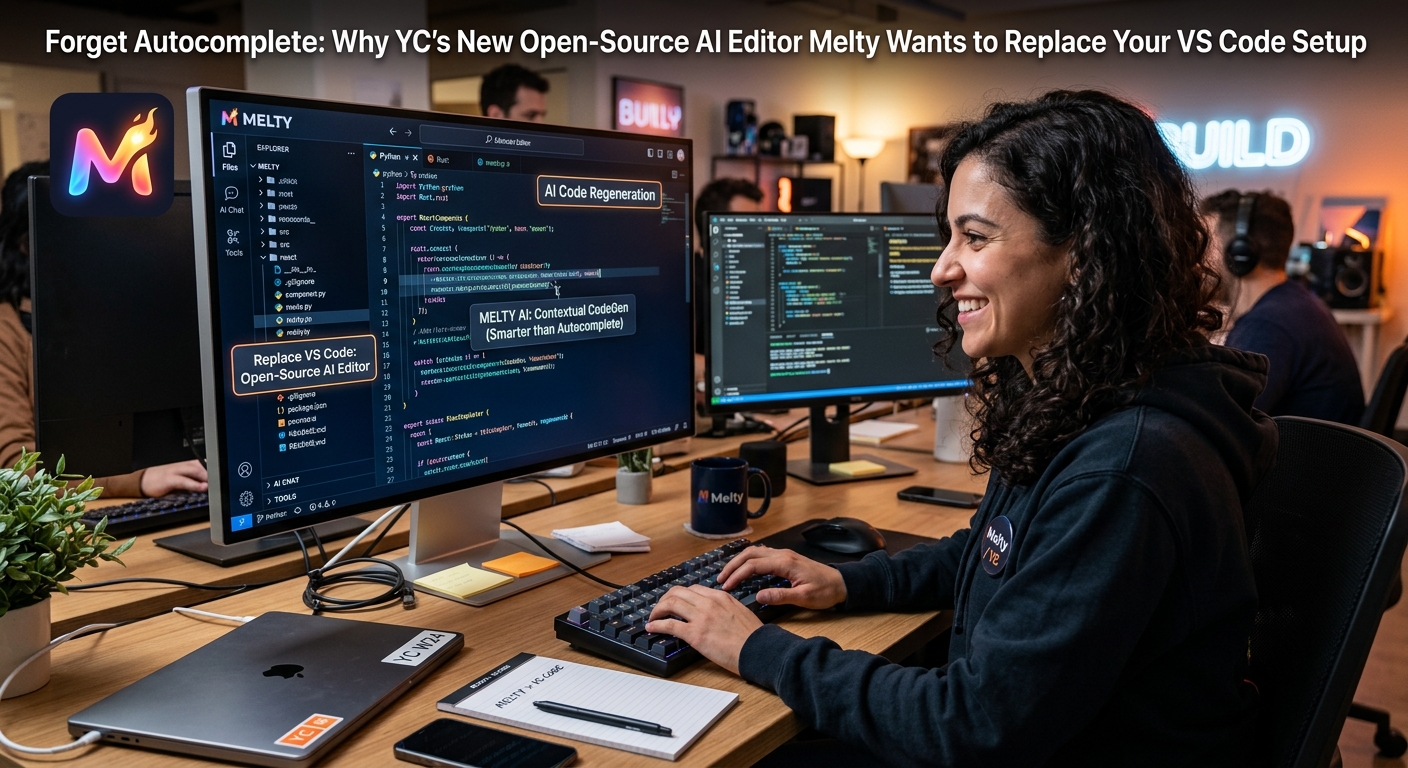
Melty AI Editor: YC-Backed Open-Source Tool for Autonomous Coding
Melty: The YC-Backed Open-Source AI Editor That Replaces Traditional Autocomplete
If you spend your days wrestling with Cursor, VS Code extensions, or trying to coax Copilot into writing more than five lines of working boilerplate without losing its mind, you know the drill. Today's AI coding tools are mostly autocomplete engines on steroids. They sit inside your editor, waiting for you to trigger them, and then spit out code that you still have to manually verify, copy-paste, and debug.
Melty takes a radically different path. Fresh out of YCombinator, this open-source AI editor is designed from the ground up to work like a human pair programmer. It doesn't just suggest lines—it understands your entire codebase, watches your terminal, writes commits, and learns from every single move you make.
Here's what makes Melty different, how it performs, and whether it's ready to replace your current setup.
What Makes Melty Actually Different?
Most developer tools treat AI as an external assistant. You write a prompt, it returns a block of code, and you handle the integration. Melty flips this flow. It acts as an autonomous collaborator that integrates deeply into your existing workflow.
True Codebase Navigation and Context Awareness
Copilot and typical RAG (Retrieval-Augmented Generation) setups struggle with large, multi-file codebases. They see only a tiny window of what you're working on. Melty indexes your entire repository. If you ask it to "refactor the authentication middleware to use our new Redis client," it doesn't just guess. It navigates to the Redis configuration, finds the current middleware file, edits both, and ensures the imports line up across your directory structure.
Autonomous Command Terminal Integration
Melty doesn't stop at writing code. It can run commands in your terminal, read the output, and self-correct. If it writes a TypeScript function that fails a compilation step or throws an error during a Jest run, it reads the stack trace, goes back to the file, and fixes its own mistake before you even have to point it out.
Automatic Git Commits and Flow
Instead of dump-and-run code generation, Melty tracks your progress in logical chunks. It writes clean, atomic Git commit messages for the changes it makes. This means you can easily roll back specific agent actions without having to manually undo hundreds of lines of scattered edits.
Real-World Use Cases: Where It Excels
Melty isn't just for building simple To-Do apps. Here is where it actually saves hours of developer time:
- Navigating Legacy Codebases: Point Melty at an undocumented Node.js or Python backend. It can trace dependencies, find unused functions, and write accurate integration tests without you having to manually map the files.
- Complex Multi-File Refactoring: When renaming a database schema or updating a core API response structure, Melty can propagate those changes across all affected controllers, services, and test files simultaneously.
- Bootstraping Integration Tests: Writing boilerplate tests is tedious. Melty can read your controller files, spinning up comprehensive unit and integration suites with mock data that actually matches your validation schemas.
The Hard Limitations: Where Melty Struggles
No tool is magic. While Melty's agentic approach is impressive, it has several raw edges you need to know about before migrating your primary workspace:
- Resource Heavy: Running deep workspace indexing and local LLM coordination takes a serious toll on system memory. If you are on an older Macbook Air, expect the fans to kick in and your battery to drain fast.
- Agent Loops and "Hallucination Spirals": Because Melty can run terminal commands and rewrite code autonomously, it can occasionally get stuck in a loop. If a test fails due to an environmental issue (like a missing local database connection), Melty might spend five minutes rewriting perfectly fine code trying to fix it.
- Youth and Stability: It is still an early-stage tool. You will encounter UI bugs, occasional workspace crashes, and moments where the agent loses track of the execution context and requires a hard restart.
Should You Switch Today?
If you are a developer who loves absolute control over every character typed, Melty might feel too aggressive. But if you find yourself spending more time managing AI prompts and copy-pasting code than actually designing systems, Melty is a breath of fresh air.
It represents a major shift from reactive autocomplete to active, agentic collaboration. It's open source, highly hackable, and fast becoming the blueprint for how we will write software in the next five years. Grab the beta, point it at a side project, and see what happens when the AI actually takes the wheel.