GPT-5.6 Explained: Sol, Terra, and Luna Compared
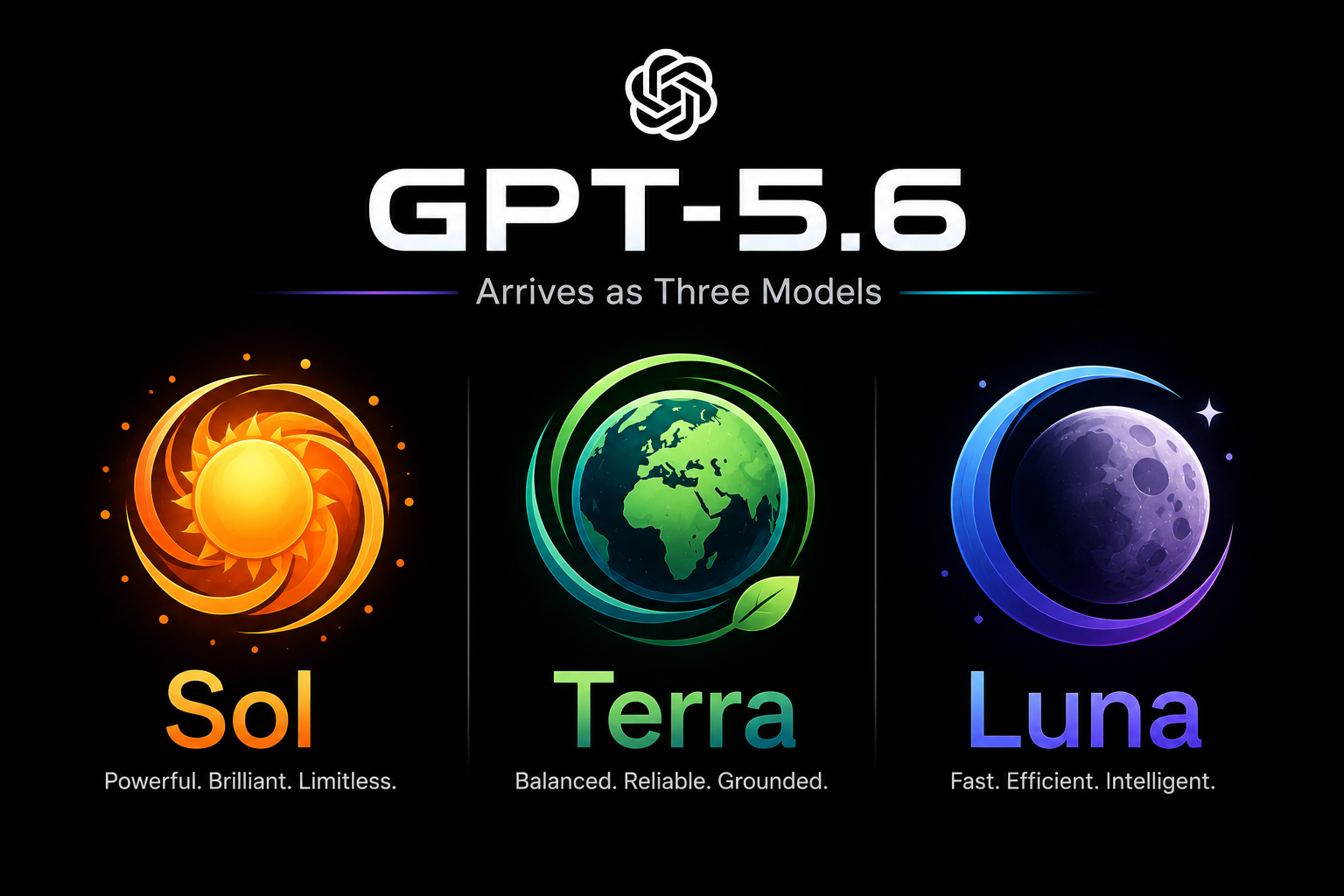
OpenAI's newest release isn't a single model — it's a family. GPT-5.6 ships as three distinct tiers, each tuned for a different job: Sol for frontier reasoning and hard problems, Terra for balanced everyday work, and Luna for fast, cheap, high-volume tasks. The move signals where the whole industry is heading — instead of one model trying to do everything, you pick the size that matches the job.
Meet the three models
- Sol — the flagship. Built for complex coding, research, cybersecurity, science, and computer-use tasks where accuracy matters more than speed. Priced at $5.00 per 1M input tokens and $30.00 per 1M output tokens.
- Terra — the workhorse. Aims to match GPT-5.5-level quality at roughly half the cost, built for the everyday work most teams actually run day to day: drafting, summarizing, coding assistance, support automation.
- Luna — the volume play. The fastest and cheapest of the three, meant for high-throughput tasks like classification, extraction, and lightweight chat where latency and cost matter more than raw reasoning depth.
Why this matters
Splitting a flagship release into three tiers is a pricing and product strategy as much as a technical one. It gives developers a dial to turn: route the hard 10% of requests to Sol, the bulk of daily traffic to Terra, and the throwaway, high-volume calls to Luna. Done right, that can cut API spend dramatically without touching the quality of the outputs that actually need a frontier model.
Prompt caching gets sharper too
Alongside the three-tier split, GPT-5.6 introduces more predictable prompt caching — explicit cache breakpoints and a 30-minute minimum cache life. Cache writes are billed at 1.25x the uncached input rate, while cache reads keep the familiar 90% discount. For teams running long, repeated system prompts or agent loops, that's a meaningful cost lever on top of picking the right tier.
What to do with it
If you're building anything that runs at scale — a support bot, a coding agent, a content pipeline — GPT-5.6's three-tier structure is worth architecting around now: send routine requests to Terra or Luna by default, and reserve Sol for the moments that genuinely need frontier-level reasoning. OpenAI says general availability is coming in the weeks ahead, so now's the time to plan the routing, not scramble for it later.