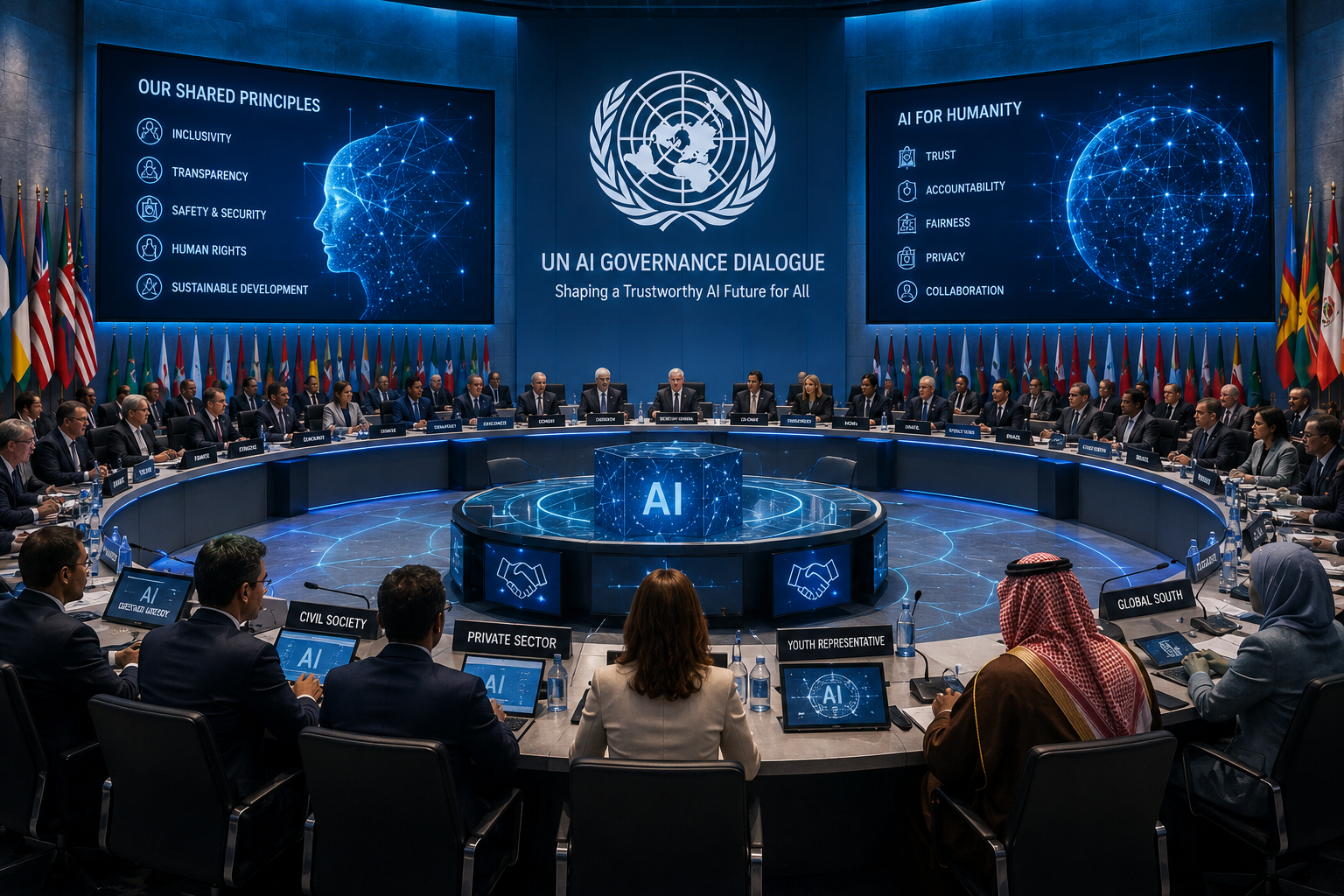
UN's First Global AI Governance Dialogue: Bengio's Warning
The UN's first Global Dialogue on AI Governance opened in Geneva on July 6-7, 2026, co-chaired by Estonia's Rein Tammsaar and El Salvador's Egriselda López. Governments, tech companies, academics, and civil society gathered to confront a technology moving faster than the rules designed to contain it.
Bengio's warning: safety guarantees don't exist yet
Yoshua Bengio, who co-chairs the Independent International Scientific Panel on AI alongside journalist Maria Ressa, delivered the dialogue's most pointed moment. The panel — forty experts who published a preliminary report on July 1 — was assembled to give policymakers an evidence-based picture of what AI systems can and cannot be trusted to do.
Bengio's message was blunt: with growing evidence of deceptive behavior in frontier models, science cannot currently guarantee that increasing AI capabilities won't cause catastrophic harm — either autonomously or in the hands of malicious users.
The statement carries weight at a UN summit. It isn't a claim that catastrophe is coming; it's a claim that nobody can prove it won't. Bengio was equally direct about governance: "We don't have the right national or even international governance tools, and we don't have good ways to steer the benefits so that they are shared by everyone." The gap isn't just about restraining risk — it's about ensuring AI's upside doesn't concentrate in the same handful of countries and companies building it.
Why a UN-level venue matters now
For most of the last three years, AI governance has been a patchwork of national efforts — executive orders, EU regulations, voluntary lab commitments. A model trained in one jurisdiction, hosted in a second, and used in a third makes single-country regulation structurally weak. A rule written in Brussels or Washington has limited reach over a model API called from Lagos or Jakarta.
The Geneva dialogue was the first serious attempt to address this mismatch collectively. It lands at a moment when frontier AI development is shifting: open-weight labs are closing the gap with closed frontier models, on-device and agentic systems are acting with less human oversight, and export-control fights are ongoing over which countries access the newest models. Every trend raises the stakes on the panel's two core questions: Can we verify what these systems can actually do, and who benefits from that capability?
What to watch next
- The scientific panel's full report. July 1's release was preliminary — the complete assessment will anchor future policy proposals.
- Whether "dialogue" becomes a standing body. Geneva was framed as the start of an ongoing process. The real test is whether it produces a durable institution or fades after the news cycle moves on.
- How labs respond in public. Every major AI company has backed "responsible" development. Geneva was the first time that claim faced scrutiny in front of a room built to hold it up against evidence.
None of this changes what ships on your product roadmap this quarter. But it's the clearest signal yet that the AI conversation has shifted from "which model is best" to "who decides how powerful these systems are allowed to get, and for whom." That question now has a venue.