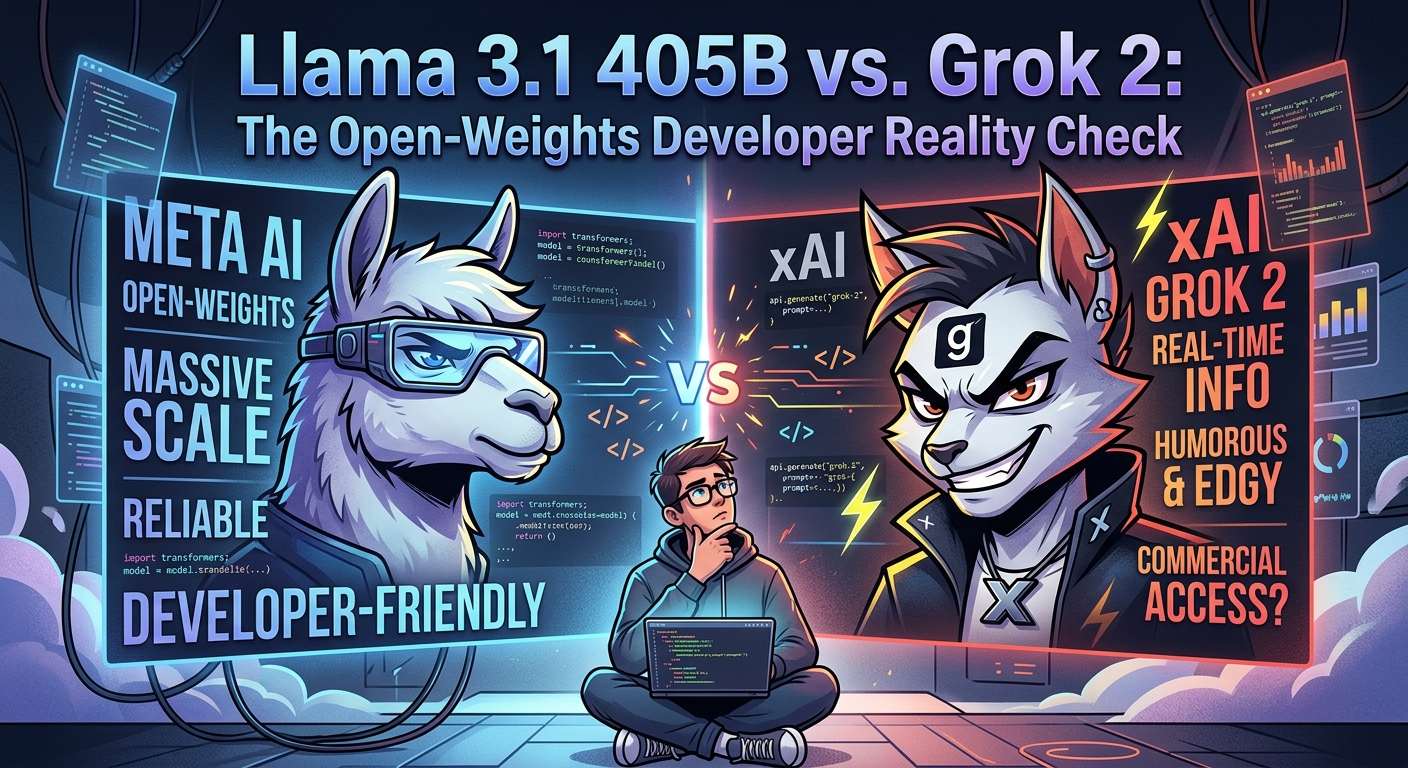
Llama 3.1 405B vs. Grok 2: The Open-Weights Developer Reality Check
Llama 3.1 405B vs. Grok 2: Which Open-Weights Model Should You Deploy?
The short answer: Llama 3.1 405B is the better choice for synthetic data generation and complex reasoning workloads where accuracy matters most. Grok 2 is the stronger pick for high-throughput agentic workflows where latency and inference speed are critical. Both models deliver frontier-level open-weights performance, but their architectures lead to very different deployment strategies.
We are officially living in the era of monster open-weights AI. While proprietary frontier APIs still demand a premium, the open-source and open-weights ecosystem has reached parity on the developer's desktop. With Meta's Llama 3.1 405B settling into enterprise pipelines and xAI's Grok 2 hitting active developer cycles, building production-grade LLM applications no longer requires a forced allegiance to closed ecosystems.
But running these beasts is not a free lunch. Let's bypass the marketing benchmarks and look at how Llama 3.1 405B and Grok 2 stack up in real-world deployment, cold hard costs, and specific developer pipelines.
---
Architecture Differences: Dense vs. Mixture-of-Experts
On paper, both models aim for the crown of open-weights supremacy, but their architectures dictate entirely different infrastructure choices.
Llama 3.1 405B is Meta's flagship dense transformer model. It boasts a massive 128k context window, which is highly robust for long-document analysis, retrieval-augmented generation (RAG), and complex agentic workflows. Because it is a dense 405-billion parameter model, running it locally or in a private cloud requires massive hardware.
Grok 2 is xAI's contender, built on a Mixture-of-Experts (MoE) architecture. While its total parameter count is massive, it only activates a fraction of those parameters per token. This gives Grok 2 a distinct edge in inference speed and throughput, making it significantly cheaper and faster to run at scale compared to Llama's dense footprint.
---
When to Choose Llama 3.1 405B
Llama 3.1 405B excels in scenarios that demand deep reasoning and the ability to generate high-fidelity training data.
Complex Reasoning and Synthetic Data Generation
If you are building a pipeline to distill smaller, specialized models, Llama 3.1 405B is your target. Meta explicitly updated its licensing terms to allow developers to use the 405B model's outputs to train other models.
Its deep, dense reasoning makes it unmatched for generating high-quality synthetic datasets. It handles multi-step logic, code generation, and math with a level of nuance that MoE models sometimes struggle to maintain over long, complex generations.
Long-Context Applications
The 128k context window makes Llama 3.1 405B ideal for RAG pipelines, document summarization, and any workflow that needs to process large documents in a single pass without chunking.
---
When to Choose Grok 2
Grok 2 is purpose-built for speed-sensitive applications where response time directly impacts user experience.
High-Throughput Agentic Workflows
When you are building autonomous agents that need to make hundreds of rapid, iterative tool calls, latency kills the user experience. This is where Grok 2 shines. Thanks to its MoE architecture, token generation is fast. It excels at real-time information retrieval and processing, making it the better choice for consumer-facing chatbots, rapid-fire search agents, and live data analysis.
Cost-Constrained Production Environments
Because Grok 2 only activates a fraction of its parameters per token, inference costs scale more efficiently than dense models at comparable quality levels. Teams running large-scale deployments will see measurable savings.
---
Hardware and Hosting Realities
Before you pull these models down from Hugging Face, let's talk about the practical bottlenecks.
Llama 3.1 405B is a Hardware Nightmare. Running the FP16 precision version of Meta's 405B model requires a cluster of eight 80GB H100 GPUs. Even heavily quantized variants (like 4-bit AWQ) require multiple enterprise-grade GPUs. For most developers, this means relying on serverless API providers like Together AI, Groq, or Fireworks AI, which somewhat dilutes the "run it completely local" promise.
Grok 2's Licensing Constraints. xAI has made strides, but its licensing and commercial terms remain more restrictive than Meta's permissive community license. If you are building highly proprietary enterprise systems where complete data sovereignty and permissive commercial redistribution are mandatory, Meta's open-weights approach still offers a more legally comfortable framework.
---
The Verdict
If your engineering team has the budget for high-end cloud orchestration or requires absolute precision for synthetic data generation and complex reasoning, Llama 3.1 405B is the gold standard of open weights.
If your priority is latency, raw inference speed, and building fast-acting agents that don't choke your API budget, Grok 2 is the more practical daily driver.
Quit chasing the benchmark leaderboards. Pick the architecture that fits your infrastructure budget and latency targets.