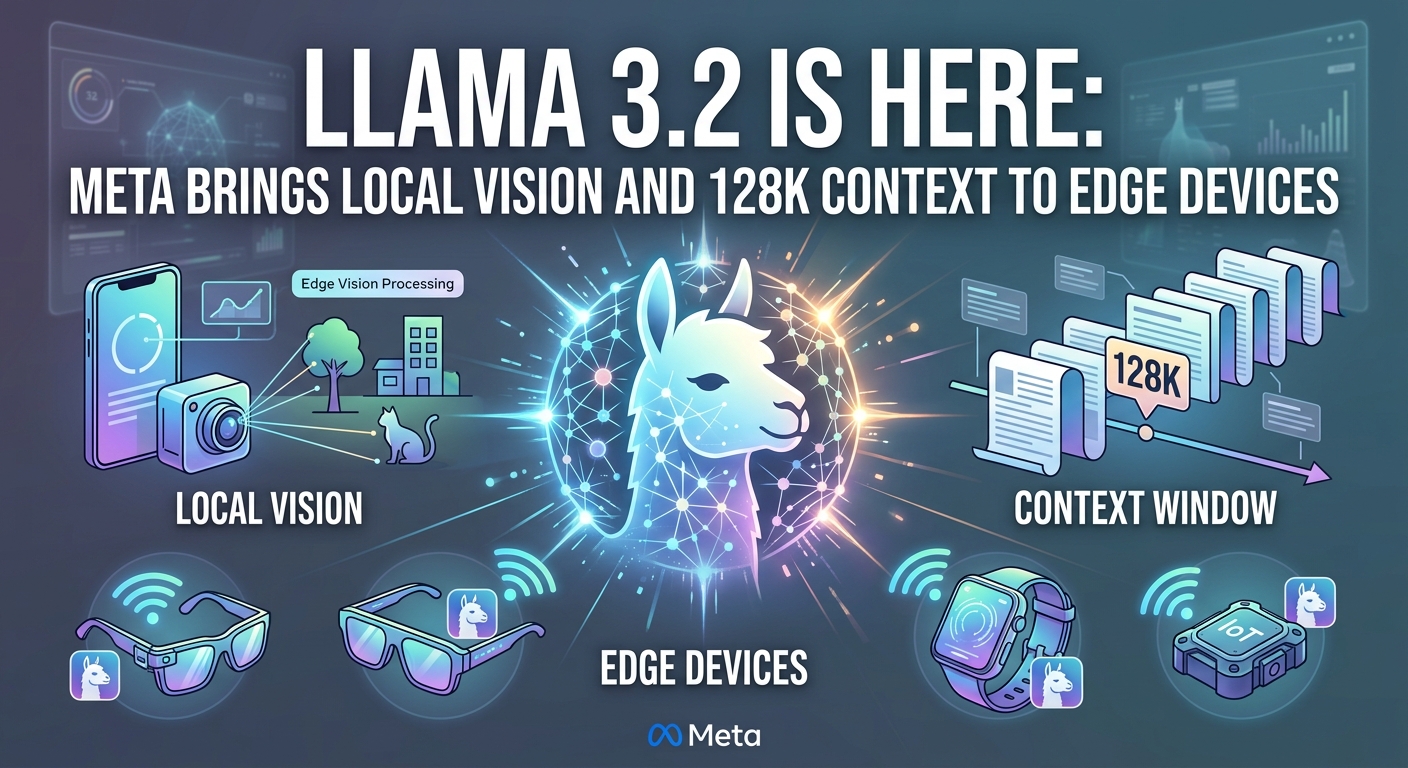
Llama 3.2: Meta's Open-Source Vision Models for Edge AI
Llama 3.2: Meta's Open-Source Vision Models for Edge AI
Meta just released Llama 3.2 at Connect, and it changes how developers can run AI locally. For the first time, Meta offers open-source multimodal models that run on your phone or edge device, plus ultra-lightweight text models with a 128k context window built specifically for mobile and IoT. Here is what you need to know after testing the weights on local hardware.
What Is Llama 3.2?
Meta is releasing two distinct model families in this update, each solving a different developer problem:
Vision Models (11B and 90B)
These are Meta's first open-source multimodal models. They drop directly into existing pipelines as replacements for text-only models like Llama 3.1 8B, with full image-understanding capability added.
- 11B Model: Designed for consumer-grade GPUs. Supports image reasoning, document understanding, and visual chart analysis.
- 90B Model: Built for enterprise-grade visual reasoning, complex data extraction, and high-accuracy chart-to-code pipelines.
Ultra-Lightweight Edge Models (1B and 3B)
Meta collaborated with Arm and Qualcomm to optimize these models for device-level execution.
- 1B and 3B Models: Text-only models with a 128k context window. You can load entire technical manuals or codebases directly on a modern smartphone.
- Hardware Native: Built specifically for Qualcomm Snapdragon, MediaTek, and Arm CPUs, removing the need for constant cloud API calls.
How to Use Llama 3.2 in Your Stack
Local Document Processing on Edge Devices
The 3B model's 128k context window enables privacy-first on-device applications. Build a medical app that analyzes patient records locally on a tablet, or an offline field-inspection tool that processes technical manuals without an active internet connection.
Automated Visual Data Extraction
The 11B vision model turns complex PDFs, charts, and infographics into structured JSON. If you are currently paying OpenAI or Anthropic API fees to parse invoices or receipts, running the 11B model on a local workstation can eliminate those costs.
Ultra-Low Latency AI Agents
Running the 1B or 3B models directly on-device bypasses network latency entirely. This makes real-time voice assistants and interactive game NPCs that respond instantly with zero API overhead practical to build.
Limitations to Plan Around
- No Vision on the Edge: The 1B and 3B models are text-only. Local visual processing on a smartphone still requires cloud APIs, or waiting for downstream quantization of the 11B model — which is too heavy for standard mobile RAM today.
- English-First Performance: While the models support multiple European languages, performance drops noticeably for non-English text, especially in the 1B and 3B variants.
- Licensing Restrictions: Meta's license restricts deployment if your app exceeds 700 million active monthly users, and you cannot use Llama outputs to train competing models.
How to Run Llama 3.2 Now
The weights are live. Pull them via Ollama or Hugging Face:
```bash
Run the 3B text model locally
ollama run llama3.2
Run the 11B vision model
ollama run llama3.2-vision ```
For mobile deployment, check out Meta's ExecuTorch runtime, which has pre-optimized pipelines for iOS and Android. Llama 3.2 makes local, private AI highly practical — start building.