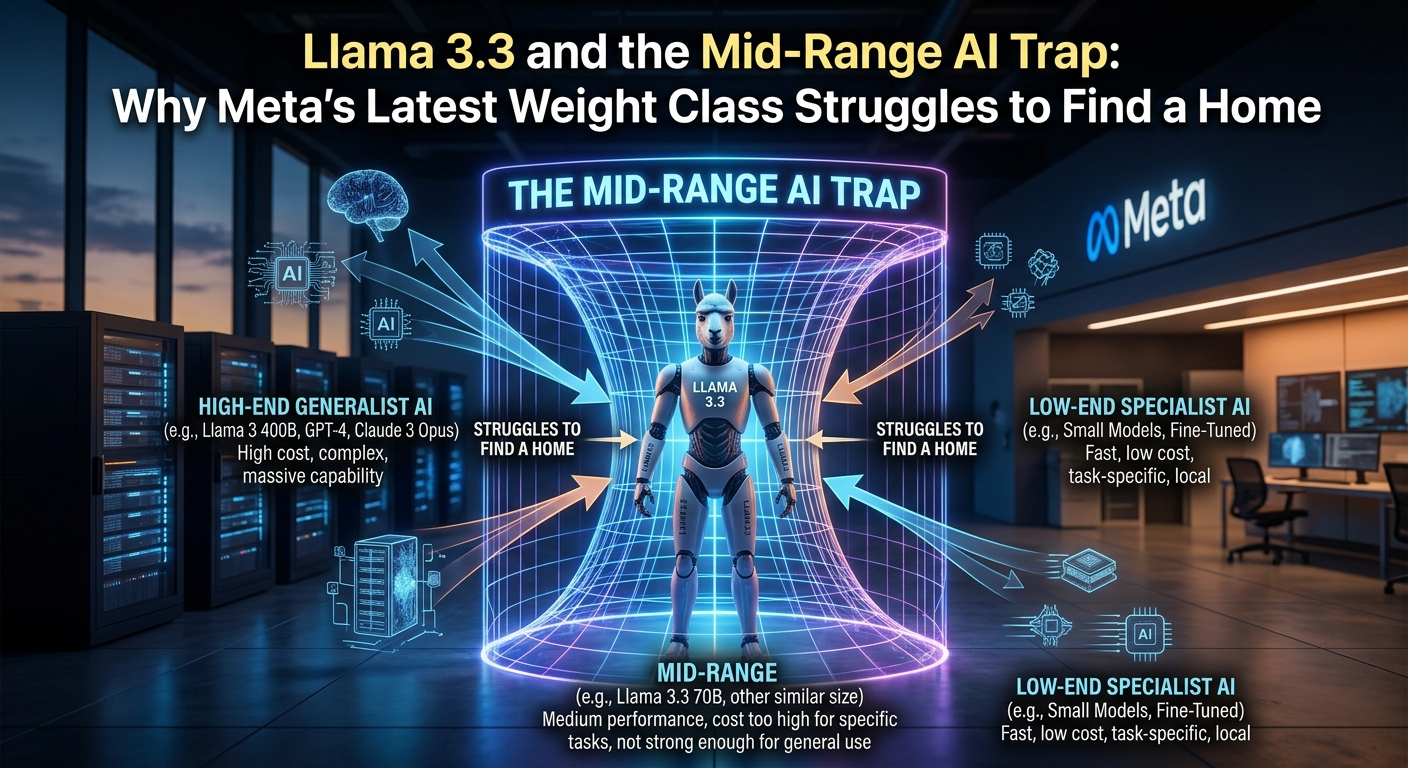
Llama 3.3 Review: The Mid-Range AI Trap Explained
Llama 3.3 Review: The Mid-Range AI Trap Explained
Is Llama 3.3 the right open-weights model for your project, or does it fall into a costly mid-range trap? Meta released this model to bridge the gap between lightweight edge models like the 8B variant and massive enterprise giants, but our testing shows it occupies an awkward middle ground.
After benchmarking, API testing, and analyzing community reactions, here is what developers need to know about where Llama 3.3 succeeds—and where it stumbles.
---
What Llama 3.3 Actually Offers
Meta optimized Llama 3.3 for developers who find the 3.1 8B model too simple but consider the 70B and 405B variants too resource-intensive to host. The key specs include:
- Expanded context window: Handles complex, multi-turn conversations without quality degradation.
- Enhanced reasoning: Marked improvements in math, logic, and code generation compared to older 70B models.
- Quantization-friendly weights: Designed to compress to 4-bit or 8-bit precision while retaining core capabilities.
In raw coding evaluations, Llama 3.3 closes the gap with proprietary models on standard benchmarks like HumanEval. It also handles complex system prompts with fewer instruction-following failures than its predecessors.
---
Where the Mid-Range Model Makes Sense
Llama 3.3 works best for tasks that demand more than basic text classification but do not justify a massive cloud bill.
Complex RAG Pipelines on a Budget
If your Retrieval-Augmented Generation system parses messy, semi-structured PDFs or multi-page documents, smaller models like the 8B fail because they lose track of context. Llama 3.3 handles dense data efficiently, synthesizing facts across long contexts without requiring a cluster of H100s.
Local-First Developer Tooling
For enterprise teams with strict data privacy mandates, hosting a 70B model locally requires expensive hardware. Llama 3.3's mid-range variants can be quantized to run on high-end consumer workstations or single-node server setups, providing an on-prem coding assistant that does not leak proprietary code to external APIs.
---
Why the Mid-Range Trap Exists
Despite its technical achievements, Llama 3.3 faces a difficult commercial reality. It sits in what many developers call "no man's land."
Hosting Costs Remain Too High for Indie Developers
While lighter than a 70B model, you still cannot run the unquantized mid-range Llama 3.3 on a cheap VPS or standard laptop. Dedicated GPU memory is required. For indie developers or early-stage startups, paying for cloud VRAM to host this model 24/7 is hard to justify when OpenAI, Anthropic, and Meta's own hosted APIs offer inexpensive inference per million tokens.
It Lacks the Creative Spark of Larger Models
Applications requiring nuanced tone, deep creative writing, or highly complex multi-lingual translation expose Llama 3.3's limitations. It reads as dry and mechanical compared to Claude 3.5 Sonnet or Llama 3.1 405B. It is a workhorse, not a poet.
The Quantization Penalty Undermines Value
Making this model economical usually means quantizing it. However, squeezing a mid-range model to 4-bit degrades reasoning faster than quantizing a larger 70B model. The result often performs no better than a highly optimized 8B model, which defeats the purpose.
---
The Verdict: Avoid the Middle Unless Necessary
Calculate your true cost of ownership before migrating production pipelines to Llama 3.3.
If you already have dedicated GPU infrastructure and need strict data privacy for moderately complex reasoning tasks, this update is a significant win. But if you are chasing raw performance, stick to larger APIs. If you are chasing speed and low hosting costs, optimize a smaller 8B model with fine-tuning instead. Do not get caught in the middle unless your use case absolutely demands it.