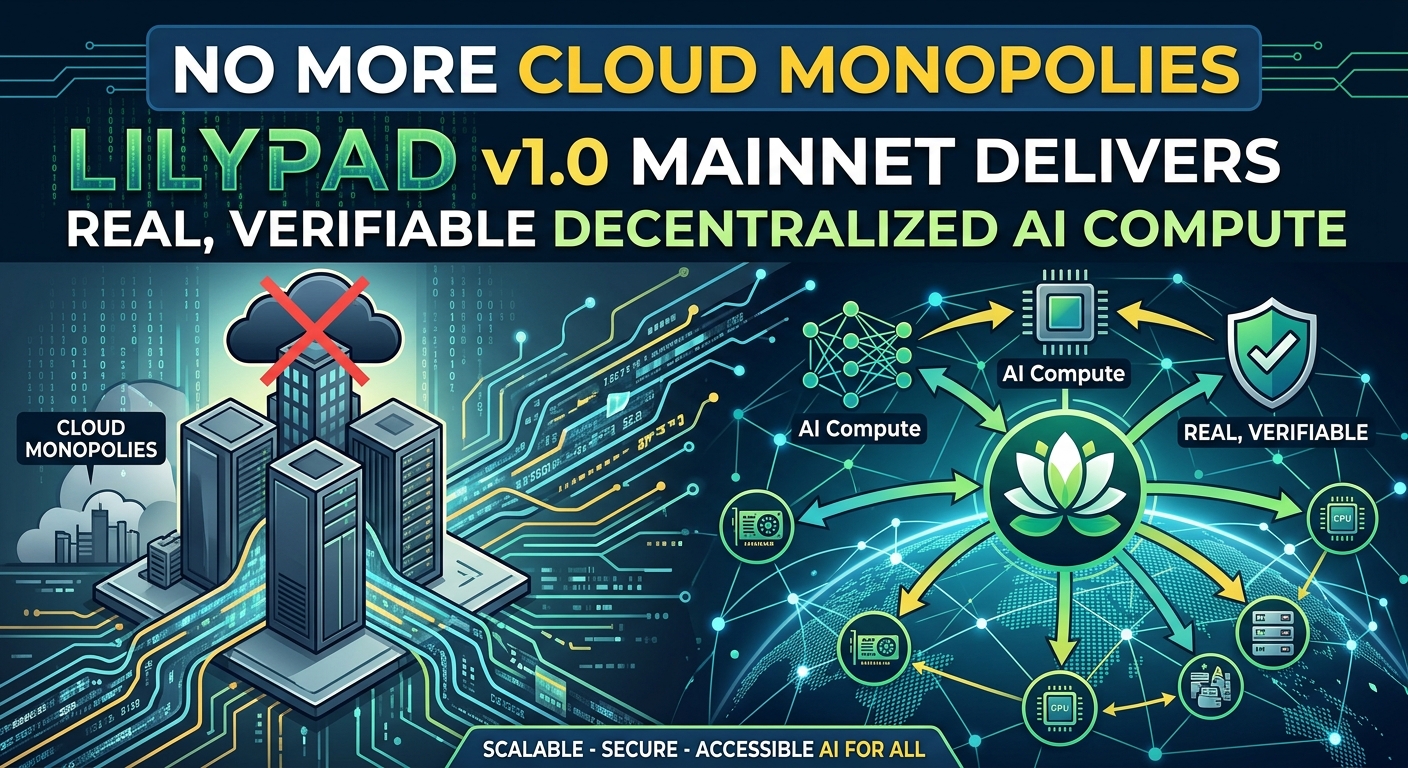
Lilypad v1.0 Mainnet: Decentralized AI Compute Is Finally Real
Lilypad v1.0 Mainnet: Verifiable Decentralized AI Compute for Developers
Lilypad v1.0 Mainnet is live and it does what decentralized AI compute promised: it runs AI inference and training jobs across a global network of GPUs with cryptographic verification and no cloud vendor lock-in. If you need batch processing, offline inference, or fine-tuning without AWS or GCP pricing, this is your platform.
For years, running models on decentralized networks meant dealing with slow latency, complex orchestration, and the constant fear that sensitive data was leaking to anonymous nodes. That changed on September 4, 2026, when Lilypad, the open decentralized AI computational network, officially launched its v1.0 Mainnet.
This isn't another speculative Web3 project promising the world and delivering a PDF whitepaper. Lilypad v1.0 delivers real-time, verifiable compute-over-data, letting developers run high-performance AI workloads across a permissionless GPU network without the egress fees, lock-ins, or privacy risks of centralized hyperscalers.
---
How Lilypad v1.0 Actually Works
Most decentralized compute networks function like basic marketplaces: you rent a GPU, SSH in, and manually set up your environment. Lilypad takes a different approach, treating compute as an on-demand utility that executes jobs deterministically.
Here is what the v1.0 launch delivers:
- Deterministic Runtime Environments: Lilypad uses WebAssembly (Wasm) and secure containerized runtimes. You package your AI model, send it to the network, and it runs identically on any node regardless of the host OS.
- Cryptographic Verification (Proof of Compute): You don't have to trust that a node runner actually generated your images or processed your LLM queries correctly. Lilypad's consensus mechanism verifies execution outputs cryptographically, reducing the risk of malicious or faulty nodes.
- Dynamic Resource Matching: The network automatically matches your workload's hardware requirements—like V100 versus H100 equivalents—with the cheapest, most efficient node available in real time.
- Zero Egress Fees: Unlike AWS or GCP, which charge penalties for moving data out of their ecosystems, Lilypad bills only for the exact compute cycles consumed.
---
What You Can Build With Lilypad v1.0
Lilypad v1.0 is optimized for developers who need to scale compute without scaling their cloud bills. Here are three immediate use cases.
1. Large-Scale Batch Inference
Need to run sentiment analysis or summarization on five million customer service logs? Instead of spinning up an expensive, idling cluster on AWS, you can distribution-pipe the logs to Lilypad. The network splits the batch across thousands of independent nodes, processes them concurrently, and returns verified outputs in minutes.
2. Privacy-Preserving Edge AI
Because Lilypad supports secure enclaves—TEE hardware compatibility is rolling out—developers can run inference on sensitive datasets without exposing raw data to the node operator. This matters for medical imaging startups and fintech developers handling regulated data.
3. Open-Source Model Fine-Tuning
Training a custom LoRA on a budget? Push your dataset and base model, such as Llama 3.1 or Mistral, to Lilypad. The platform distributes the training job, saves intermediate weights, and outputs your fine-tuned adapter for a fraction of centralized GPU cloud costs.
---
Known Limitations of v1.0
Lilypad v1.0 is a significant milestone, but it isn't perfect. Developers should account for these bottlenecks before migrating production workloads.
- Latency Overhead: Jobs require cryptographic verification and network orchestration, so Lilypad is not suited for ultra-low-latency real-time chatbots. If your app needs sub-100ms time-to-first-token, stick with a dedicated API provider for now.
- Cold Start Penalties: Fetching model weights across a decentralized network takes time. If a node hasn't cached your specific model container, expect several seconds of cold-start delay on first execution.
- Wasm Compilation Hurdles: Container support is improving, but compiling complex Python-heavy ML pipelines into optimized WebAssembly runtimes still requires manual tweaking and debugging.
---
The Bottom Line
Lilypad v1.0 moves decentralized AI from theoretical alternative to practical utility. It won't replace your real-time production LLM APIs tomorrow, but for batch processing, offline inference, and decentralized training it offers a genuine escape from centralized cloud dependency.
It's open, it's live, and it's usable. Grab their SDK, fund a local wallet with gas, and deploy your first verifiable job today.