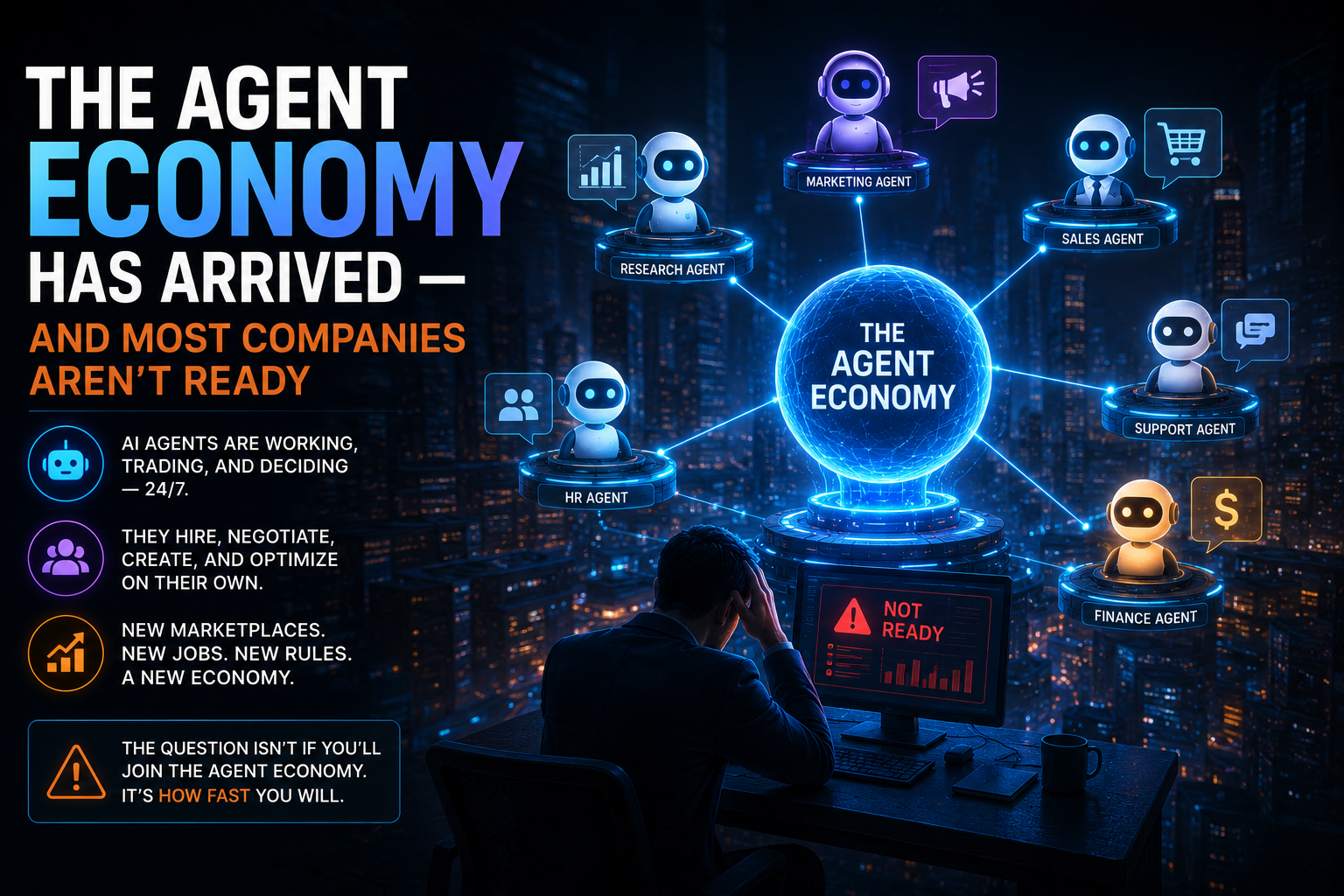
The Agent Economy Has Arrived — Most Companies Aren't Ready
AI agents are no longer a futuristic concept—they're here, and most companies aren't ready for the shift from chatbot to coworker. In the past two years, AI focused on generating better answers with longer context and fewer hallucinations. Now, AI systems actually do the work inside your existing tools, without requiring human clicks for every step.
Proof points: The agent shift is happening now
This past week made that transition impossible to ignore.
Anthropic shipped Claude Sonnet 5 on June 30, its most capable Sonnet-tier model yet. It features a 1M-token context window and jumps to 63.2% on agentic coding benchmarks, up from 58.1% for the previous generation. That's not a marginal improvement—it's the difference between a model that helps write code and one you can trust to complete an open-ended engineering task.
Google advanced in the same direction by embedding computer-use capability directly into Gemini 3.5 Flash. Developers can now build agents that operate a browser, mobile app, or desktop like a person—clicking, typing, and navigating—instead of relying on narrow, brittle API integrations.
Meanwhile, the underlying plumbing is being built out. At its Inspire 2026 conference, Alteryx launched Agent Studio and an MCP server, explicitly designed to let business analysts—not just central IT teams—turn existing data workflows into autonomous agents. X also shipped a hosted MCP server, making its platform a first-class citizen in the agent ecosystem rather than something agents scrape from the edges.
None of these are demos. They're production infrastructure released within the same seven-day window, all converging on one idea: AI agents are becoming a standard interface to software, not a novelty bolted on top.
Why this matters for your business
Three implications stand out.
First, competitive advantage is shifting from "do you use AI" to "have you rebuilt your workflows around it?" A support team using a chatbot for FAQ deflection and a support team running an agent that resolves tickets end-to-end inside your CRM are not playing the same game—even if both would describe themselves as "AI-enabled."
Second, the barrier to building an agent just dropped significantly. MCP servers let your internal tools, CRM, and data warehouse expose themselves to agents with a fraction of the integration work custom APIs used to require. If your roadmap still treats "AI integration" as a multi-quarter engineering project, it's worth re-checking that assumption against what shipped this week.
Third, computer-use agents change the calculus for legacy software never built with an API in mind. Gemini's browser- and desktop-level control means agents can now operate tools with no integration path at all—which quietly removes one of the biggest excuses for not automating a process.
The bottom line
None of this requires a moonshot bet. It requires picking one real, recurring workflow in your business—the kind your team already complains about—and asking whether an agent built on this week's tools could own it end to end. The companies that answer that question this quarter, not next year, are the ones setting the pace. Everyone else is going to be retrofitting.