Why OpenAI's o1-preview is Killing Complex Prompt Engineering
Why OpenAI's o1-preview is Killing Complex Prompt Engineering
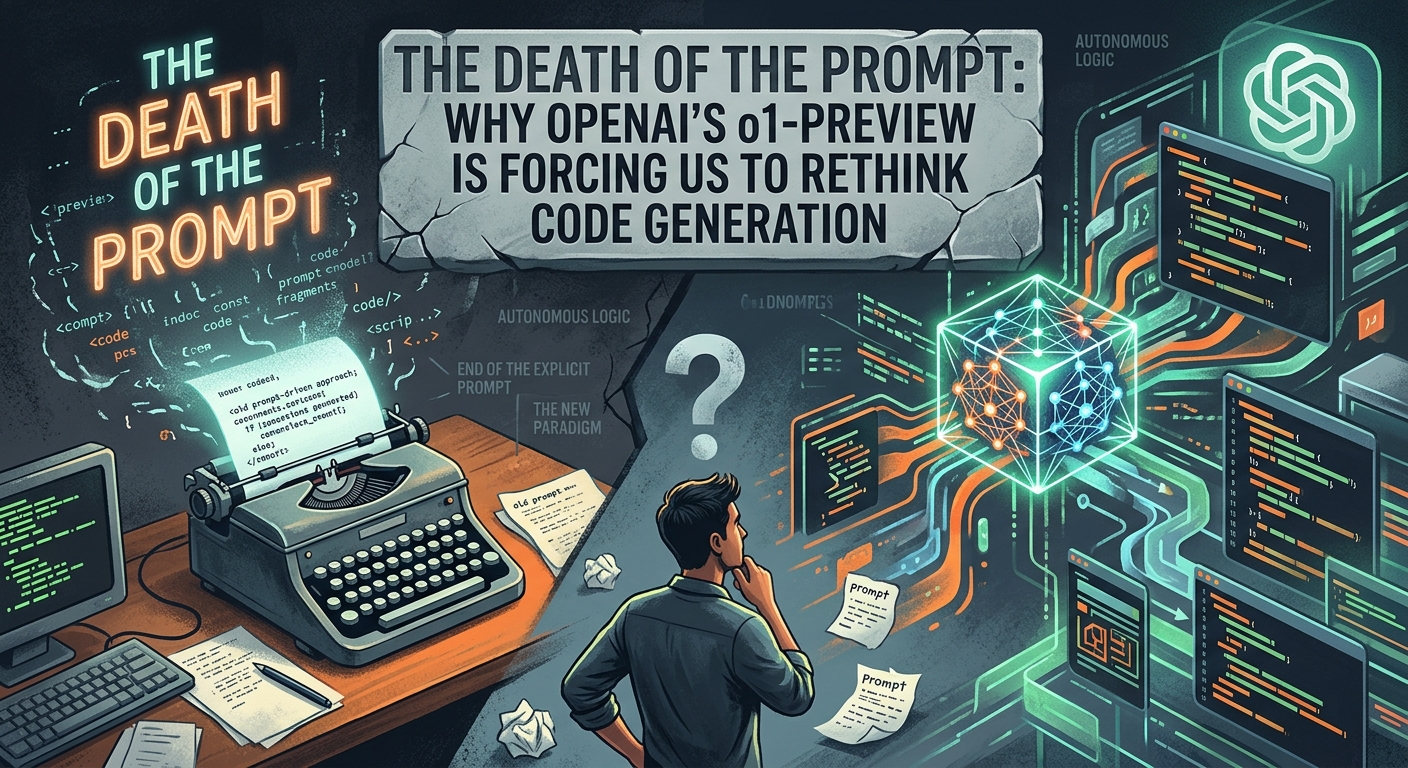
OpenAI just released its o1-preview and o1-mini models, and they are radically changing how developers write code. If you spent the last year perfecting your prompt engineering workflows, bracing for complex system prompts and chain-of-thought instructions, here is the reality: much of that work may become unnecessary.
These new models are specifically designed to "think" before they answer, meaning they no longer need your complex, multi-step prompts. In fact, giving them highly structured instructions can actually degrade performance. Below is what is happening on the ground, how these models tackle complex coding tasks, and how you can adapt your developer workflow to get the most value—despite higher costs and slower response times.
How o1 Models Handle Complex Code Internally
For the last two years, using LLMs for software engineering was a game of prompting gymnastics. You had to tell the model to "take a deep breath," "think step-by-step," and outline its architecture before writing a single line of code.
OpenAI's o1 series moves that entire chain-of-thought process to the backend. The model spends seconds—sometimes up to a minute—running internal reasoning paths, correcting its own logical fallacies, and testing edge cases before outputting anything at all.
In our testing of o1-preview on legacy codebase refactoring, we observed three major shifts in how the model handles code:
- Self-correction without guidance: When asked to refactor a messy React component with complex state management, the reasoning logs showed the model initially went down a path that would have broken hook rules. It caught its own error, pivoted, and delivered a working solution on the first try.
- Simple prompts outperform complex ones: Direct instructions work best. Providing a massive 1,500-word system prompt loaded with formatting constraints caused the model's reasoning process to bloat and occasionally time out. When we stripped it down to "Refactor this component to use context instead of prop drilling," it succeeded cleanly.
- Context windows that actually work: The model does not just read the code; it maps dependencies during its "thinking" phase, drastically reducing the hallucination rate in deeply nested modules.
Where o1 Shines in Real-World Development
While o1 is too slow and expensive for simple autocomplete or basic boilerplate, it is highly effective for heavy-duty engineering tasks:
1. Complex Algorithm Implementation
Need to implement a custom graph traversal algorithm or a highly optimized data structure? This is where o1 excels. It does not simply pull a generic template from GitHub; it tailors the algorithm to your specific memory and CPU constraints, testing its own logic during the reasoning window.
2. Debugging Obscure Concurrency Issues
We fed o1-mini a Go service suffering from a rare race condition. It spent 14 seconds reasoning, mapped out the potential deadlock scenarios, and provided a precise fix using channels. It explained why the deadlock occurred far better than GPT-4o ever could.
3. API Integration Migration
If you are upgrading an SDK across a large codebase with breaking changes, o1 can parse the new documentation and migrate your old endpoints systematically without losing edge-case handling.
The Trade-offs: Price, Speed, and Rate Limits
It is not all sunshine and clean code. Developers migrating their workflows to o1-preview are hitting immediate, painful walls.
Speed is a major factor. Waiting 30 seconds for an LLM to "think" feels like an eternity when you are used to the instant gratification of Claude 3.5 Sonnet or GPT-4o. It disrupts the conversational flow of pair programming.
The cost is steep. At $15 per million input tokens and $60 per million output tokens, o1-preview is three times more expensive on inputs and four times more expensive on outputs than GPT-4o. Even worse, OpenAI charges you for "reasoning tokens"—the tokens the model uses to think internally, which you never see in the final output. You are literally paying for the model's internal monologue.
Rate limits are restrictive. If you are trying to build an agentic workflow that calls o1 repeatedly, you will hit API limits within minutes.
The New Coding Playbook
Stop trying to force o1 to behave like older models. If you want to integrate it into your daily stack, follow these rules:
- Keep prompts declarative, not procedural. Tell the model what you want the final state to look like, not how to think about getting there.
- Save o1 for the hard stuff. Use fast models like Claude 3.5 Sonnet or GPT-4o for daily boilerplate, UI tweaks, and simple tests. Switch to o1 only when you hit a logical wall or need architecture design.
- Monitor your token usage. Keep an eye on those hidden reasoning tokens, or your API bill will shock you at the end of the month.
The era of hyper-complex prompt engineering is ending. The models are starting to do the hard thinking on their own, and our job is shifting from "AI whisperers" back to what we do best: system architecture and problem definition.