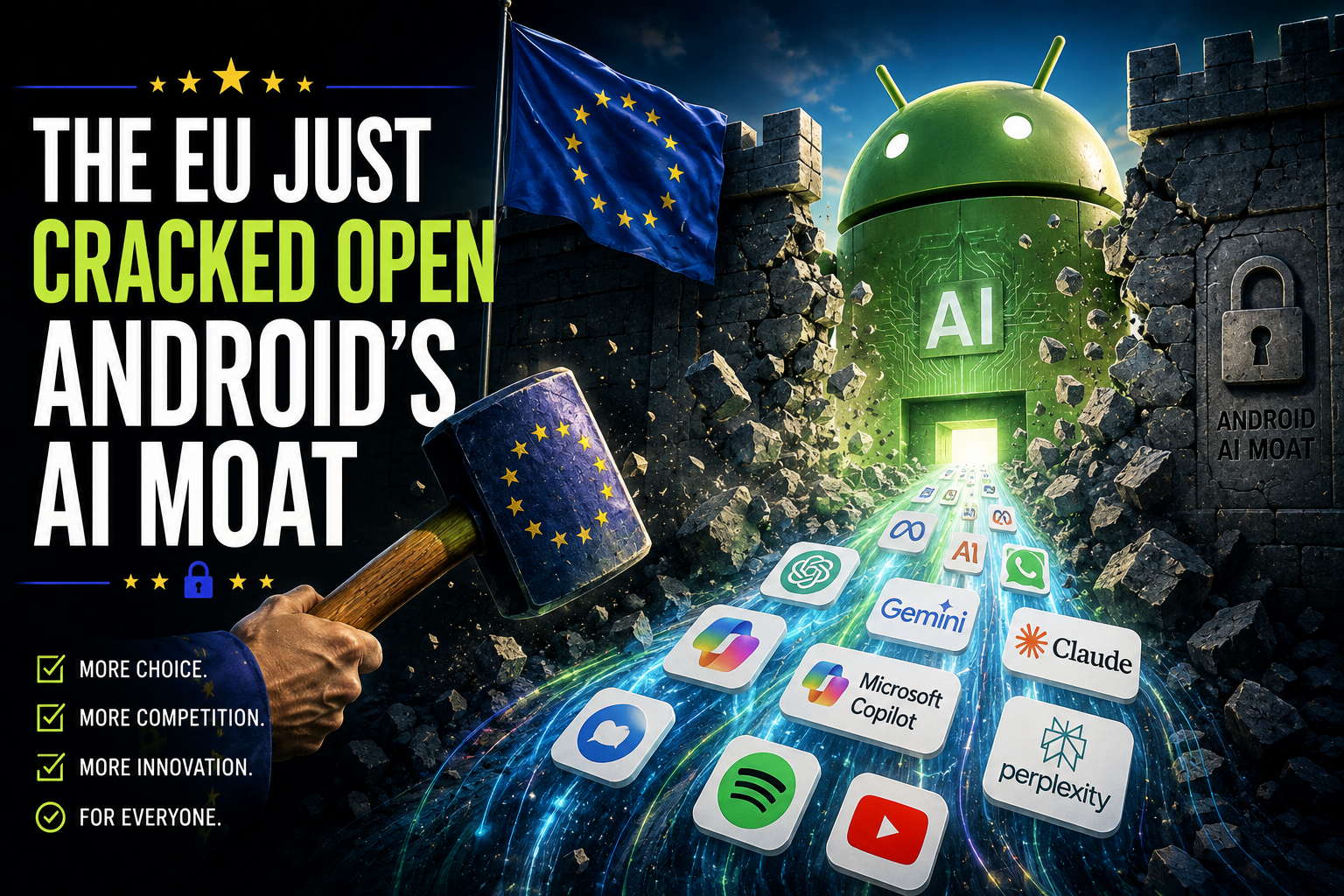
EU Rules: Google Must Open Android AI to Rivals
On July 16, 2026, the European Commission handed down two binding orders against Google under the Digital Markets Act. Together, they represent the biggest structural challenge to Google's AI position since Gemini launched. The first order forces Google to open 11 Android features so rival AI assistants can be invoked the same way "Hey Google" is invoked today — meaning a user could summon Claude, ChatGPT, or Perplexity by voice to book a taxi, pull up directions, or answer a question, without ever routing through Gemini. The second order requires Google to share the anonymized data it collects to power Search with competing AI chatbots that have search functionality, starting in January 2027.
This is not a fine. Google has absorbed plenty of those. This is a mandated re-architecture of how Android decides which AI gets first crack at a user's intent, and it strikes directly at the thing every AI company has been fighting over for two years: distribution. A model can be brilliant and still lose if it never gets summoned. Google's advantage was never just Gemini's quality — it was that Gemini is the default, wired into the operating system on billions of phones. The DMA order says that wiring has to become a shared cable, not a private line.
Why the EU Android AI Ruling Matters Beyond Europe
Android ships on roughly seven out of every ten smartphones sold worldwide. While this order technically applies inside the EU, Google has historically found it more efficient to ship one global Android build than to fork behavior by region. If that pattern holds again, the practical effect of a Brussels order could show up on Android phones well outside Europe by the time the changes land in July 2027. That is the same playbook that turned GDPR's cookie consent banners into a worldwide default rather than a European one.
The search-data-sharing piece is arguably the sharper edge. Every AI assistant with a chat interface is racing to answer questions with current, grounded information, and the single biggest lever for grounding quality is access to fresh, high-coverage search data. Google has built that moat for two decades. Forcing it to hand anonymized signals to OpenAI and other chatbot-search hybrids doesn't erase the moat, but it does lower the water level enough that smaller players can start wading in.
How Google Is Pushing Back
Google's response leaned on privacy and security, with chief legal officer Kent Walker warning that the changes "risk undermining vital privacy and security guardrails for millions of Europeans." That's a real concern worth taking seriously — opening deep OS-level hooks to third-party assistants does expand the attack surface, and anonymization of search data is harder to get right than it sounds, especially at the scale Google operates at. But it's also the same argument every incumbent makes when a regulator asks it to share the thing that makes it an incumbent. The DMA's answer, in effect, is that Google gets a year to solve the security problem, not a veto over whether it has to.
What to Watch Next
The assistants best positioned to benefit are the ones that already have a strong standalone product and just lack the OS-level shortcut Gemini enjoys — think Claude, ChatGPT, and Perplexity. None of them need Android's permission to be good; they need Android's permission to be reachable in the same one-tap, one-voice-command way Gemini already is. Watch for two signals over the next year: whether Google's actual implementation genuinely opens the 11 features or complies in a way that keeps friction high (regulators have caught this move before), and whether rival assistants ship Android-native integrations fast enough to matter once the door opens in mid-2027. Distribution battles move slowly until they don't — this is the moment the battle for the Android home screen officially became a regulatory fight instead of just a product one.
The deeper story is that AI competition has entered its platform-policy phase. For the first two years of the current AI boom, the fight was almost entirely about model capability — who had the smartest model, the longest context, the cheapest inference. That fight isn't over, but it's now running in parallel with a second one: who controls the pipes those models travel through to reach a user. Brussels just ruled that Google doesn't get to own both the smartest assistant and the only door it walks through. Every other major AI company just got handed a reason to build a much better Android integration than they've bothered to until now.