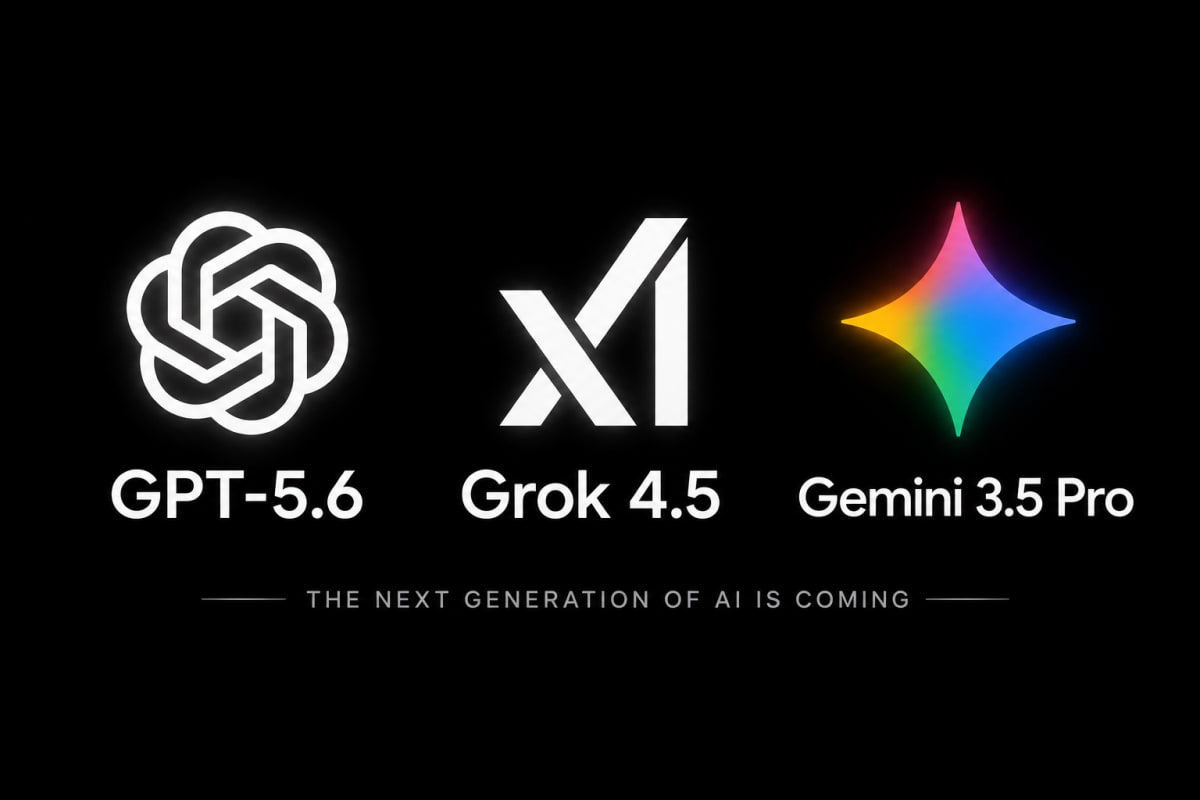
AI Model Reset July 2026: GPT-5.6, Grok 4.5, Gemini 3.5
The scoreboard got crowded
For most of this year, the frontier model conversation had a simple shape: a handful of labs, a handful of benchmarks, and a new leader every few months. July broke that pattern. In three weeks, OpenAI shipped an entire family of models, xAI pushed out its next flagship, Google delayed then re-launched its most anticipated release of the year, and Anthropic's Claude Sonnet 5 quietly became the default model for every Claude plan. The result is a market that is finally competing on more than leaderboard position.
GPT-5.6 stops pretending one model fits every job
OpenAI's GPT-5.6 launch on July 9 did not ship as a single model. It shipped as three: Sol, Terra, and Luna. Each targets a different workload.
Sol is the high-end reasoning and coding option. It is priced at $5 per million input tokens and $30 per million output tokens. OpenAI aims Sol squarely at teams doing serious scientific and engineering work.
Terra targets GPT-5.5-level quality at roughly half the cost. Teams that need strong performance without paying frontier prices use Terra.
Luna is built for high-volume, latency-sensitive work that most production apps actually run. This is the tier that handles everyday requests cheaply and quickly.
The signal matters more than any individual price point. OpenAI is explicitly segmenting by workload instead of asking every customer to pay frontier prices for commodity tasks. Builders now have a choice between the best reasoning tier, the balanced tier, and the high-volume tier.
Grok 4.5 leans into efficiency, not just scale
xAI's Grok 4.5 launched in early July with a specific positioning: Opus-class, but faster, more token-efficient, and lower cost. That is a notable shift in messaging for a lab that has historically leaned on raw scale as its headline.
It is a tacit admission of where the market's attention has moved. Labs are shifting focus toward cost-per-task and response latency, not just raw capability ceilings. Builders who measured token spend across their applications will notice the difference immediately.
Gemini 3.5 Pro's delay was the most telling story of the month
Google pushed Gemini 3.5 Pro's release from June into July. It then targeted July 17 for general availability, citing feedback from early testers. The model that shipped carries a 2M-token context window, a Deep Think reasoning mode, and no government-access restrictions.
A slipped release date from a major lab used to be treated as a stumble. Increasingly, it reads as the opposite. Evidence that labs are willing to hold a launch to get the underlying product right, rather than ship on a fixed calendar to win a news cycle.
Claude Sonnet 5 becoming the default is the quiet story
Anthropic did not run a splashy launch event. Claude Sonnet 5 simply became the default model across all Claude plans on June 30. Fable 5 followed with global availability on Claude.ai, the Claude Platform API, Claude Code, and Claude Cowork starting July 1, after export controls were lifted.
For builders already inside the Claude ecosystem, this is the change that actually shows up in production without anyone having to flip a switch. The impact is immediate: every existing Claude API call routes through Sonnet 5 by default unless you specify otherwise.
What this means if you're actually building something
The headline benchmark score is losing relevance fast. What is replacing it is a much more practical set of questions:
- What does this cost at your actual volume?
- What is the latency on the task you care about?
- Does the context window match your real documents, or just the marketing slide?
- Do you need frontier reasoning for this step, or would a cheaper tier do the job just as well?
The labs are answering that shift by segmenting their own lineups. Tiered pricing is now standard. Task-specific models are shipping faster. Longer context is becoming a differentiator rather than a gimmick.
The practical move for any team shipping AI features right now is to stop picking a single house model and start routing by task. Reasoning-heavy work goes to the frontier tier. High-volume work goes to the cheap-and-fast tier. Everything in between should be benchmarked against your own workload, not someone else's leaderboard.
That is the real story of July 2026. Not one model winning. A market finally admitting that different jobs need different tools, and building the pricing and product lineups to match.
For a full breakdown of each model, pricing, and recommended use cases, see our guide at Tool Directory AI.
Tools in this post
Written by
Co-founder of Tool Directory AI. Tests and reviews the AI tools listed here.