Windsurf vs Cursor: Cascade Engine Deep Dive
Windsurf's Cascade Engine vs Cursor Agent: Deep Dive Into Next-Gen AI Code Editors
Cursor has owned the AI-native editor discussion for months. Every developer on Twitter posted snippets of single-prompt web apps, while traditional VS Code extensions started feeling painfully retro. Then Codeium dropped Windsurf, bringing its new "Cascade" flow system to compete directly with Cursor's multi-file Agent mode.
I spent the past week throwing complex TypeScript refactors, messy Rust async code, and broken Docker builds at both IDEs. Here is what actually happens when you push these agentic editors past simple boilerplate generation.
Cascade Flows vs Cursor Agent: Architectural Differences
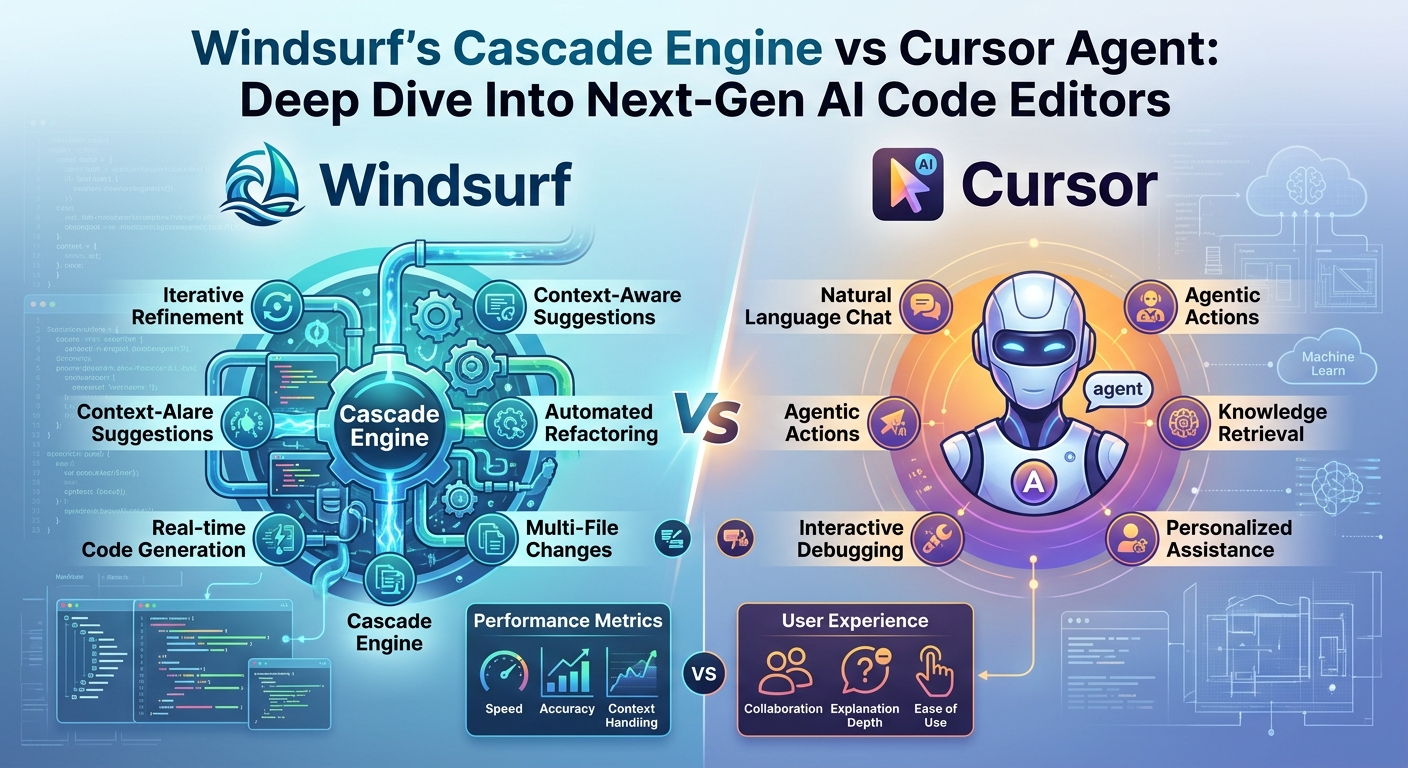
Cursor relies heavily on fast vector search, workspace indexing, and fine-tuned prompt routing to feed context to Claude 3.5 Sonnet. When you toggle Cursor Agent, it spins up a local command runner, reads terminal errors, and iteratively patches files until tests pass or it hits its loop cap.
Windsurf takes a noticeably different path with Cascade. Instead of just embedding your files into a vector store, Cascade maintains a running graph of your editor actions, terminal outputs, and active execution context. It treats developer actions as continuous streams rather than static snapshot prompts.
In practice, this means Windsurf catches variable renaming across obscure module boundaries faster than Cursor. When renaming an exported interface in a monorepo, Windsurf updated four downstream packages without forgetting type re-exports. Cursor got three right but hallucinated an import path in the fourth.
Real-World Engineering: Where Each Tool Wins
Multi-File Refactoring
Windsurf handles deep codebase context with surprisingly low memory usage. On a 120,000-line React/Go codebase, Windsurf indexed in under 45 seconds while consuming under 1.2 GB of RAM. Cursor's background indexing spiked memory usage to 3.8 GB, occasionally causing input latency on larger workspace tabs.
Terminal & Execution Autonomy
Cursor still leads in terminal execution autonomy. If a build fails during a local pnpm build, Cursor Agent reads the build logs, diagnoses the missing peer dependency, runs pnpm add, and re-runs the build script automatically. Windsurf's terminal integration asks for user approval more aggressively, which feels safer but slows down rapid prototyping workflows.
Autocomplete Latency
Codeium's proprietary inline completion models inside Windsurf are visibly faster than Cursor's default completions. Inline completions arrive in under 80 milliseconds. They feel nearly instantaneous, matching your typing rhythm without freezing your editor mid-function.
Hard Limitations & Annoyances
Neither tool is bulletproof. Both will happily break your build if you give them blind trust.
- Context Drift: Feed Cursor a prompt spanning more than six files, and it occasionally edits the wrong function overload. It forgets earlier constraints once the turn count crosses ten messages.
- Aggressive File Overwrites: Windsurf's Cascade sometimes rewrites entire files instead of applying surgical diffs, wiping out manual comment blocks and custom formatting rules.
- Token Drain: Both platforms consume high-tier API quota rapidly when running autonomous loops. A single stubborn bug fix in Cursor Agent can burn through 20 fast requests in ten minutes.
- Custom Config Ignorance: Neither editor respects obscure
.prettierrcor ESLint flat configs reliably out of the box, forcing you to revert auto-formatted diffs.
The Verdict: Which Editor Should You Run?
If you rely heavily on autonomous terminal actions and want an AI assistant that behaves like a junior dev tackling full GitHub issues, Cursor remains the sharper knife. Its agentic loop feels slightly more mature for unstructured debugging sessions.
However, if you want blazing-fast completions, lower system overhead, and tighter state tracking across multi-file refactorings, Windsurf is a genuine contender. Codeium built something genuinely fast here, and for long coding sessions in large codebases, Windsurf's Cascade engine is worth every bit of your attention.