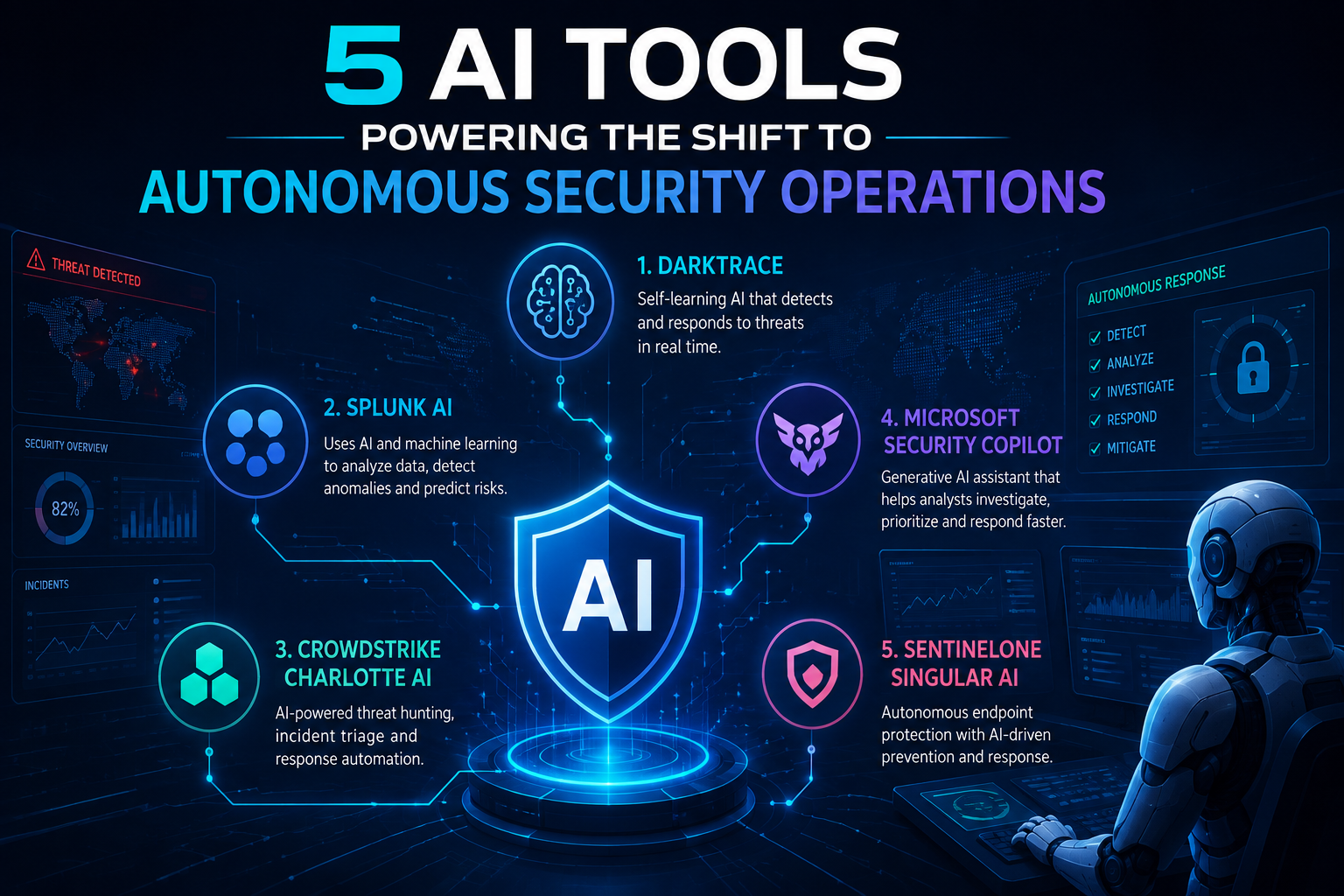
5 AI Tools for Autonomous Security Operations
5 AI Tools for Autonomous Security Operations
Security teams are the newest buyers in the agent economy, and the tools built for them look different from the general-purpose assistants dominating everywhere else — narrower scope, harder permission boundaries, and a lot less patience for "trust me." Here are five worth knowing about right now.
1. Scoped Triage Agents for SOC Teams
The most credible new entrants in this space don't try to fix anything. They ingest the alert stream, correlate it against recent deploys and known CVEs, and hand a human analyst a ranked, evidence-backed shortlist instead of a raw firehose. Boring by design — and that's exactly why security teams are adopting them faster than the flashier "fully autonomous SOC" pitches.
2. Sandboxed Remediation Agents
A newer category runs isolated in a contained environment with a fixed menu of pre-approved actions — quarantine a host, snapshot it, kill a process — and nothing else. No open-ended access to production. It's a deliberately smaller promise than "autonomous remediation," and it's winning enterprise budget precisely because the blast radius is provably capped.
3. Playbook-Driven Copilots Inside Existing Security Suites
The major platform vendors are shipping agentic features into tools teams already run, executing playbooks a human has already signed off on rather than improvising a response live. Less exciting than a standalone agent, but it's the version showing up fastest in regulated industries where every automated action needs a paper trail.
4. Credential-Scoping Layers Built for Agents, Not Humans
As more agents get standing access to repos, browsers, and internal tools, a new layer of infrastructure has emerged just to manage what those agents are allowed to touch — short-lived, task-scoped credentials instead of long-lived service accounts. It's unglamorous plumbing, but it's the piece that makes every other agent on this list safe to deploy at all.
5. Agent-to-Agent Audit and Observability Tools
The newest category logs and replays what one agent said to another — the actual reasoning chain, not just the final action — so a human can reconstruct why an autonomous system did what it did after the fact. As more of the stack becomes agents talking to agents, this kind of trace becomes the difference between a five-minute postmortem and a week of guessing.
The Pattern Worth Noticing
Every tool on this list is selling restraint, not raw capability. In a year when agentic AI has already caused at least one very public incident, "here's exactly what my agent can and can't do" is turning into the actual competitive edge — not "my agent can do more than yours."
Key takeaway: The most credible autonomous security tools don't maximize capability. They minimize risk — scoped permissions, bounded actions, and full observability are what enterprises are actually buying.