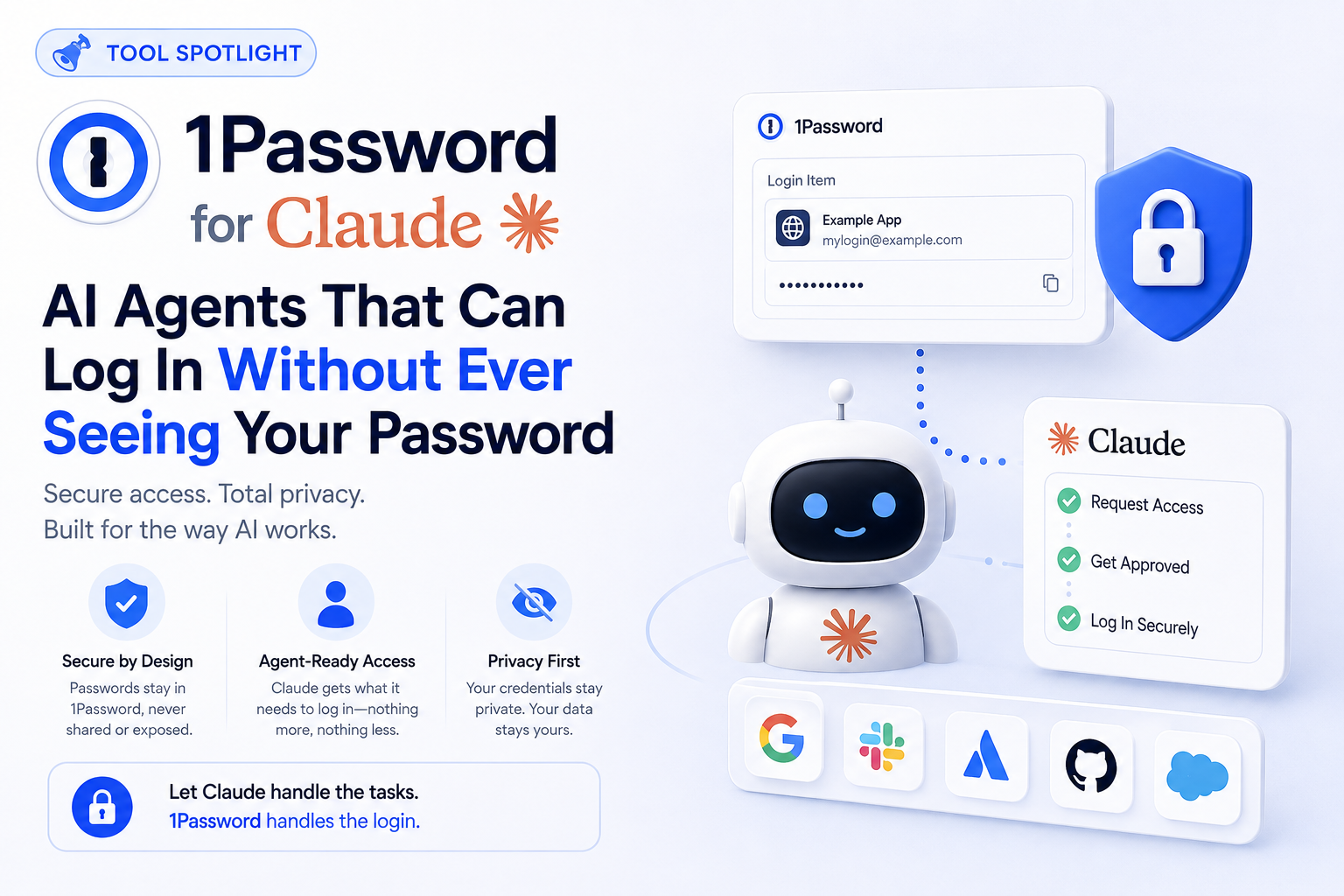
How 1Password Lets Claude Agents Log In Without Seeing Your Password
The one thing that's kept AI agents from finishing tasks on your behalf — booking a flight, renewing a subscription, updating a shipping address — has never been intelligence. It's been access. Doing any of that requires a password, and handing an AI model your passwords has been correctly treated as a non-starter. 1Password's new browser integration for Claude is the first serious attempt to solve that without asking users to just trust the model.
How zero-exposure access actually works
The integration lets Claude complete multi-step tasks — booking travel, managing an account, filling out a form gated behind a login — using credentials stored in 1Password, without those credentials ever passing through the model itself. A new security framework injects the username and password directly into the page at the moment they're needed, through a channel Claude has no visibility into. The model can trigger the action ("log in and proceed"), but it never sees, stores, or has the ability to leak the actual secret.
Access isn't a one-time toggle. Each task requires its own approval, confirmed with a single biometric check, so a user isn't granting blanket password access and then hoping the model behaves. They're authorizing one specific action at a time — the same way you'd approve a payment.
Why this matters more than another agent demo
- It removes the actual blocker. Most "AI agent" demos over the past two years have stalled at exactly this step — the agent gets to a login wall and either fails or asks a human to take over. This is a real fix for that specific wall, not a workaround.
- The threat model is honest. Instead of asking users to trust that a language model won't misuse or leak a password, the architecture makes it structurally impossible for the model to see the password in the first place. That's a meaningfully different, and more defensible, security posture.
- It's a template other vendors will likely copy. Credential managers and browser-agent builders have been circling this problem from opposite directions for a while. A working, shipped zero-exposure pattern gives the rest of the industry something concrete to build toward instead of a hypothetical.
What to actually watch for
The interesting test isn't whether Claude can log into a familiar site and click through a well-worn checkout flow. It's how the system behaves on sites with unusual multi-factor prompts, CAPTCHAs, or session logic that doesn't match the happy path. Zero-exposure credential injection solves the "don't leak the password" problem cleanly; it doesn't automatically solve "the agent got confused halfway through a multi-step form and needs to safely bail out." That second problem is where most agent-based automation still stumbles, and it's the one worth watching as this rolls out more broadly.
Still, this is a genuinely useful unlock. The gap between "AI that can tell you how to book a flight" and "AI that can book the flight" has mostly been a trust problem, not a capability one — and this is the first mainstream integration that closes it without asking users to take that trust on faith.