Tool Spotlight: Buzz — Jack Dorsey's Open-Source Chat App Where AI Agents Are Teammates, Not Bots
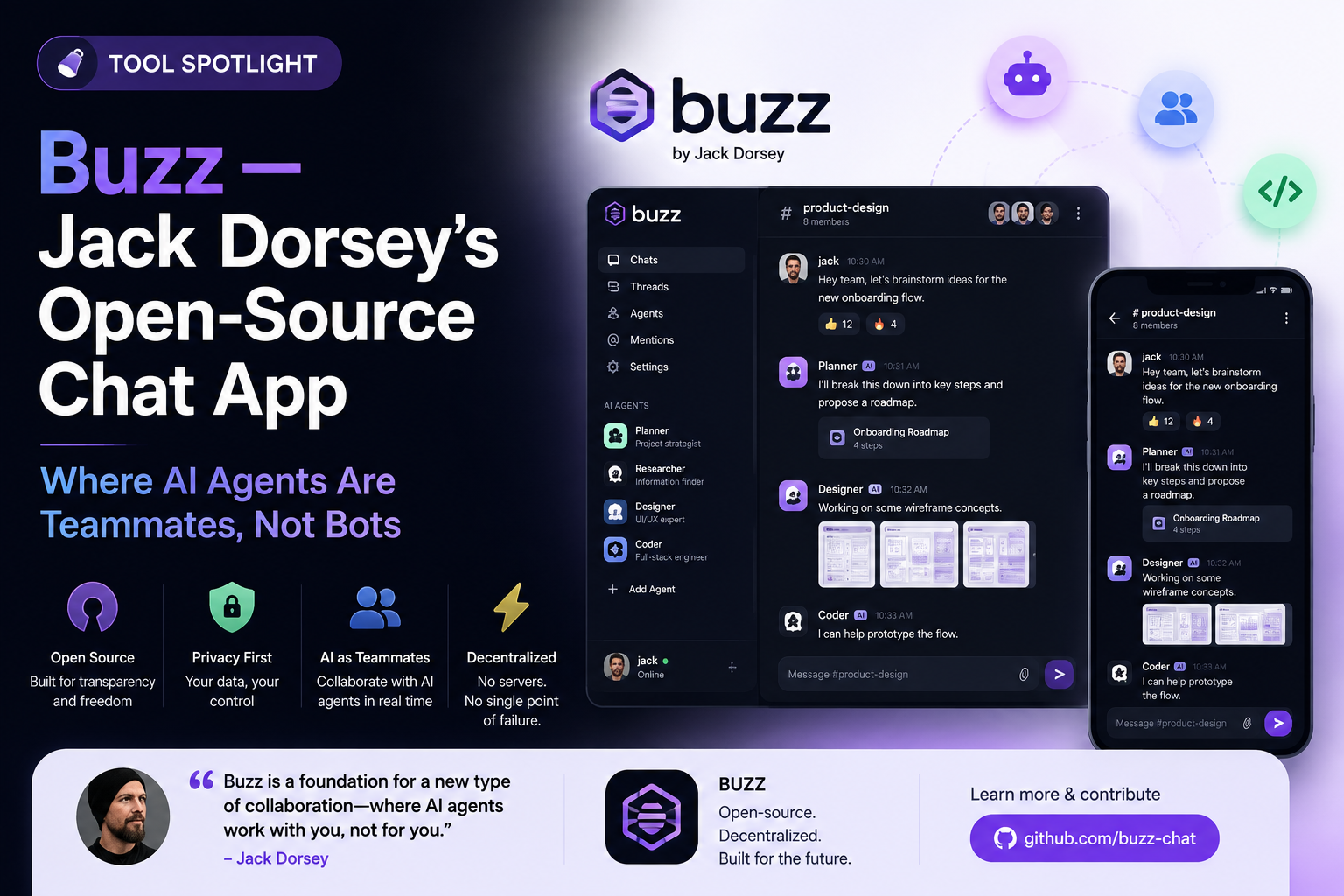
Jack Dorsey's Block just released Buzz, a free open-source group chat app that treats AI agents as full teammates rather than slash-command chatbots. It is built for teams that already live in Slack and GitHub but want AI woven into the workspace instead of bolted on.
What Buzz does
Buzz combines messaging, project workflows, and code or repo management in one shared workspace. The key difference is that AI agents show up in channels as identifiable participants with their own permissions and an audit trail alongside humans. You can see what an agent did, when, and under what authority — the same way you would check a teammate's commit history.
Why the architecture matters more than the feature list
Buzz is built on Nostr, the decentralized protocol, and released under Apache 2.0. That means any team can self-host it, fork it, or run its own instance instead of trusting a vendor's servers. Dorsey has described it as model-agnostic by design: plug in whichever AI provider you want per agent instead of being locked into one vendor's assistant baked into the chat client. For AI-heavy teams already juggling multiple models for different jobs, that flexibility is the real pitch, not the chat UI.
Who should try Buzz
Buzz is early. A free desktop app is live for macOS, Windows, and Linux, and it is clearly aimed at teams willing to run something rougher than Slack in exchange for owning their own data and choosing their own models.
Buzz is worth a pilot if your team already runs multiple AI agents against your codebase and you are tired of stitching together Slack notifications, GitHub webhooks, and a separate agent dashboard.
Buzz is not the right fit yet if you just want AI autocomplete in your existing chat tool.
The takeaway
Buzz trades polished convenience for ownership and model freedom. It is an honest bet for teams that want cryptographic identity and full auditability for their AI agents, but it is not a drop-in replacement for mature Slack-integrated automation today.