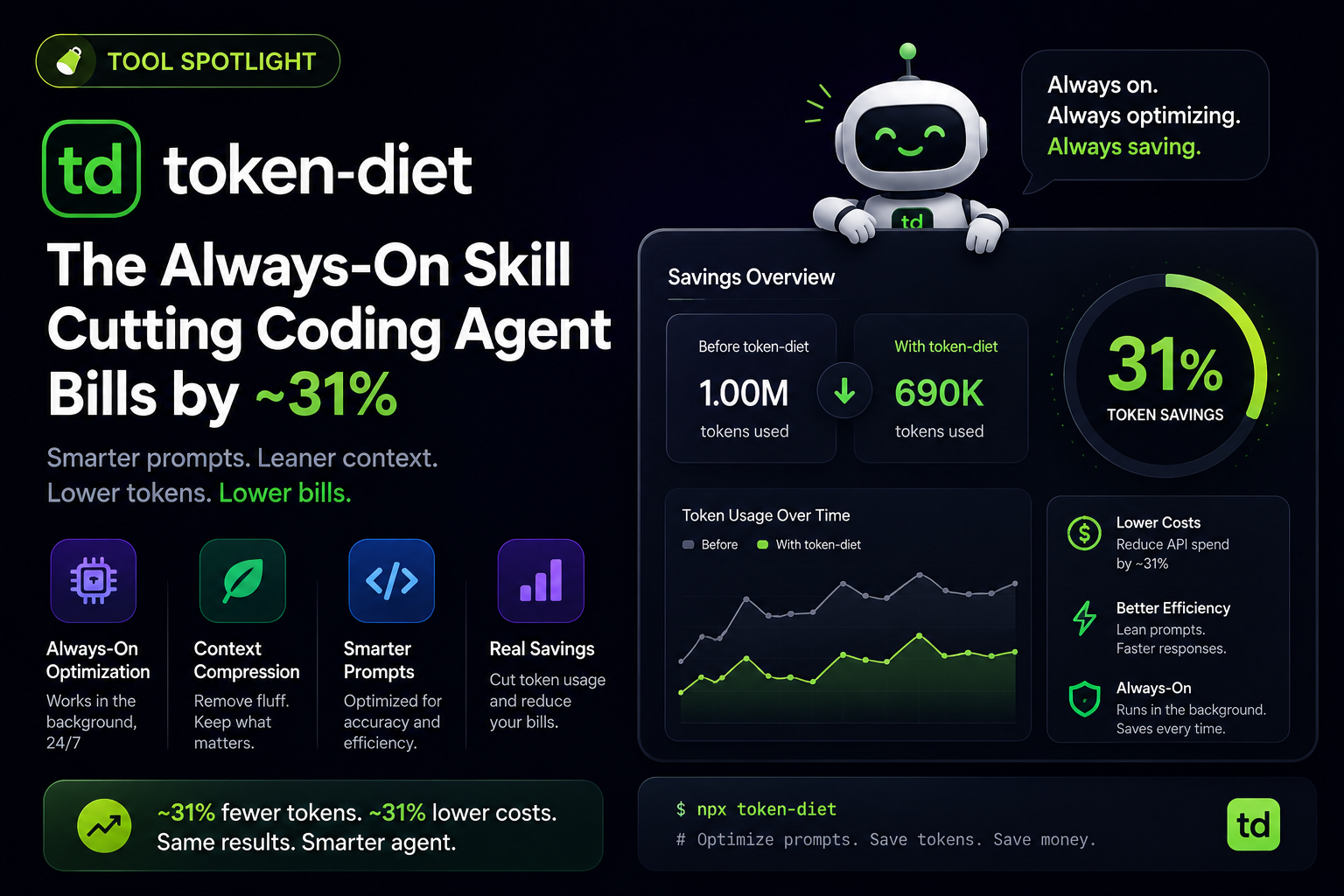
token-diet: Cut AI Coding Agent Bills by ~31%
Coding agents are getting more capable — and more chatty. Longer explanations, verbose comments, and extra context pulled "just in case" don't matter when you're paying by the hour. They matter enormously when your bill is per token. That gap between a lean session and a wasteful one shows up directly on the invoice. token-diet solves exactly that problem.
What token-diet Does
token-diet installs as an always-on skill rather than a command you have to remember to invoke. Once it's running, it applies efficiency rules across every part of a session:
- Replies lead with the answer instead of preamble and summary
- Documentation and code comments use the minimum words needed to stay clear
- Tests and code are built to exactly what was asked, not padded with speculative extras
- Tool calls get batched instead of issued one at a time
None of that touches what the agent decides to build. It changes how much it costs to say and do it.
The reported numbers back that framing up: roughly 31% lower billing on average across sessions, ranging from 17% to 54% depending on session type, with output token reduction as high as 81% on real Sonnet 5 runs. Because it trims only verbosity and redundant context — not reasoning or code quality — the project reports no loss of correctness alongside those savings.
Where It Fits
token-diet supports the tools most agentic coding workflows already run on: Claude Code, Codex, Cursor, Windsurf, and Cline. It installs with a one-line setup and runs by default. It also exposes manual control through /token-diet on, lite, ultra, or off for cases where you want maximum verbosity back, such as while debugging something unusual and actually wanting the agent to show its work.
Why This Matters Now
The frontier-model conversation this year has shifted from "which model scores highest" to "which setup is actually worth running day to day." Cost, speed, and reliability now weigh as heavily as raw capability. Tools like token-diet are a sign of that shift showing up at the tooling layer, not just the model layer: it's not a new model or a new agent, it's a thin efficiency layer sitting on top of the agents people already use, quietly lowering the cost of running them at scale.
For teams running agents against large codebases or high-volume ticket queues, a free skill claiming a third off the bill with no correctness tradeoff is a low-risk, high-upside thing to try.