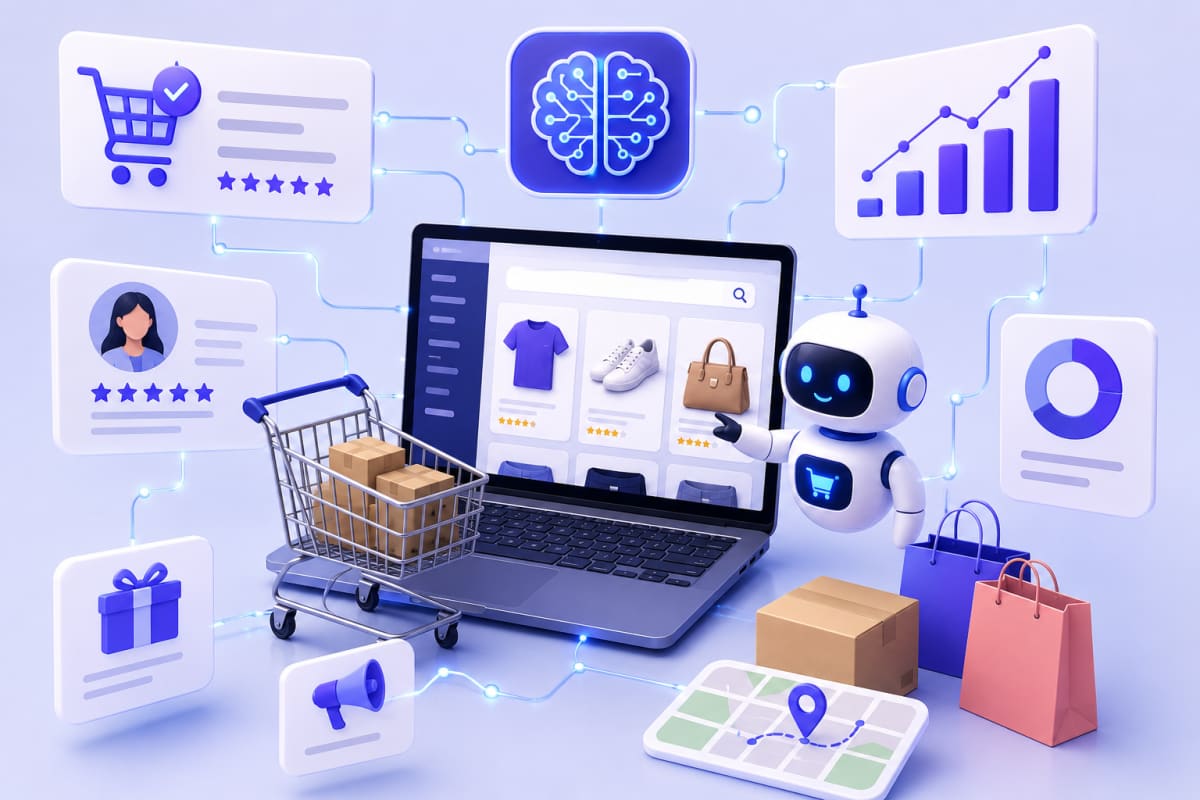
Where AI Actually Makes Money in E-commerce Stores
AI helps e-commerce stores recommend the right products, set smarter prices, and automate repetitive work, all by learning from your own customer data. You don't need a large store or a data-science team to benefit; most platforms already include AI features you may not be using yet.
This guide walks through where AI actually earns its keep in an online store: personalization, pricing, and the day-to-day growth work that quietly eats your team's hours. The goal is not to chase every shiny tool, but to put AI where it moves revenue or saves time.
Personalization That Customers Actually Notice
Personalization is the most mature use of AI in e-commerce, and for good reason. Recommendation engines look at what a shopper browses, adds to cart, and buys, then surface products they are more likely to want. Done well, this lifts average order value and makes a store feel attentive rather than random.
The same logic applies beyond the product grid. AI can tailor homepage banners, reorder category pages, and adjust on-site search results so the most relevant items rise to the top. A shopper who keeps looking at running shoes should not have to scroll past formal wear to find them.
Email and Lifecycle Messaging
AI helps you send the right message at the right moment instead of blasting everyone the same newsletter. Abandoned-cart reminders, replenishment nudges for consumable products, and win-back offers for lapsed customers can all be triggered by behavior. Many email platforms now use AI to predict the best send time per subscriber and to suggest subject lines worth testing.
A Quick Caution on Personalization
More personalization is not always better. Shoppers notice when recommendations feel intrusive or repetitive. Keep it useful, give people a clear way to see why something was suggested, and respect privacy choices. The aim is to feel helpful, not to feel watched.
Smarter Pricing and Promotions
Pricing is where small percentage changes turn into real money. AI-driven pricing tools analyze demand, competitor prices, stock levels, and historical sales to recommend price points that protect margin without scaring off buyers.
- Dynamic pricing adjusts prices based on demand and inventory, common in travel, electronics, and fast-moving categories.
- Promotion optimization predicts which discounts will actually drive incremental sales rather than giving margin away to people who would have bought anyway.
- Markdown planning helps clear slow-moving stock at the right time instead of letting it sit or slashing it too early.
A word of realism: dynamic pricing can backfire if customers feel manipulated, and constant price swings can erode trust. Set guardrails, exclude sensitive categories, and review the rules the system follows so a model never sets a price you would be embarrassed to defend.
Customer Support and Operations
AI chat assistants now handle a meaningful share of routine questions: order status, returns, sizing, and stock availability. The best implementations answer common questions instantly and hand off cleanly to a human for anything complex or emotional. That combination keeps response times low without making customers feel stuck in a loop.
Behind the scenes, AI supports operations too. Demand forecasting helps you order the right quantities and avoid both stockouts and overstock. Fraud-detection models flag suspicious orders before they ship. Image tools can auto-generate product tags or background-clean photos at scale, cutting hours of manual catalog work.
Content and Merchandising at Scale
Writing product descriptions, alt text, and category copy for hundreds of SKUs is slow. AI can draft these quickly, giving your team a starting point to edit rather than a blank page. The same applies to ad variations and landing-page copy you want to test.
Treat AI-generated content as a first draft, not a final one. Review for accuracy, brand voice, and anything a model might invent about a product it does not truly understand. A wrong material or measurement in a description creates returns and complaints, so a human check stays essential.
How to Start Without Overcomplicating It
You do not need a data-science team to benefit. Most e-commerce platforms and popular apps already bundle AI features you may not be using yet. Start where the payoff is clearest and the risk is lowest.
- Pick one problem, abandoned carts, slow support, or weak product recommendations.
- Use what is built in before buying new tools; your store platform likely has options already.
- Measure honestly by comparing against a baseline so you know the AI actually helped.
- Keep a human in the loop for pricing rules, customer escalations, and published content.
Clean, well-organized data is the quiet foundation under all of this. AI trained on messy product information and inconsistent customer records will produce messy results, so tidying your catalog and tracking is rarely wasted effort.
Frequently Asked Questions
Do I need a large store before AI is worth it?
No. Smaller stores often see fast wins from built-in features like recommended products and abandoned-cart emails. The main requirement is having enough order and browsing data for patterns to emerge, which builds up over time even at modest volume.
Is dynamic pricing risky for my brand?
It can be if customers feel prices change unfairly or too often. Set minimum and maximum limits, avoid surprising loyal buyers, and keep certain categories at fixed prices. Used carefully, it helps margins; used carelessly, it damages trust.
Will AI replace my support or marketing team?
More often it shifts what they do. AI handles repetitive questions and first drafts, freeing people for complex cases, strategy, and the judgment calls software cannot make. Plan for AI to assist your team rather than remove it.
The Takeaway
AI in e-commerce works best as a set of focused tools aimed at real problems, better recommendations, smarter pricing, faster support, and less manual catalog work, rather than a single magic switch. Start with one high-impact area, keep a human reviewing the important decisions, and let measured results guide where you expand next.
Written by
Co-founder of Tool Directory AI. Tests and reviews the AI tools listed here.