Devin Desktop: Cognition's Multi-Agent Coding Command Center
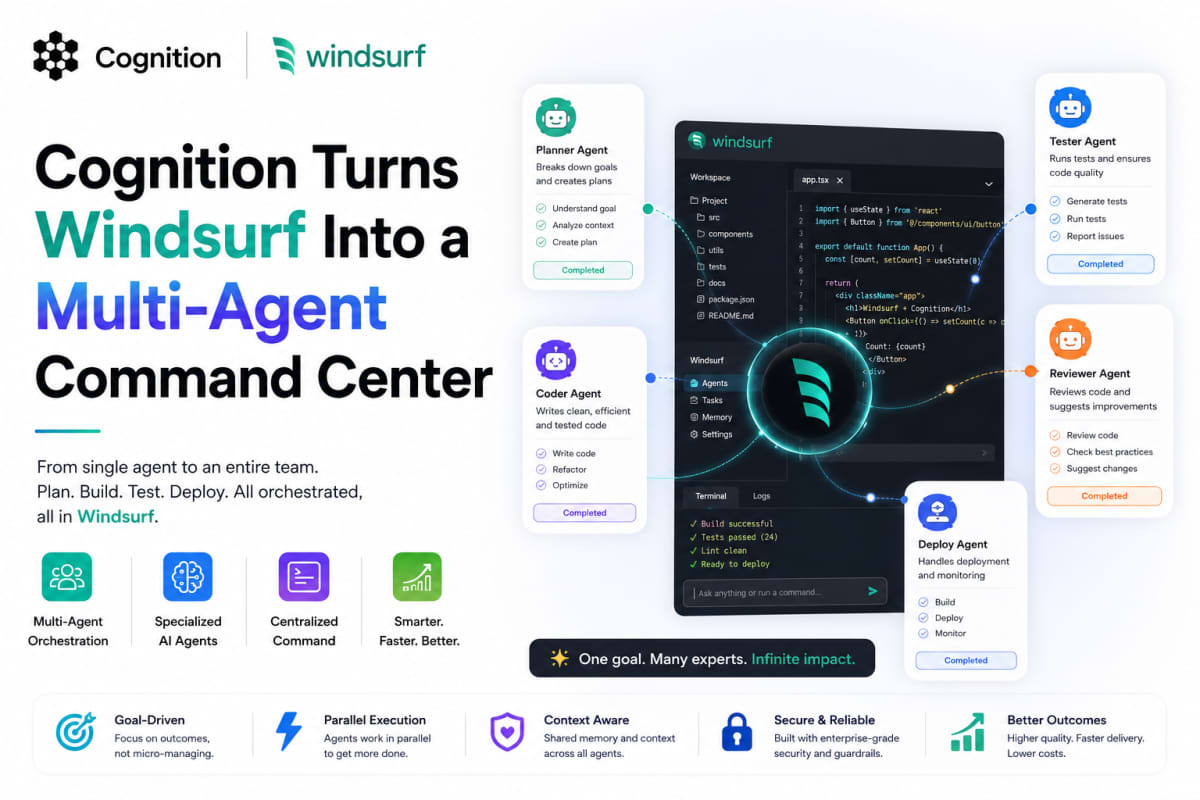
Cognition just shipped Devin Desktop, a multi-agent command center that merges its Windsurf IDE acquisition with its autonomous software engineer. It is built to run a fleet of coding agents simultaneously, not to assist a single developer typing line by line.
What Cognition shipped
For most of the last two years, the coding-assistant story was a chat box bolted onto an editor. Cognition told a different story with Devin Desktop.
It is a rebrand with teeth. Windsurf no longer ships under its own name. The desktop control surface is built around one idea: you are no longer the person writing the code. You are the person directing the agents that do.
- One brand, one surface. Devin the cloud agent and the former Windsurf IDE now live under the Devin name, giving you a single place to launch, watch, and steer work.
- Multiple agents in parallel. Devin Desktop is built to orchestrate several agents working on different tasks or different parts of a codebase at the same time.
- Agent Client Protocol (ACP) support. It speaks ACP, an open protocol for connecting agents to editors and tools, meaning it is designed to talk to agents beyond Cognition's own.
Why a command center instead of an IDE
The shift in language is the whole point. An IDE assumes a human in the chair doing the work with AI assisting. A command center assumes the opposite: the agents do the work, and the human supervises, reviews, and unblocks.
When you have three or four agents running at once, one fixing a bug, one writing tests, one refactoring, the screen you need is not a code editor. It is a dashboard.
That is the bet Cognition is making. The unit of work is shifting from a file you are editing to a task you have delegated, and the tooling has to follow.
The protocol is the quiet headline
It would be easy to read this as just a name change, but ACP support is the detail worth circling. By building on an open agent protocol rather than a closed integration, Devin Desktop positions itself as a control plane for managing agents in general, not a walled garden that only runs Devin.
In a market where every lab wants to own the IDE, betting on interoperability is a deliberate, contrarian move.
Who Devin Desktop is for
- Engineers already delegating to agents who are tired of juggling separate tabs, terminals, and chat windows to keep track of what each one is doing.
- Small teams that want to run more parallel work than they have people and need a single surface to review it all before it ships.
- Tool builders who care that it speaks an open protocol and can be wired into their own stack.
Bottom line
Devin Desktop is less a new feature than a statement about where coding tools are headed. They are moving away from the assisted editor and toward the supervised agent fleet.
Whether managing multiple agents day to day is actually pleasant is the question that will decide it. But the direction is clear, and Cognition is one of the first to ship a product that fully commits to it.
Written by
Co-founder of Tool Directory AI. Tests and reviews the AI tools listed here.