How to Use AI Responsibly Without Losing Trust
AI ethics is not just a topic for philosophers and policy teams. It shows up in everyday business decisions: which tool you adopt, what data you feed it, how much you trust its output, and what you tell your customers. If you use AI to write, analyze, hire, or decide, you have already made ethical choices, whether you meant to or not.
Responsible AI is not about memorizing a framework. It is a handful of practical habits that protect your customers, your team, and your reputation. This guide breaks them down in plain terms so you can act on them today.
What "AI Ethics" Actually Means
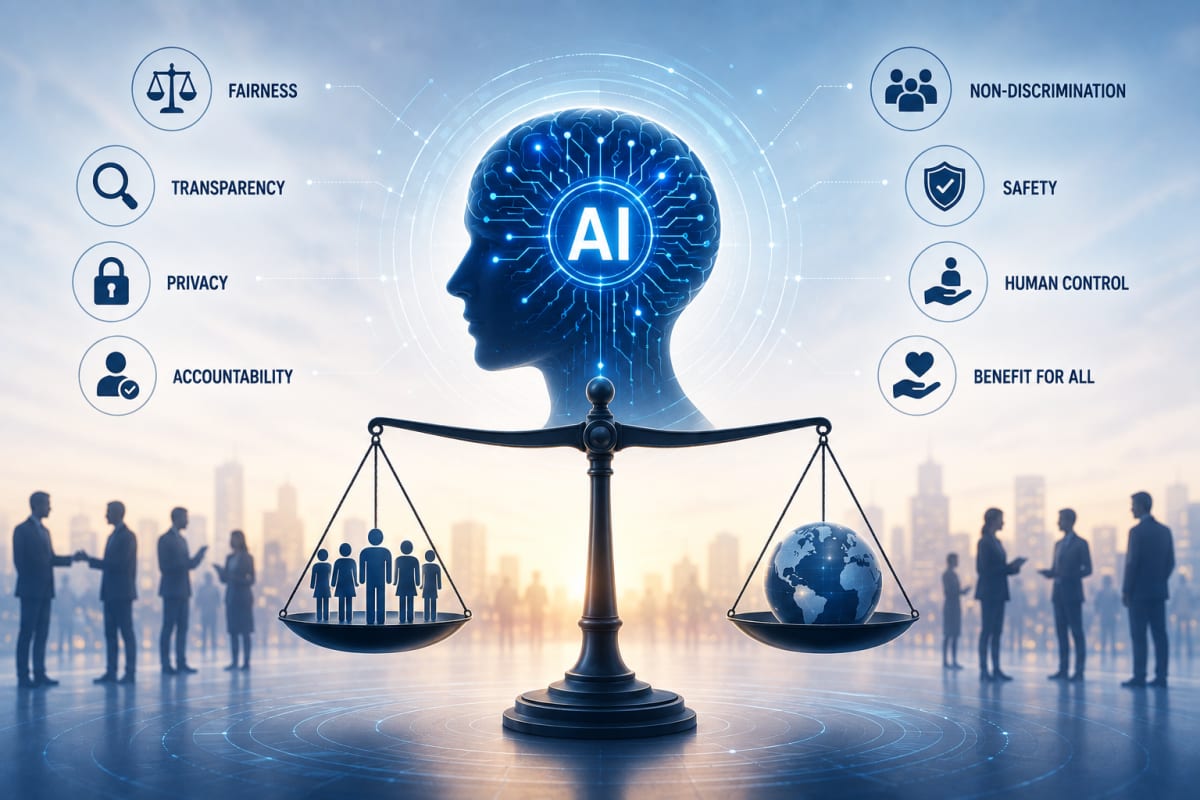
At its core, AI ethics is about making sure the systems you build or use treat people fairly, respect their data, and behave in ways you can explain and stand behind. It covers five recurring themes:
- Fairness, the system does not systematically disadvantage certain groups of people.
- Transparency, people understand when AI is involved and roughly how it reaches its conclusions.
- Accountability, a human stays responsible for the outcome, not the algorithm.
- Privacy, personal data is collected and used with consent and care.
- Safety, the system avoids causing harm, including misinformation and unsafe advice.
You do not need to solve all of these perfectly. You need to be aware of them and make deliberate choices instead of accidental ones.
Where AI Bias Comes From
AI models learn from data, and data reflects the world as it was recorded, including its inequalities. If a hiring model is trained mostly on resumes from one type of candidate, it may quietly favor that type. If a customer-support model only saw polite, fluent English, it may serve other users worse.
Bias is rarely intentional. It hides in the training data, in how a problem is framed, and in who tested the system before it shipped. The practical takeaway is simple: assume some bias exists, and check for it where the stakes are high, such as hiring, lending, pricing, or anything that affects a person's access to opportunity.
Practical Steps for Using AI Responsibly
Keep a human in the loop
For any decision that affects a person meaningfully, a human should review and own the final call. Use AI to draft, summarize, and suggest. Do not let it auto-reject job applicants, deny refunds, or send sensitive messages without a person signing off.
Be transparent about AI use
If a customer is talking to a chatbot, say so. If AI helped generate content or a recommendation, do not pass it off as something it is not. Transparency builds trust, and increasingly it is becoming a legal expectation in many regions.
Check outputs before you trust them
AI tools can produce confident, fluent answers that are simply wrong. This is often called "hallucination." Treat AI output as a capable first draft, not a verified fact. Spot-check claims, numbers, and citations before they reach a customer or a decision.
Mind the data you put in
Before pasting customer records, contracts, or confidential information into an AI tool, ask where that data goes and whether it might be used to train the model. When in doubt, anonymize or use a tool with a clear no-training data policy.
Document your choices
Keep a short, plain-language note of which AI tools you use, for what, and what safeguards you have. If a customer, auditor, or regulator ever asks, you want a real answer, not a shrug.
Responsible AI for Builders
If you are building products on top of AI rather than just using off-the-shelf tools, the bar is higher. Design with clear boundaries on what the system is allowed to do, log its decisions so you can review them, and give users a way to flag and correct errors. Test with a diverse set of inputs, not just the happy path you imagined. The goal is a system you can explain and stand behind, even when something goes wrong.
Common Mistakes to Avoid
- Treating AI as neutral, every model carries the assumptions baked into its data.
- Over-automating sensitive decisions, speed is not worth removing human judgment where people's lives are affected.
- Hiding AI involvement, getting caught erodes trust faster than disclosing it ever would.
- Ignoring edge cases, the rare inputs are often where harm concentrates.
Frequently Asked Questions
Is AI ethics only a concern for big tech companies?
No. Any business that uses AI to make or influence decisions about people has ethical responsibilities. A small team using AI for hiring or customer communication faces the same core questions as a large one, just at a smaller scale.
How do I know if an AI tool is biased?
Test it with varied inputs and compare the results across different groups or scenarios. If outcomes differ in ways that have nothing to do with the actual task, you likely have bias. For high-stakes uses, this kind of testing should be routine, not one-time.
Do I have to tell customers when I use AI?
Disclosing AI use is good practice and is increasingly required by law in some regions, especially for chatbots and automated decisions. Even where it is not mandated, transparency protects trust and is the safer long-term choice.
The Takeaway
Responsible AI is not a compliance burden you bolt on later. It is a set of everyday habits. Keep humans accountable, be honest about AI's role, check the output, protect the data, and watch for bias. Build those habits in early and ethical AI stops being a worry and becomes a quiet competitive advantage.
Written by
Co-founder of Tool Directory AI. Tests and reviews the AI tools listed here.