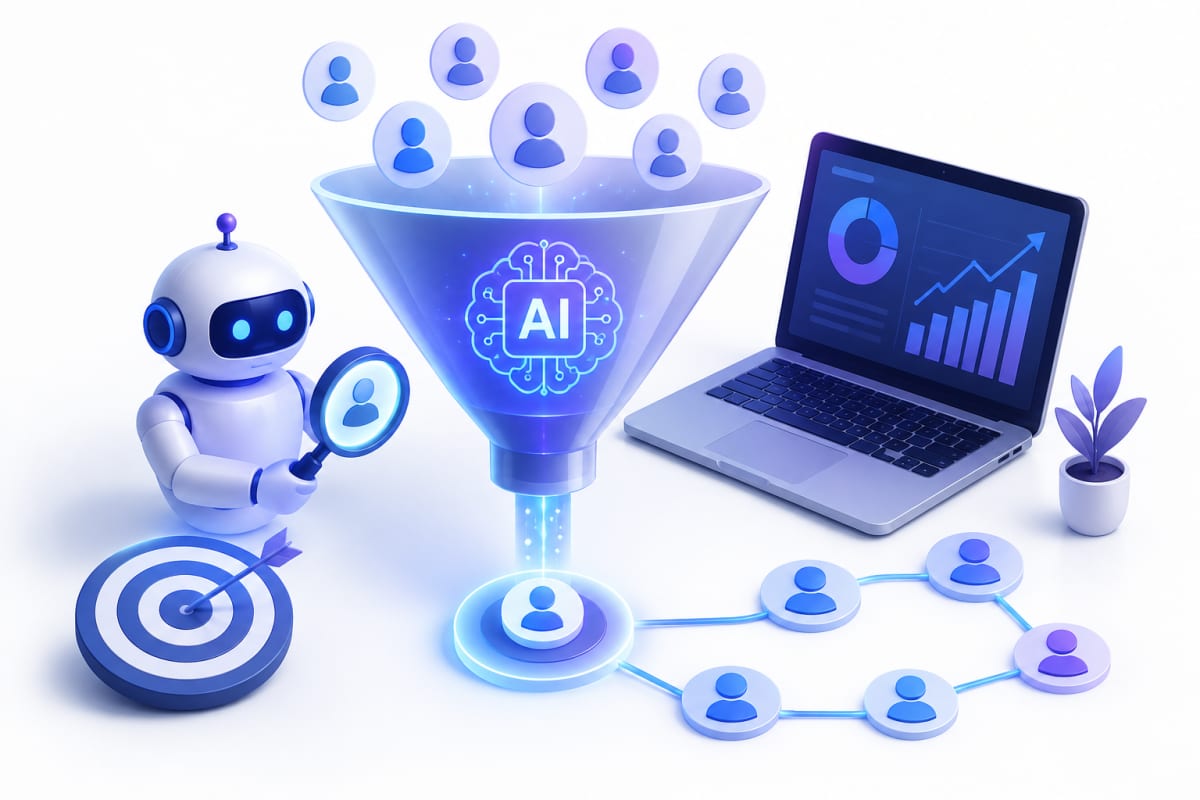
How AI for Lead Generation Actually Works
AI helps you find the right prospects, enrich their details, score who is most likely to buy, and send personalized outreach, all at a scale that used to require a full team. This guide explains where AI actually moves the needle in lead generation and gives you a simple workflow to start.
Lead generation has always been a numbers game with a personal touch, and that combination is hard to scale by hand. AI changes the math.
Below you will find where AI helps, the mistakes that trip people up, and a lean starting workflow you can build on.
Finding and Enriching Leads with AI
The first job of any lead-gen system is to build a list of the right people. AI tools can scan public data, professional networks, company sites, and your own CRM to surface contacts that match your ideal customer.
Instead of manually combing through directories, you describe who you want and let the system gather candidates.
Enrichment is where AI quietly saves hours. A raw lead might just be a name and a company. AI-assisted tools can fill in the role, company size, industry, location, and contact details, turning a thin record into something your team can actually act on.
Cleaner data means less wasted outreach and fewer dead ends.
Score and Qualify Leads
Not every lead deserves equal attention. Lead scoring uses AI to rank prospects by how likely they are to buy, based on signals like company profile, behavior on your site, email engagement, and how closely they match past customers who converted.
The payoff is focus. Instead of treating a tire-kicker and a ready buyer the same way, your team spends its energy on the prospects most likely to close.
Done well, scoring shortens the sales cycle and keeps your pipeline from clogging with leads that were never going anywhere.
Personalized Outreach at Scale
Generic outreach gets ignored. The problem has always been that real personalization does not scale until now. AI can read what is publicly known about a prospect and their company, then draft a message that references their actual situation rather than a mail-merge token.
- Tailored first lines that reference a prospect's role, industry, or recent activity.
- Variations on a theme, so you can test different angles without writing each one from scratch.
- Smarter follow-ups that adapt based on whether and how someone responded.
The key is to use AI for the heavy lifting while keeping a human eye on tone and accuracy. The best results come from AI-drafted, human-approved messages, not fully automated blasts.
Chatbots That Capture Leads
Your website gets visitors at all hours, and most of them leave without a word. An AI chatbot can engage them in the moment, answer common questions, qualify their need, and collect contact details before they bounce.
Unlike the rigid menu bots of the past, modern chatbots understand natural language and can hold a real conversation.
Used well, a chatbot becomes a tireless front-line rep that captures leads while your team sleeps, then hands warm prospects off with context already gathered.
Predictive Analytics for Pipeline Insights
Beyond scoring individual leads, AI can look across your whole pipeline to spot patterns. Predictive analytics estimates which deals are likely to close, which customers might churn, and which segments are worth doubling down on.
It can even suggest the best time to reach out based on past engagement.
This turns lead generation from a reactive scramble into something closer to a forecast. You stop guessing where to put your effort and start letting the data point you toward the opportunities most likely to pay off.
Content and SEO for Inbound Leads
The best leads often find you, and AI can accelerate the content engine that makes that happen. It helps with keyword research, drafting blog posts and landing pages, repurposing one asset into many formats, and identifying the questions your audience is actually searching for.
A word of caution: search engines and readers reward genuinely useful content, not volume for its own sake. Use AI to draft and speed up, then add real expertise and a human edit so the work stands out instead of blending into the noise.
A Practical Starter Workflow
You do not need a dozen tools to begin. A lean workflow looks like this:
- Define your ideal customer in plain terms, so every tool downstream knows who to look for.
- Use an AI-assisted tool to build and enrich a focused list rather than buying a giant, generic one.
- Score the list and prioritize the top tier.
- Draft personalized outreach with AI, then review and approve each message before it sends.
- Add a chatbot to your site to capture inbound interest.
- Track what works and feed those results back in to sharpen scoring and messaging over time.
Start with one or two steps, prove they work, then expand.
Common Mistakes to Avoid
AI makes lead gen faster, which also means it makes bad habits faster. Watch out for these:
- Spraying generic messages at scale and calling it personalization. Volume without relevance just trains people to ignore you.
- Trusting unverified data. Enriched records can be wrong; reaching out with bad details damages credibility.
- Removing humans entirely. Full automation tends to feel robotic and miss nuance. Keep a person in the loop.
- Ignoring consent and privacy rules. Respect opt-outs and regional regulations, or risk your domain reputation and worse.
- Chasing tools instead of strategy. A clear offer and a defined audience matter more than the shiniest software.
Frequently Asked Questions
Can AI completely automate lead generation?
It can automate large parts of it, like finding, enriching, scoring, and drafting, but the best results still come from human oversight. AI handles the volume and the busywork while people guide strategy, approve messaging, and build the relationships that actually close deals.
Do I need technical skills to use AI for lead generation?
Usually not. Most modern lead-gen tools are built for non-technical users, with simple setups and plain-language controls. Start with one tool that solves a clear problem, learn it well, and add more only as your needs grow.
Is AI-generated outreach considered spam?
It depends entirely on how you use it. Relevant, well-targeted, consent-respecting outreach is welcome. Mass, generic, unsolicited messages are spam no matter how they are written. Personalize genuinely, respect opt-outs, and follow privacy rules to stay on the right side of the line.
The Takeaway
AI gives a small team the reach of a large one across finding, qualifying, and personalizing at scale but only when paired with a clear audience, clean data, and human judgment.
Start with one step, measure results, and let what works guide where you expand next.
Written by
Co-founder of Tool Directory AI. Tests and reviews the AI tools listed here.