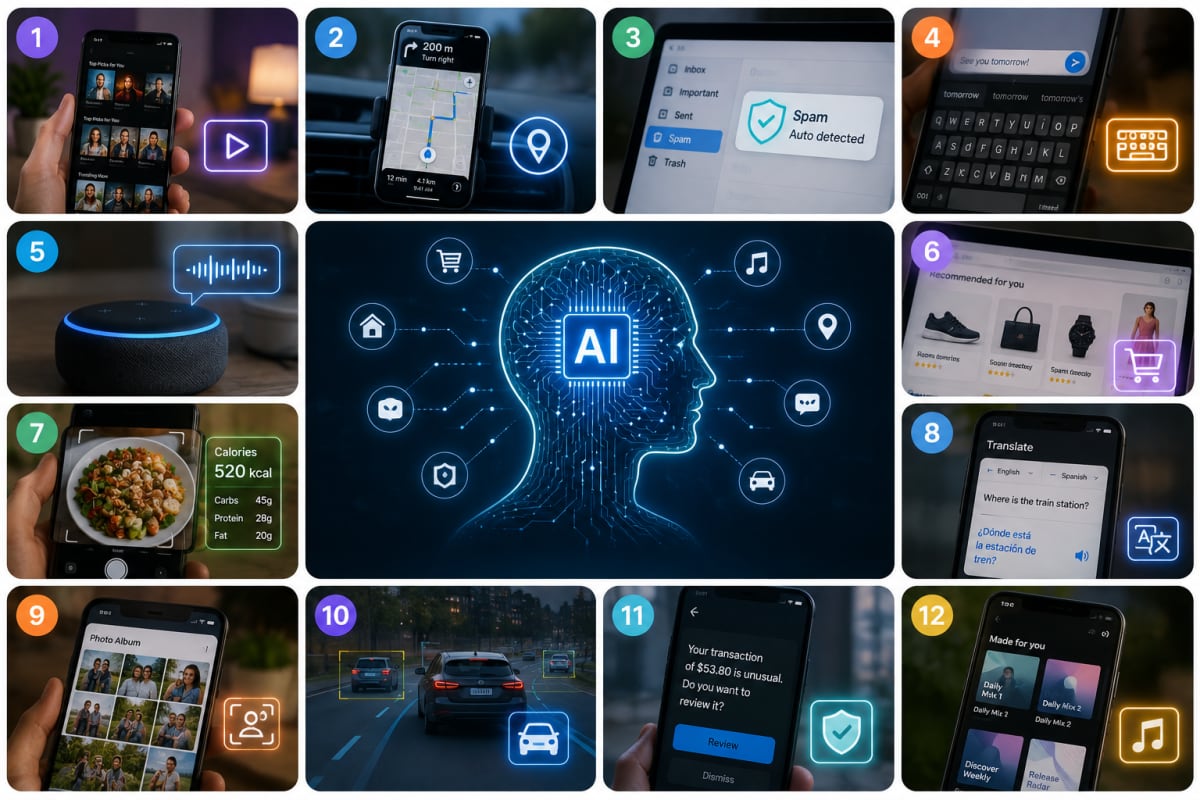
12 AI Tools Hiding in Plain Sight in Your Phone and Home
You have probably interacted with a dozen AI systems before lunch. AI is not a futuristic concept, it is the invisible engine behind the apps and devices you touch every day. From the moment you wake up to the time you go to bed, AI is filtering your emails, routing your commute, recommending what you watch, and protecting your money. Below are the twelve most common examples, what they are actually doing behind the scenes, and why they work the way they do.
1. Voice assistants help you get things done hands-free
Asking your phone or speaker to set a timer, play a song, or answer a quick question relies on AI to turn your speech into text, figure out what you meant, and respond. The reason these assistants keep getting better at understanding accents and casual phrasing is that they learn from enormous amounts of spoken language.
2. Recommendations learn what you actually want
The "you might also like" row on a streaming service, the products suggested when you shop, the next video that autoplays, these are all AI looking at patterns in what you and people like you have watched, bought, or skipped. It is the engine behind most of what you are shown online.
3. Maps and navigation predict the fastest route
When your map app reroutes you around traffic or estimates your arrival time, it is weighing live conditions against historical patterns to predict the fastest path. The reason it knows a road is jammed is that it is reading signals from many devices on that road at once.
4. Spam and junk filters keep your inbox clean
Your inbox stays mostly clean because AI is constantly judging which messages look like spam, phishing, or junk. It learns from billions of examples and from what people mark as unwanted, which is why obvious scams rarely reach your main inbox anymore.
5. Photo features organize and edit without manual tags
Search your photos for "beach" or "dog" and the right pictures appear even though you never tagged them. AI recognizes what is in each image. The same technology groups photos by the people in them and powers the editing tools that remove backgrounds or sharpen a blurry shot.
6. Autocorrect and predictive text anticipate what you will write
Every time your keyboard fixes a typo or suggests the next word before you type it, that is AI predicting language based on what you usually write and how words tend to follow one another. It is one of the oldest everyday uses of the technology, and one of the most invisible.
7. Smart home devices make small decisions for you
Thermostats that learn your schedule, doorbell cameras that tell a person from a passing car, lights that adjust on their own, these lean on AI to interpret sensor data and make small decisions so you do not have to flip switches all day.
8. Banking and fraud detection protect your money
If your bank has ever paused a strange charge or texted you to confirm a purchase, AI flagged it. These systems learn your normal spending patterns and react when something looks out of place, a purchase in another country, an unusual amount, an odd time of day.
9. Health and fitness wearables turn raw data into insights
Watches and bands that track sleep, count steps, estimate calories, or notice an irregular heart rhythm use AI to turn raw sensor readings into something meaningful. The reason a wearable can tell sleeping from sitting still is that it has been trained to recognize the difference.
10. Translation breaks language barriers in real time
Translating a menu by pointing your camera at it, or reading a webpage in another language with one tap, is AI converting meaning between languages in real time. It has gotten good enough that millions of people now use it daily for travel, work, and staying in touch.
11. Search and autocomplete understand your intent
The suggestions that appear as you type a search, and the way results understand what you meant even when you phrase it loosely, come from AI interpreting intent rather than just matching keywords. It is why you can describe a thing you cannot name and still find it.
12. Customer support chat handles routine questions around the clock
That chat window on a company website that answers your question instantly at midnight is usually AI handling the common requests, then passing you to a person when things get complicated. It is why basic help is available around the clock now.
Why you do not notice AI
Good AI tends to disappear. When a spam filter works, you simply do not see spam. When a recommendation lands, it feels like the app just gets you. The technology succeeds precisely when it fades into the background and makes something feel effortless. That is also why it is easy to underestimate how much of it you rely on every day.
- It is usually a feature inside something else, not a separate app you open.
- It works quietly, so you only notice it when it gets something wrong.
- It improves gradually, so the upgrades rarely feel like a dramatic moment.
Frequently Asked Questions
Is all of this "real" AI?
These systems use machine learning, software that improves by finding patterns in data rather than following only fixed rules. It is a different flavor than the chatbots making headlines, but it is the same family of technology, and it has been around in everyday tools for years.
Does using these features mean my data is being collected?
Often, some data is involved because these systems learn from how things are used. How much, and whether it is tied to you personally, varies widely by company and product. It is worth checking the privacy settings on your devices and apps to see what you are comfortable sharing.
Can I turn AI features off?
Many of them, yes, you can usually disable recommendations, predictive text, smart home learning, or photo recognition in settings. Some, like spam filtering or fraud detection, are baked in for your protection and are not meant to be switched off.
The takeaway
AI is not something coming in the future. It is already stitched into the ordinary moments of your day, from your inbox to your commute to your bank. Noticing where it already lives is the easiest way to understand what it is genuinely good at and where it still needs a human keeping watch.
Written by
Co-founder of Tool Directory AI. Tests and reviews the AI tools listed here.