AI in Education: Personalized Learning That Actually Works
Can AI Really Personalize Learning at Scale?
Yes, but only when teachers stay in the loop. AI in education is now making personalized learning practical at scale. It adapts to each student's pace, fills gaps, and frees teachers from repetitive work. The promise is real. The risks around accuracy, over-reliance, and privacy deserve careful handling, not hand-waving.
What Personalized Learning Actually Means
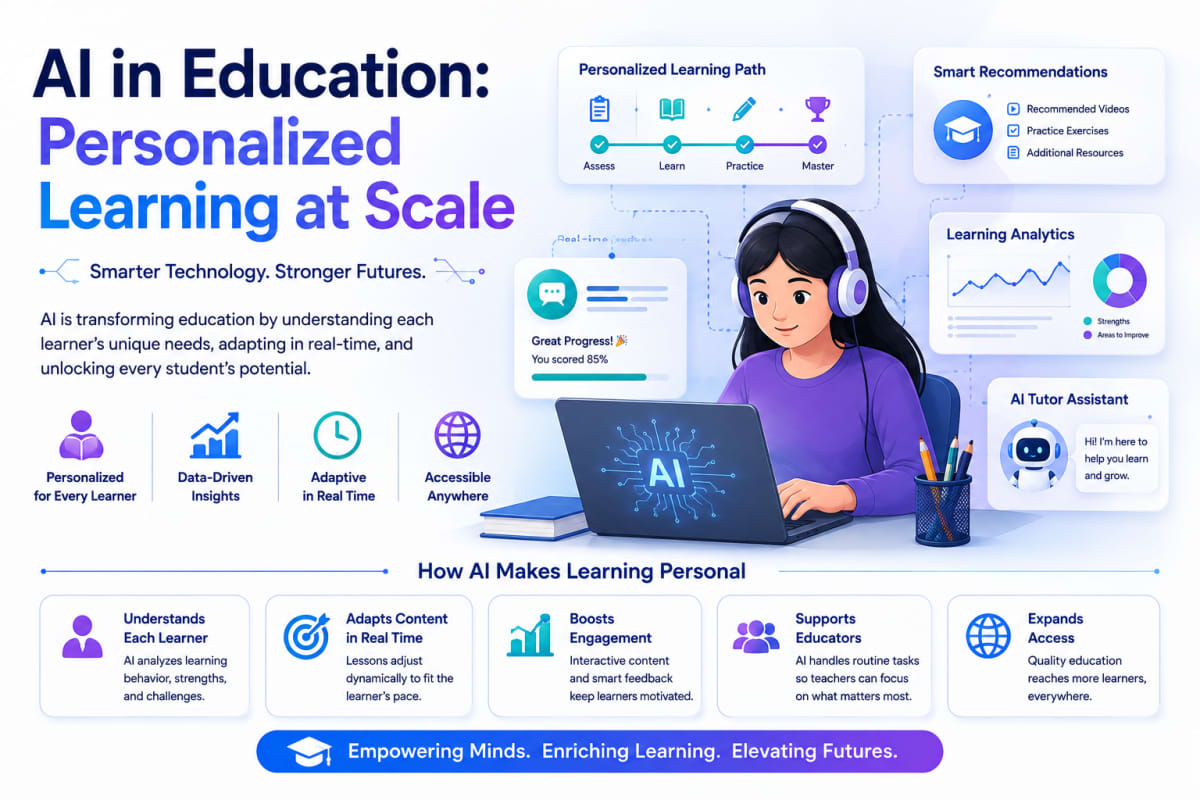
Personalized learning is simple in principle: meet each learner where they are. A student who has already mastered a concept should move on. One who is struggling should get more practice and a different explanation. Doing this by hand for every student is nearly impossible at scale, which is exactly the gap AI tries to fill.
An AI tutoring system tracks how a learner answers questions, spots where they get stuck, and adjusts what comes next. If you keep missing a certain type of problem, it offers more of those, perhaps explained differently. If you breeze through, it raises the difficulty so you stay challenged.
Where AI Helps Today
AI in education is not a single product. It shows up across several practical areas, each solving a real problem for learners or educators.
Adaptive Practice
Many learning platforms now adjust difficulty based on performance. Instead of everyone doing the same worksheet, the system serves each learner the problems they most need. This keeps stronger students engaged and gives struggling students the repetition that helps concepts stick.
On-Demand Tutoring
AI tutors can answer questions any time. That matters most for learners without easy access to a teacher after hours. A student stuck on a math problem at night can ask for a hint, a worked example, or a simpler explanation. The best tools guide the learner toward the answer rather than just handing it over.
Help for Teachers
Some of the biggest gains are for educators, not just students. AI can draft lesson plans, generate practice questions, summarize where a class is struggling, and handle first-pass grading on straightforward assignments. That gives teachers back time they can spend on the human parts of teaching: mentoring, encouraging, and explaining in person.
Accessibility
AI also helps learners who have been underserved by standard materials. Real-time translation opens content to non-native speakers. Text-to-speech and speech-to-text support students with different needs. Materials can be rewritten at a simpler reading level on demand, so the same lesson reaches more people.
The Concerns Worth Taking Seriously
Accuracy
AI tutors can be confidently wrong. A model may explain a concept incorrectly or invent a fact, and a student who trusts it will absorb the mistake. For now, AI works best as a study aid that a teacher or trusted source can back up, not as the sole authority.
Over-Reliance
If a tool simply gives answers, students can finish their homework without learning anything. The point of education is to build understanding, not just to produce correct answers. Good tools are designed to teach the process, and learners need to use them that way.
Privacy and Equity
These systems collect data about how children and adults learn, which raises real privacy questions about how that information is stored and used. There is also an access gap: students with reliable devices and internet benefit far more than those without. Personalized learning only scales fairly if access scales with it.
How to Use AI in Education Well
Teachers and trainers: Start small. Use AI to handle the time-consuming prep work, such as drafting quizzes or summarizing student progress. Keep yourself firmly in the loop on anything that affects grades or guidance. Treat AI output as a first draft to review, never as a final verdict.
Self-learners: Use AI as a patient tutor that never tires of your questions. Ask it to explain ideas in different ways, quiz you, or break a big topic into steps. Then verify important facts against a reliable source, because the tutor can be wrong. The goal is to understand, not just to complete.
Frequently Asked Questions
Will AI replace teachers?
No. AI can handle repetitive tasks like drafting practice questions and first-pass grading, but it cannot mentor, motivate, or read a room the way a teacher does. The realistic future is teachers supported by AI, with more time for the human side of their work.
Are AI tutors accurate enough to rely on?
Not entirely. AI tutors are helpful for practice and explanations, but they can state wrong information confidently. Use them as a study aid and verify important facts with a textbook, teacher, or other trusted source.
Is personalized learning only for schools?
No. The same approach works for corporate training, professional upskilling, and self-directed learning. Anywhere people need to learn at different paces, adaptive tools can tailor the experience to each individual.
The Takeaway
AI in education is at its best when it gives each learner a more personal path and frees teachers from repetitive work, all without pretending to replace the human relationships that make learning stick. Used thoughtfully, with people verifying the output and guiding the journey, it brings genuine one-to-one attention closer to reach for far more learners than before.
Written by
Co-founder of Tool Directory AI. Tests and reviews the AI tools listed here.