AI in Healthcare: 5 Ways It's Actually Working Today
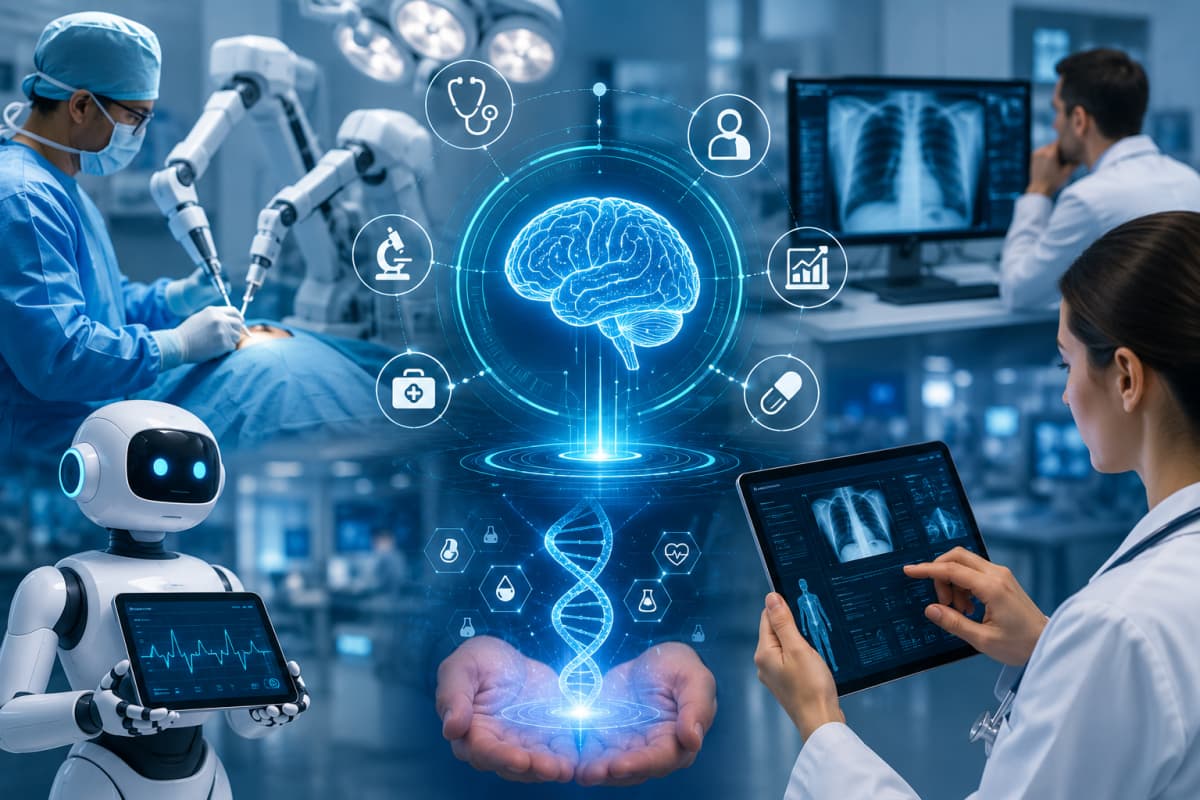
AI in healthcare is already doing real work, and it is nowhere near replacing doctors. Today, AI helps clinicians read medical images faster, cut through paperwork, predict patient risks, accelerate drug research, and streamline hospital operations. It is a support tool, not a decision-maker, and that distinction matters.
This article breaks down exactly how AI is used in healthcare right now, where it delivers tangible value, and the guardrails that keep humans firmly in control of medical decisions.
1. Reading Medical Images Faster
Medical imaging ranks among AI's strongest current applications in healthcare. Models trained on large datasets of X-rays, CT scans, MRIs, and retinal photos can flag patterns that may signal disease. In radiology, AI highlights suspicious areas for a specialist to review, acting as a second set of eyes rather than a replacement.
This is especially valuable where expert time is scarce or patient volumes are high. Screening programs for conditions like diabetic eye disease and certain cancers use AI to prioritize cases so patients who need attention most are seen sooner. The clinician still makes the diagnosis. The AI simply directs where to look.
2. Cutting the Paperwork Burden
Some of the most practical wins in AI healthcare are unglamorous. Clinicians spend a large share of their day on documentation, and AI is now actively easing that load.
- Ambient note-taking tools listen to a visit (with consent) and draft the clinical note, which the clinician reviews and signs.
- Coding and billing support suggests the right codes from a visit summary, reducing errors and delays.
- Inbox triage helps sort patient messages and draft routine replies for staff to approve.
These tools do not make medical decisions. They give time back to people, which can mean more attention on the patient in the room and less burnout among staff. Given how much administrative work weighs on healthcare, this is a quietly significant benefit.
3. Supporting Diagnosis and Risk Prediction
AI can sift through large amounts of patient data to spot risks that are difficult to detect manually. Hospitals use predictive models to flag patients who may be deteriorating, at risk of readmission, or developing complications like sepsis, prompting earlier intervention.
Decision-support tools also surface relevant guidelines, drug interactions, and similar past cases at the point of care. The pattern holds: AI offers information and alerts, while the clinician weighs them against the full picture of the patient in front of them.
4. Drug Discovery and Research
Behind the scenes, AI is reshaping how new treatments are found. Researchers use it to predict how molecules might behave, narrow down promising drug candidates, and design experiments more efficiently. Protein-structure prediction has been a notable advance, helping scientists understand biology that was previously slow and costly to map.
This work is early-stage and long-term. AI speeds up parts of research and helps prioritize what to test, but new treatments still require rigorous trials and regulatory approval before they reach patients. The promise is faster, cheaper exploration, not instant cures.
5. Smoother Hospital Operations
Hospitals and clinics are complex operations, and AI helps run them more smoothly. It supports scheduling, predicts patient demand so staffing can adjust, and manages supply levels. AI chat assistants handle routine tasks like appointment booking and answering common questions, which can widen access for patients who struggle to reach a clinic by phone.
These uses rarely make headlines, but they affect real outcomes. Shorter waits, fewer missed appointments, and better-resourced wards all improve the experience of care.
The Limits and Cautions
For all its promise, AI in healthcare carries serious responsibilities. A few principles matter.
Accuracy and Bias
A model is only as good as the data it learned from. If that data underrepresents certain groups, the AI may perform worse for them. Tools must be validated across diverse populations and monitored after deployment, not assumed to be correct.
Privacy and Consent
Health data is among the most sensitive information that exists. Any responsible use of AI must protect that data, follow regulations, and be transparent with patients about how information is used.
Human Accountability
AI in care is a support tool, not a decision-maker. A qualified professional remains responsible for diagnosis and treatment. The strongest systems are designed so AI informs the human, and the human stays accountable.
Frequently Asked Questions
Can AI diagnose me instead of a doctor?
Not on its own. AI can flag possible issues and support a clinician's judgment, but diagnosis and treatment remain the responsibility of qualified professionals. Online symptom checkers can offer general guidance, but they are not a substitute for medical care.
Is my health data safe when AI is involved?
It should be governed by strict privacy rules, but safety depends on how each organization handles it. Responsible providers protect data, limit access, and are transparent about its use. If you are unsure, you can ask how your information is stored and whether it trains any models.
Will AI reduce healthcare costs?
It can in specific areas by cutting administrative work, catching problems earlier, and using staff time better. But adoption itself has costs, and savings depend on careful implementation. AI is a contributor to efficiency, not a guaranteed shortcut to cheaper care.
The Takeaway
AI in healthcare today is less about robots replacing doctors and more about quietly assisting them, reading scans, drafting notes, flagging risks, and speeding up research. Used carefully, with strong privacy protections and a human firmly in charge of decisions, it helps clinicians do their work better and gives patients faster, more attentive care.
Written by
Co-founder of Tool Directory AI. Tests and reviews the AI tools listed here.