10 AI Myths Debunked: Stop Letting Hype Slow You Down
AI is surrounded by more hype, fear, and confusion than almost any technology in recent memory. Some of it makes the tools sound magical. Some of it makes them sound terrifying. Most of it gets in the way of using AI well.
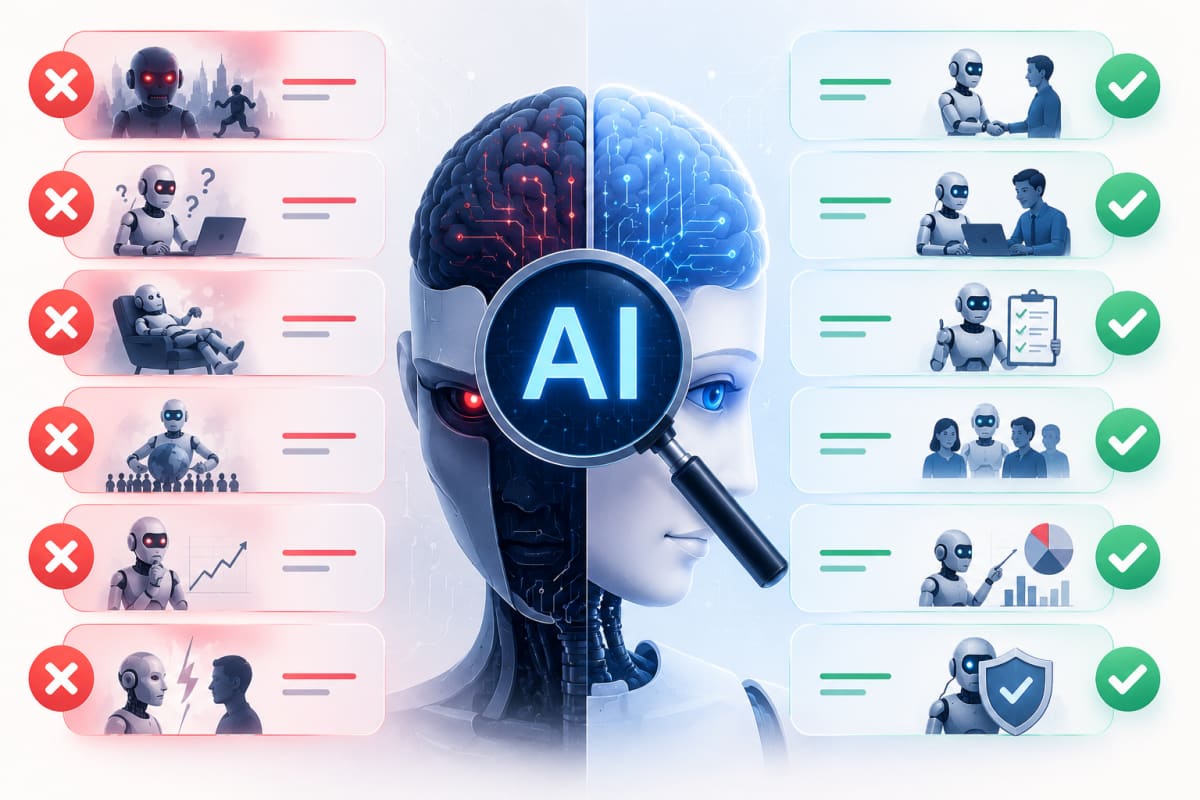
Here are ten of the most common myths, cleared up in plain language, so you can make decisions based on how these tools actually work rather than on headlines.
Myth 1: AI Thinks Like a Human Brain
It does not. Today's AI predicts likely patterns from data, whether that is the next word in a sentence or the next pixel in an image. There is no understanding, intention, or awareness behind it. It can sound thoughtful while having no idea what it is saying, which is exactly why it sometimes produces confident nonsense.
Myth 2: AI Is Always Objective and Unbiased
Because AI feels mechanical, people assume it is neutral. In reality, models learn from data created by humans, and they absorb the biases in that data. A model trained on past hiring decisions can quietly repeat old patterns of unfairness. The output looks impartial, which makes the bias harder to spot, not easier.
Myth 3: AI Is Going to Take Everyone's Job
AI is changing jobs more than it is erasing them. It is good at specific tasks like drafting, summarizing, sorting, and answering common questions. But most roles are bundles of many tasks, including judgment and relationships that AI handles poorly. The realistic near-term picture is people using AI to offload routine work, not entire professions disappearing overnight.
Myth 4: AI Is Almost Always Right
Confidence and accuracy are not the same thing. Generative AI can state wrong facts, invent sources, and make up details in a tone that sounds completely authoritative. This is called a hallucination, and it is a built-in trait, not a rare glitch. Anything important that comes out of an AI tool needs to be checked by a human.
Myth 5: More Data Always Means Better AI
Quantity is not the whole story. A smaller set of clean, relevant, well-labeled data often beats a giant pile of messy, irrelevant data. Feed a model bad inputs and you get confident bad outputs. Quality, relevance, and how the data is prepared matter as much as raw volume.
Myth 6: AI Learns and Updates Itself in Real Time
Most AI tools you use are static between updates. A model is trained on data up to a certain point, then deployed. It does not quietly teach itself from your conversations or browse for fresh information unless it has been specifically connected to do so. That is why a model may not know about recent events, and why "learning" usually means a deliberate retraining process, not constant self-improvement.
Myth 7: AI Is Basically Sentient or About to Be
A chatbot that says "I understand how you feel" understands nothing. It has no consciousness, no emotions, and no self. It generates the words most likely to fit the conversation. The fluency is convincing, but it is a reflection of human language in its training data, not a sign of an inner mind waking up.
Myth 8: AI and Robots Are the Same Thing
Movies blur these together, but they are separate. AI is software, the decision-making and pattern-recognition part. A robot is physical hardware. A robot may run on AI, and plenty of AI never touches a physical machine at all. The AI writing an email or analyzing a spreadsheet has no body and never will.
Myth 9: AI Will Solve Every Problem
On the other side of the fear is overblown optimism. AI is powerful for well-defined tasks with good data, but it is not a cure-all. It cannot fix a broken process, supply judgment it was never given, or replace clear human goals. Point it at a vague or messy problem and it will produce vague or messy results, just faster.
Myth 10: AI Is Too Complex for Ordinary People to Use
Building AI is hard. Using it is not. Modern tools are designed so anyone can get value by typing a plain request, no coding or data science required. If you can describe what you want clearly, you can use most AI tools today. The real skill is asking well and reviewing the output, not understanding the math underneath.
Why These Myths Matter
Believing AI is always right leads to unchecked mistakes. Trusting it to be unbiased leads to unfair decisions. Thinking it is too complex to touch means missing real productivity gains. Accurate expectations help you capture the benefits while avoiding the pitfalls.
How to Tell AI Fact from Fiction
Be skeptical of anything that makes AI sound either magical or apocalyptic. Look for explanations of how a tool actually works, what data it uses, and where it fails. Test tools yourself on low-stakes tasks because hands-on experience cuts through hype faster than any article.
The Takeaway
AI is neither a thinking machine nor a passing gimmick. It is a powerful, narrow, sometimes-wrong tool that rewards clear expectations. Drop the myths, keep a human in the loop, and you can use AI confidently without falling for either the hype or the fear.
Written by
Co-founder of Tool Directory AI. Tests and reviews the AI tools listed here.