AI in 2026: The Real Shifts That Matter (No Hype)
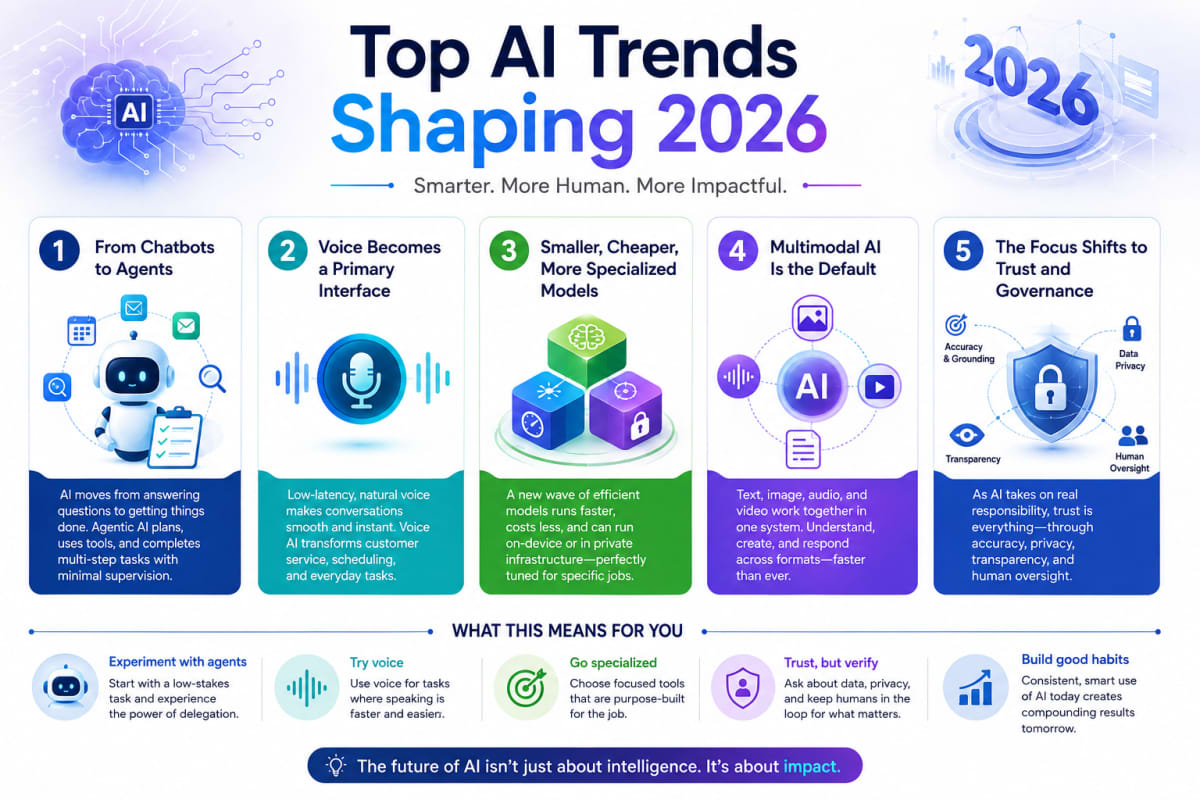
If you want to know what's actually shaping AI in 2026, the answer comes down to five shifts: AI moving from passive chatbots to active agents, voice becoming a primary way people interact, smaller specialized models matching bigger ones in usefulness, multimodal tools replacing single-format apps, and a maturing focus on trust and governance. These moves are real, practical, and already changing how work gets done.
This is a grounded look at the trends worth paying attention to, written for people who want signal over hype. No predictions about robot overlords, just what is happening and what it means for the way you work.
From Chatbots to Agentic AI
The biggest shift in AI right now is the move from systems that answer questions to systems that take action. Early assistants were reactive: you asked, they replied. Agentic AI works differently. You give it a goal, and it plans steps, uses tools, and pushes through a multi-step task with limited supervision.
In practice, that means an AI that can research a topic, draft a document, check it against your data, and schedule a follow-up, all triggered by a single instruction. For everyday users, agents are starting to handle errands like booking, comparison shopping, and routine admin work. The headline for 2026 is that AI is becoming something that does work, not just something that talks about it.
Why Voice Is Becoming a Primary Interface
Typing is no longer the only natural way to work with AI. Voice interfaces have become fast and accurate enough that talking to a system feels conversational rather than clunky. Low-latency voice means responses arrive almost instantly, removing the awkward pauses that made earlier voice tools frustrating.
For businesses, this is reshaping customer support, scheduling, and phone-based service, where a voice AI can handle a full conversation end to end. For individuals, dictating a request and hearing a useful reply is becoming a default mode rather than a novelty.
Smaller, Cheaper, More Specialized AI Models
For a few years the story was bigger is better. In 2026 the story is more nuanced. Alongside the large frontier models, a wave of smaller, efficient models has arrived that run faster and cost far less to operate.
This matters for two reasons. First, smaller models can run on your own device or inside a company's own infrastructure, which improves speed and privacy. Second, organizations are increasingly using a specialized model tuned for one job rather than paying for a giant general model to do everything. The result is AI that is cheaper to deploy and easier to fit to a specific task.
Multimodal AI Has Become the Default
The line between text, image, audio, and video AI has blurred. Modern systems are multimodal by default, meaning a single tool can read a document, look at a chart, listen to a recording, and respond across all of them.
You can show an AI a photo of a broken appliance and ask how to fix it, hand it a slide deck and ask for a summary, or describe a scene and get an image back. For marketers and creators, this collapses several separate tools into one and makes producing mixed-media content dramatically faster.
The Focus on Trust and Governance in AI
As AI takes on more real responsibility, the conversation has matured from "what can it do" to "can we trust it." Several themes define this in 2026:
- Accuracy and grounding. Tools increasingly cite sources and connect to verified data so answers can be checked rather than taken on faith.
- Data privacy. Companies want AI that respects where their data lives, fueling demand for on-device and private deployments.
- Transparency. Growing pressure to disclose when content is AI-generated and to explain how automated decisions are made.
- Human oversight. The most trusted systems keep a person in the loop for high-stakes decisions rather than acting fully alone.
For any business adopting AI, governance is no longer an afterthought. It is becoming a competitive advantage and, in many regions, a legal requirement.
What These 2026 AI Trends Mean for You
You don't need to act on every trend. But a few practical moves make sense in 2026:
- Experiment with agents on a low-stakes task to see how delegating to AI actually feels.
- Try voice for tasks where speaking is faster than typing.
- Favor focused tools over one giant all-in-one platform when a specialized option does the job better.
- Ask vendors how they handle your data before you commit, and keep humans reviewing anything that matters.
Frequently Asked Questions
What is the single most important AI trend in 2026?
The rise of agentic AI, systems that complete multi-step tasks toward a goal rather than just answering questions. It changes AI from a tool you consult into something that does work on your behalf, which is why it is reshaping so many other trends.
Will smaller AI models replace the big ones?
Not entirely. Large frontier models still lead on the hardest, most general problems. But smaller, efficient models are taking over a growing share of everyday tasks because they are faster, cheaper, and easier to run privately. Most organizations will use a mix of both.
Should small businesses worry about falling behind on AI?
There is no need to panic, but there is value in starting. The advantage in 2026 goes to teams that adopt a few well-chosen tools and build good habits, not to those who chase every release. Begin with one workflow, learn it, and expand from there.
The Takeaway
The defining theme of 2026 is AI growing up: more capable as an agent, more natural through voice, cheaper to run, multimodal by default, and held to higher standards of trust. You don't need to adopt everything at once, but understanding these shifts now puts you in a strong position to use AI well for the rest of the year.
Written by
Co-founder of Tool Directory AI. Tests and reviews the AI tools listed here.