Claude Ship: PR Steward, Approvals and Auto-Merge
Claude Ship: PR Steward, Approvals and Auto-Merge
Claude Ship puts Claude in the approval chain, not just the comment thread. If you merge GitHub PRs on a Team or Enterprise plan, this is the change that affects you.
Anthropic launched Claude Ship on November 23. It bundles three agents: Claude Code Review, now generally available, plus PR Steward and Claude Approvals, both in public beta.
An Owner turns the agents on for the whole org. There is also a new /ship command in Claude Code and the desktop app to get one of your own PRs reviewed and fixed. It is for Team and Enterprise plans, and GitHub only.
Most write-ups stop at the launch post. We read Anthropic's Claude Ship docs instead, including the policy and PR Steward setup pages.
We haven't run it on a production repo yet, so everything below comes from those docs. Three details there can bite you on day one.
How Claude Ship Works: Claude Code Review, PR Steward and Claude Approvals
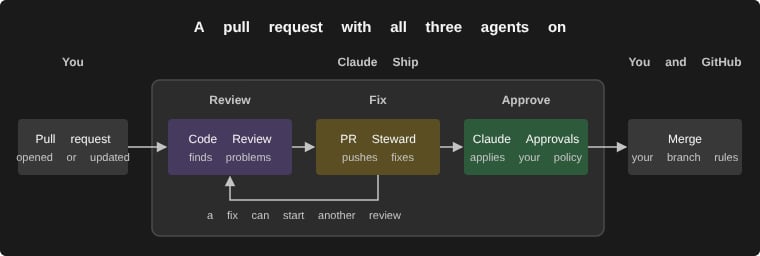
Think of Claude Ship as three stages a PR passes through.
Claude Code Review (GA). Claude Code review runs on your GitHub PR at one of three review levels: Quick, Standard or Deep. You pick the level for each repository. When you add a repo, review turns on by default and runs After every push.
Claude PR Steward (beta). The PR steward handles the chores. It fixes failing CI, resolves merge conflicts and works through review feedback.
It is built not to approve or merge anything. After each push, it comments with what it changed and how to roll it back.
You steer it from PR comments:
@claude stewardstarts it on a PR, or add theclaude-pr-steward-watchinglabel- A comment that starts with
@claudeand says what you want steers it @claude stophalts it
For each repo, you choose when it starts: Manual, On, On (including drafts), or Off. You can turn it on for up to 256 repos, and you can set a per-PR cap in US dollars.
Claude Approvals (beta). Claude approvals let you write an approval policy in .claude/approvals.yml in the repo.
Anthropic describes it as a smarter CODEOWNERS file. A rule can tell Claude to approve, comment or block, and can set required human approvals from 0 to 16.
Here is a starter policy in observe mode:
version: 1
mode: observe
rules:
  - purpose: "Everything except docs: one reviewer besides the author."
    paths: ["**", "!docs/**"]
    verdict: { claude: comments, seats: [{ count: 1, from: [humans, "!pr/authors"] }] }
    advisory: [claude/code_review]
  - purpose: "Docs-only changes: Claude approves once its review passes."
    paths: ["docs/**"]
    verdict: { claude: comments, seats: 1 }
    override:
      - { if: "claude/code_review = pass", verdict: { claude: approves, seats: 0 } }
This claude ship setup splits docs from code with claude approvals. Claude clears docs on its own once its review passes. Everything else needs one person who isn't the author, and listing claude/code_review keeps that github pr review running.
The !docs/** exclusion is what makes the split work. When rules overlap, Approvals applies the strictest verdict, so without it docs changes would never reach zero seats. Use double quotes around every purpose, pattern and condition, as the docs ask.
Rules can read PR facts like pr/files_changed, pr/diff_lines, pr/authors and pr/base. Custom classifiers live in .claude/classifiers/, and Anthropic's announcement says you can write those classifiers in natural language for claude code review.
Some files always need a person, whatever the policy says. That includes the policy and classifier files themselves, plus REVIEW.md, CODEOWNERS and .gitattributes. That makes sense, or a PR could quietly approve its own rules.
Hard limits apply to claude ship. Each policy file caps at 448 KiB and 512 rules. PRs that touch 2,000 or more files aren't evaluated.
Who Can Use It, and What It Costs
Eligibility for Claude approvals is narrower than the launch buzz suggests.
- Plans: Team and Enterprise only.
- Code host: GitHub only. No GitLab, no Bitbucket.
- Excluded: organizations using Zero Data Retention, the HIPAA configuration or customer-managed keys. If you work in a regulated shop, you're likely locked out for now. We covered how Claude's Zero Data Retention setup works earlier this week, and this is the trade off it now carries.
- Setup: an Owner turns it on under Organization settings > Claude Ship. It works alongside your existing branch protection.
Billing is by tokens, through usage credits that sit outside your normal plan usage. There is no flat price per GitHub PR review.
Cost for claude ship scales with the review level, the size of the change, and how many times you push. Claude Approvals has no base fee, but its classifiers are token billed, and observe mode still bills tokens.
Eligible organizations can claim $10,000 to $50,000 in credits based on active Claude Code seats. You must claim by 23:59 UTC on January 15, 2027.
Credits must be used within 30 days of claiming. If you already claimed the earlier Code Review offer, you can't claim again. The credits now cover Steward and Approvals too, but the amount didn't go up.
The Three Setup Gotchas
This is the part most launch coverage skips. All three points come straight from Anthropic docs.
1. Your automatic reviews can silently stop. Once .claude/approvals.yml lands on the default branch, automatic claude code review stops unless a rule names claude/code_review. Ship a policy without that line and you turn off the github pr review you were paying for.
2. PR Steward has no spend cap until you set one. Code Review defaults to After every push, so a busy repo can burn tokens fast. Set the per PR dollar cap before you flip Steward to On.
Set the monthly PR Steward limit in Organization settings > Usage too. Spend can pass the per-PR cap before Steward stops.
3. PRs can merge with no human touching them. If the repo uses auto-merge or a merge queue, and a policy rule doesn't require a person, a claude ship PR can merge with nobody acting on it.
That is the point for docs typos. It is a real risk for anything that touches auth or billing. And watch out: the PR author can fill a seats: 1 on their own.
The docs give a setup order: Claude Code Review first, then Steward, then Claude Approvals. Turn them off in reverse, Approvals first, because a live policy can kick off billed reviews.
Real-World Use Cases
Docs and config churn. With claude ship, you can let Claude approve docs-only PRs after a passing claude code review. It clears a lot of trivial traffic, so it is the safest place to start.
Refactors that break CI. When a PR fails tests in code it touched, the pr steward can push a fix and comment with the commit to revert. A human still approves the github pr review.
Note that Steward skips PRs a bot opened, so Dependabot and Renovate bumps are out.
Large teams drowning in review queues. Anthropic says its own Claude Code team more than doubled merged PRs from June to September, while the share of PRs reverted fell by more than 40%. Treat that as a ceiling, not a forecast, since it is a vendor number on its own tool.
Hard Limitations and Flaws
- GitHub lock-in. Claude Ship only covers GitHub PR review for now. If you use GitLab or Bitbucket, there is nothing for you yet.
- Compliance gap. The orgs that most want auditable Claude approvals, those with ZDR, HIPAA, or CMK needs, are exactly the ones excluded.
- Unpredictable bills. Token billing plus a fresh Claude code review on every push makes cost hard to forecast, and observe mode isn't free.
- Two of three parts are beta. Expect the policy format and defaults for PR Steward and approvals to shift.
- No bot PRs for Steward. PR Steward skips bot pull requests, so the dependency update grind it could help with most stays off the table.
- Trust boundary. Letting a model approve code moves your security review into a YAML file. A loose
pathsglob is now a security bug.
Verdict: A Developer Action Plan for Claude Ship
Claude Ship puts AI inside the approval chain, not just in the comments. PR Steward is useful now. Claude approvals are strong, but a small config mistake can let risky code through.
If you're on Team or Enterprise and use GitHub for PR review, start with this plan:
- Turn on Claude Code Review on one repo. Use Standard, not Deep, so you see the real cost first.
- Set a PR Steward per-PR dollar cap plus a monthly limit before you switch Steward to On.
- Add
.claude/approvals.ymlwithmode: observe, and add a rule that namesclaude/code_reviewso reviews keep running. - Watch the observe-mode verdicts for two weeks. Then enforce approvals only on docs-only paths.
- Check if auto-merge or a merge queue is on. If it is, require at least one approver other than the author (
from: [humans, "!pr/authors"]) for anything outside low-risk paths. - Enterprise admins: claim the credits before January 15, 2027, and plan to spend them within 30 days.
If you use ZDR, HIPAA, or customer-managed keys, wait. None of this Claude Ship setup is available to you yet.
Tools in this post
Written by
Co-founder of Tool Directory AI. Tests and reviews the AI tools listed here.
