7 AI Risks Every Business Faces (And How to Fix Them)
AI Is Powerful. It Is Also Risky.
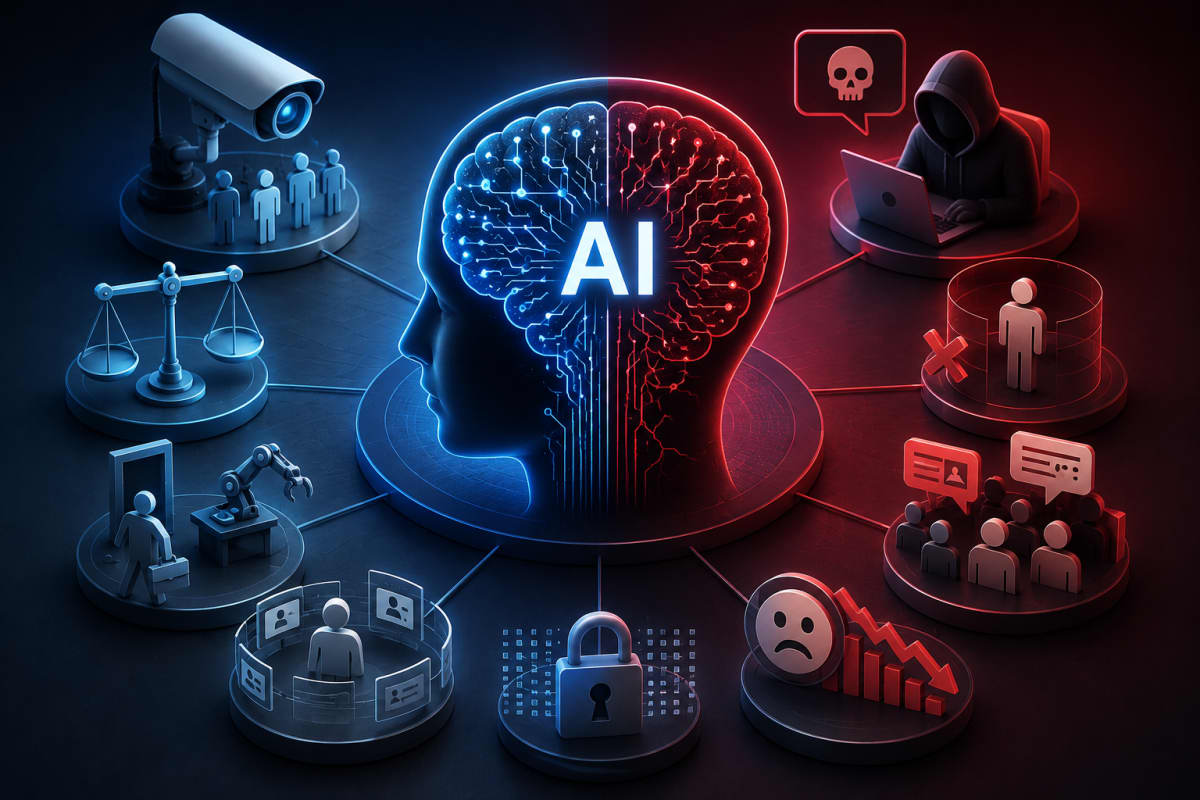
AI can write emails, summarize meetings, draft code, and answer customer questions in seconds. But those same capabilities carry real risks that can damage a business if ignored. Bias, hallucinations, privacy leaks, hidden costs, and over-reliance are not theoretical problems. Understanding where AI tends to go wrong is the single most important step before wiring it into your operations.
This is not an argument against AI. It is a practical guide to adopting these tools with your eyes open and putting the right guardrails in place.
1. Bias Built Into the Training Data
AI models learn from large collections of text, images, and records. If that source material reflects existing human biases, the model can absorb and repeat them. A hiring tool trained on past decisions may quietly favor the same kinds of candidates a company favored before. A lending or scoring model can disadvantage groups that were underrepresented in its training data.
The tricky part is that bias rarely announces itself. The output looks confident and neutral. Any AI used in decisions about people, money, or access deserves human review and regular checks for unfair patterns.
2. Hallucinations and Plain Inaccuracy
Generative AI predicts likely text, not verified truth. It can invent facts, cite sources that do not exist, and state wrong answers with total confidence. This is often called a "hallucination," and it is one of the most important risks to understand.
For low-stakes drafting, an occasional error is easy to catch. For legal, medical, financial, or technical content, a confident mistake can cause real harm. Treat AI output as a first draft from a fast but unreliable assistant, and verify anything that matters before you act on it.
3. Privacy and Data Security Risks
Whatever you paste into an AI tool may be processed on servers you do not control. Depending on the provider and plan, it may be stored or used to improve future models. That raises real concerns when the input includes customer data, contracts, source code, or anything covered by privacy rules.
- Read the data policy. Know whether your inputs are retained or used for training.
- Strip sensitive details. Remove names, account numbers, and confidential information when you can.
- Use business-grade plans. Many providers offer tiers with stronger data protections and no training on your inputs.
4. Job Displacement and Workforce Impact
AI is changing what work looks like. Tasks that once filled hours, like first-draft writing, basic research, or routine support replies, can now happen in minutes. For some roles, that means fewer hands are needed. For others, it means the same people get more done.
The honest view is that AI shifts work more than it simply erases it. Roles centered on judgment, relationships, and oversight tend to grow in value. The responsible move for any team is to be transparent about how AI is used and to invest in helping people move toward higher-value work rather than quietly replacing them.
5. Over-Reliance and Skill Erosion
When a tool is good enough most of the time, it is tempting to stop checking its work. That is where over-reliance creeps in. Teams accept AI output without scrutiny, skills atrophy, and no one notices until a serious error slips through.
AI works best as a co-pilot, not an autopilot. Keep a human in the loop for decisions that carry real consequences, and make sure your team still understands the work well enough to catch when the machine is wrong.
6. Lack of Transparency and Explainability
Most powerful AI systems are effectively black boxes. They give you an answer but not a clear, traceable reason for it. When a model declines a loan, flags a transaction, or ranks a candidate, "the AI decided" is not an acceptable explanation. In some regulated settings it is not a legal one either.
If you use AI in decisions that affect people, favor tools that let you document the inputs, the logic where possible, and the human who signed off. Being able to explain a decision protects both your customers and your business.
7. Hidden Cost and Overhead Traps
AI looks cheap until you scale it. Usage-based pricing can climb quickly as volume grows. Beyond the subscription, there is the cost of integration, training your team, monitoring for errors, and cleaning up mistakes when they happen. A tool that saves time in one place can create work in another if it is poorly chosen or poorly supervised.
Before committing, run a small pilot, measure the real time saved, and compare it against the full cost, not just the headline price.
How to Use AI Responsibly: Practical Guardrails
The goal is not to avoid AI but to use it with discipline. A few habits go a long way:
- Keep humans in the loop for anything involving people, money, safety, or legal exposure.
- Verify before you trust, especially facts, figures, and citations.
- Protect your data by minimizing what you share and choosing privacy-respecting plans.
- Be transparent with customers and staff about where and how AI is used.
- Start small, measure results, and expand only what genuinely works.
Frequently Asked Questions
Is AI safe to use in my business?
For most everyday tasks, yes, as long as you keep a human reviewing important output and protect sensitive data. Safety comes from how you use the tool, not from the tool alone. The higher the stakes of a decision, the more oversight it deserves.
What is an AI hallucination?
It is when an AI confidently produces information that is false or made up, such as a fake statistic or a non-existent source. Because the wording sounds authoritative, these errors are easy to miss. Always verify factual claims before relying on them.
Will AI take my job?
AI is more likely to change your job than eliminate it outright. Routine tasks get automated, while work that depends on judgment, relationships, and oversight grows in value. Learning to use AI well is the most reliable way to stay ahead of the shift.
The Takeaway
AI is a powerful assistant with real limitations, not a flawless oracle. Understand its risks around bias, accuracy, privacy, and transparency. Keep people in the loop and start small. Used with care, AI gives you leverage. Used blindly, it gives you liability.
Written by
Co-founder of Tool Directory AI. Tests and reviews the AI tools listed here.