Agentic AI in 2026: Agents Already Reshaping Every Industry
What Is Agentic AI and Why Does It Matter Now?
Agentic AI refers to artificial intelligence systems that can autonomously plan, take actions, use tools, and complete multi-step tasks without constant human guidance. Unlike traditional AI chatbots that respond to a single prompt, AI agents operate in loops: they reason about a goal, execute steps, observe results, and self-correct until the task is done.
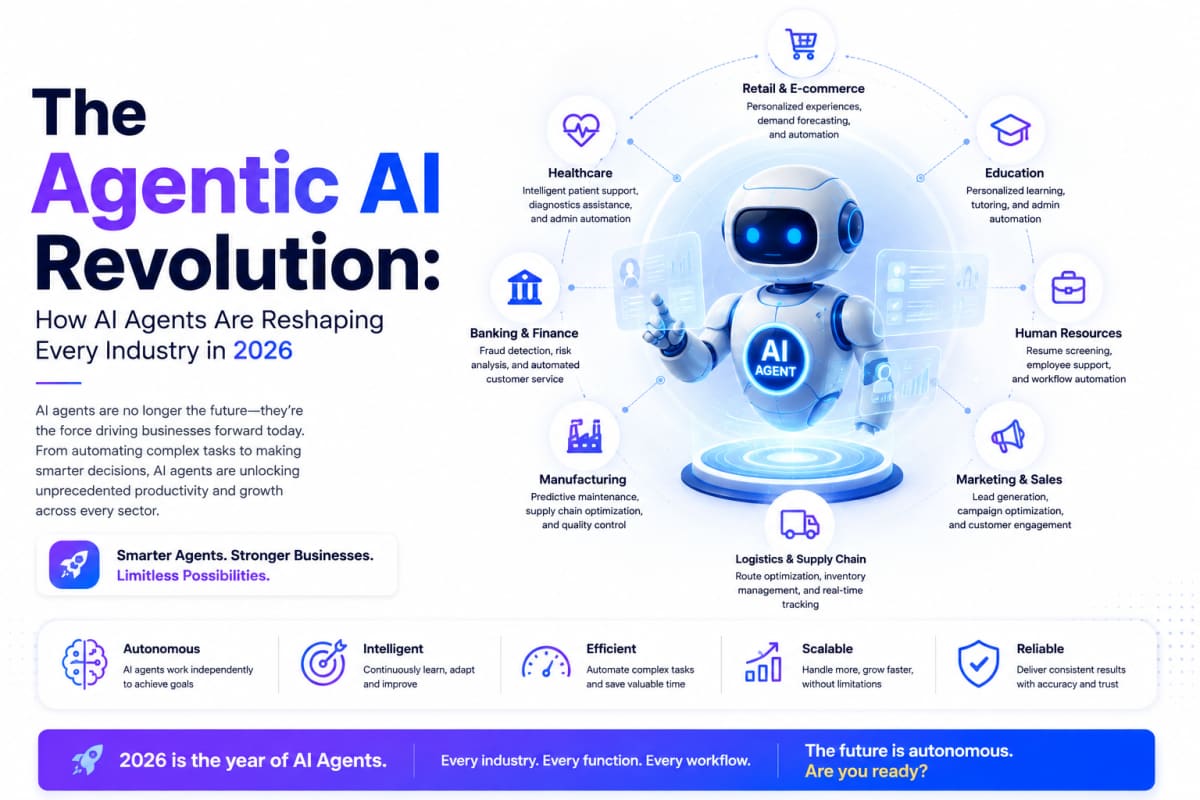
The shift from reactive AI to proactive AI agents represents one of the most significant technological transitions since the smartphone. In 2026, companies across finance, healthcare, marketing, and engineering are deploying fleets of specialized agents that collaborate to accomplish goals that would have taken entire human teams just two years ago.
The Four Pillars of Modern AI Agents
- Long-horizon planning: Agents can decompose a complex goal like "launch a marketing campaign" into dozens of subtasks and execute each in the right order.
- Tool use and API access: Modern agents natively call external services: web browsers, code interpreters, databases, email clients. They bridge the gap between thinking and doing.
- Memory and context: Agents maintain both short-term working memory and long-term episodic memory, enabling them to learn from past interactions and improve over time.
- Multi-agent collaboration: Orchestrator agents delegate to specialist subagents, creating organizational structures that mirror human teams at machine speed.
How AI Agents Are Transforming Key Industries
Software Development
AI coding agents like GitHub Copilot Workspace and Cursor can now take a natural language feature request and produce fully-tested, deployable code. Engineering teams that once spent 60% of their time on routine implementation are redirecting that energy toward architecture and product strategy. Early adopters report 3 to 5x increases in feature shipping velocity.
Financial Analysis
Investment firms are deploying research agents that autonomously monitor earnings calls, scrape filings, compare competitor metrics, and surface investment theses in minutes. Tasks that previously required a team of junior analysts working overnight can now be completed before the market opens.
Healthcare and Drug Discovery
Biotech companies are using agentic AI to run literature reviews across millions of papers, propose novel compound combinations, and design experimental protocols. What once took a PhD researcher six months of literature review now takes an agent hours, freeing scientists to focus on hypothesis validation and lab work.
Marketing and Content
Marketing agents run end-to-end campaigns: researching target audiences, generating ad copy variants, running A/B tests, analyzing performance data, and autonomously reallocating budget to winning creatives. All of this happens without human intervention between cycles.
The Human-Agent Collaboration Model
The most successful organizations in 2026 are not replacing humans with agents. They are restructuring around human-agent teams. In this model, humans provide strategic direction, handle edge cases that require ethical judgment, and maintain accountability for outcomes. Agents handle execution, research, and repetitive decision-making at scale.
Key Challenges to Watch
- Reliability and hallucination: Agents that confidently execute wrong steps can compound errors through an entire workflow before a human notices.
- Security and prompt injection: Agents that read emails or browse the web are vulnerable to adversarial inputs designed to hijack their actions.
- Cost management: Poorly designed agent loops can burn through API credits at enormous speed. Metering and circuit-breakers are now essential infrastructure.
- Accountability gaps: When an agent takes a business-impacting action, determining responsibility across human, orchestrator, and subagent requires new governance frameworks.
How to Start Your Agentic AI Journey
Start with a single, well-defined workflow with clear success criteria and low downside risk. Choose a platform: Anthropic's Claude, OpenAI's Assistants, or Microsoft Copilot Studio, and map out the exact tools your agent will need.
Run the agent in a supervised mode first, reviewing every action before it executes. Once you trust the patterns, progressively increase autonomy.
The agentic AI era is not coming. It is already here. The question is no longer whether to engage with it, but how fast your organization can adapt.
Tools in this post
Written by
Co-founder of Tool Directory AI. Tests and reviews the AI tools listed here.