AI vs Human Intelligence: Where Each Actually Wins
Artificial intelligence is not a digital brain that thinks like ours. It can draft contracts, pass exams, and hold fluent conversations, but it works in a fundamentally different way from the human mind. Understanding this difference is the single most useful thing you can do before relying on these tools.
This guide breaks down where AI and human intelligence diverge, overlap, and what it means for real work.
What Intelligence Means in Each Case
Human intelligence is general by nature. A child who learns to count can later apply that understanding to money, time, cooking, and music without being retrained for each one. We reason, imagine, feel, and adapt to situations we have never seen. Our intelligence is tied to a body, a lifetime of experience, and a constant flow of senses and emotions.
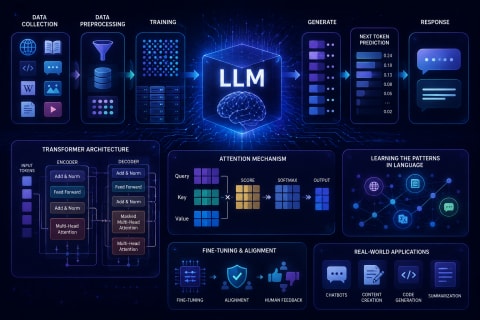
AI intelligence is narrow and statistical. Today's most capable systems are trained on enormous amounts of text, images, or other data, and they learn to predict what is likely to come next. A language model writing an email is not understanding your business. It is calculating, token by token, the most probable continuation based on patterns it absorbed during training. The results can be remarkable, but the method is pattern-matching at scale, not comprehension.
Where AI Clearly Wins
For certain tasks, AI is not just faster than a human. It is in a different league. These strengths are worth leaning into:
- Speed and scale. AI can read thousands of documents or generate hundreds of drafts in the time it takes a person to finish one.
- Consistency. It does not get tired, bored, or distracted, so it applies the same process at 3 a.m. as it does at noon.
- Pattern recognition. Across huge datasets, AI spots correlations and recurring structures that no human could hold in mind at once.
- Recall. It can draw on a vast range of information instantly, without needing to look anything up.
If a task is repetitive, high-volume, and forgiving of the occasional error, AI is usually the right tool.
Where Humans Still Lead
The gaps in AI are just as important as its strengths. They tend to show up exactly where the stakes are highest.
Genuine Understanding
AI manipulates symbols without grasping their meaning. It can define grief perfectly and still has no idea what grief is. This is why it can produce confident answers that are subtly or completely wrong, a behavior often called a hallucination. A human who does not know something can sense the gap in their own knowledge. A model often cannot.
Judgment and Context
People weigh ethics, relationships, history, and unspoken stakes when they decide something. We read a room, sense when a rule should bend, and factor in consequences that were never written down. AI has none of this lived context. It will optimize for whatever it was pointed at, even when a human would immediately see that the goal misses the point.
True Creativity and Common Sense
AI recombines what already exists in its training data with great skill, which can look creative. But it struggles with genuinely novel ideas and with basic common sense about the physical and social world, the kind of knowledge humans pick up just by living. Ask it something that requires understanding how the real world actually behaves, and the cracks appear.
It Is Not a Competition
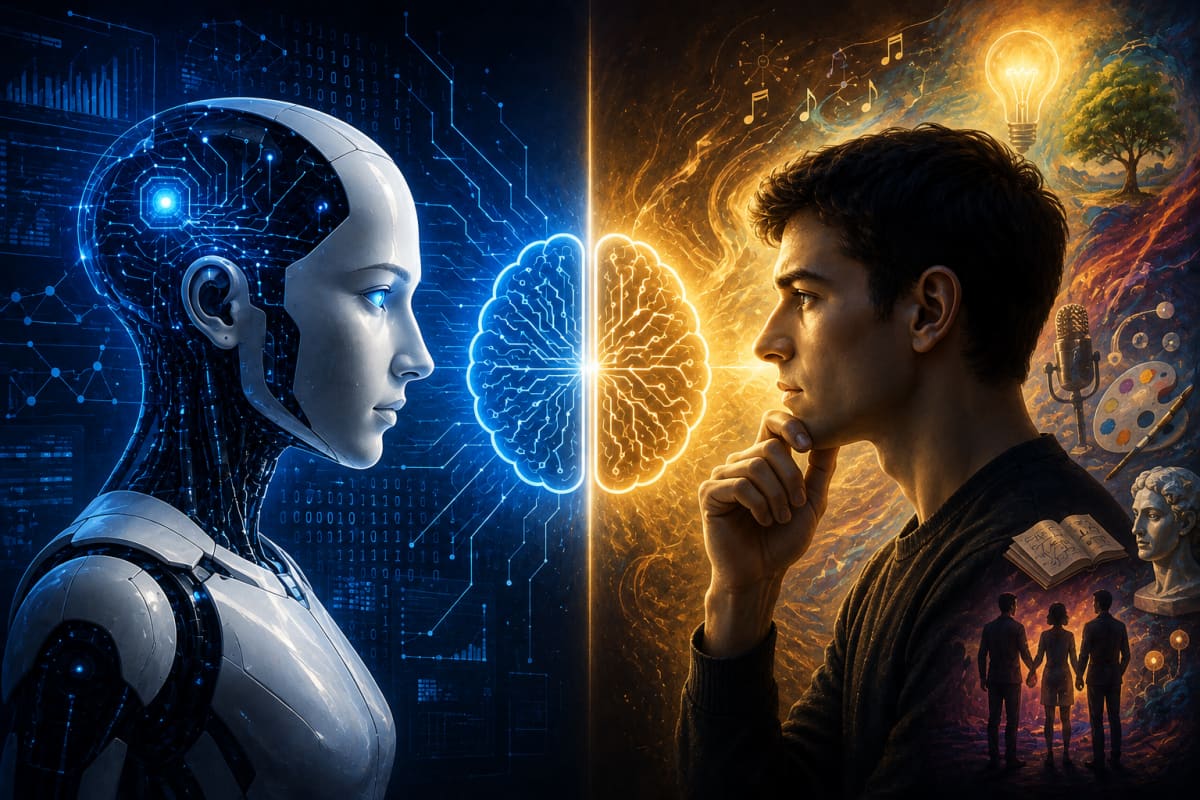
The most productive way to think about this is not AI versus humans, but AI plus humans. The two are good at almost opposite things. AI handles volume, speed, and first drafts. Humans handle judgment, meaning, and final calls.
In practice, that means treating AI like a fast, capable assistant who is also occasionally and confidently wrong. Let it do the heavy lifting, then apply human review wherever the output touches people, money, safety, or your reputation. The mistake is at either extreme: refusing to use AI at all, or trusting it blindly without a person in the loop.
Frequently Asked Questions
Is AI smarter than humans?
It depends entirely on the task. For speed, recall, and finding patterns across massive datasets, AI far outperforms any person. For understanding, judgment, common sense, and adapting to new situations, humans remain well ahead. The two kinds of intelligence are not on the same scale.
Can AI think and feel like a person?
No. Current AI has no consciousness, emotions, or self-awareness. It predicts likely outputs from patterns in data. It can describe feelings convincingly and even mimic empathy in text, but there is no inner experience behind the words.
Will AI ever match general human intelligence?
The kind of flexible, all-purpose intelligence humans have is often called artificial general intelligence, and it does not exist today. Experts disagree sharply on whether or when it might arrive. For now, every AI tool you can actually use is narrow, built to be strong at specific tasks rather than at everything.
The Takeaway
AI and human intelligence are not better or worse versions of the same thing. They are different tools for different jobs. Once you stop expecting AI to think like a person, you can use it for what it is genuinely great at, keep humans where judgment matters, and get the best of both.
Written by
Co-founder of Tool Directory AI. Tests and reviews the AI tools listed here.