Large Language Models Explained: How They Learn and Work
A large language model (LLM) is software trained to predict the next piece of text in a sequence. When you type a question into ChatGPT and receive a fluent paragraph-long answer, you are talking to an LLM, the engine behind the recent wave of AI tools, from writing assistants and customer support bots to coding helpers. Understanding how they work, even at a high level, makes it much easier to use them well and spot where they fall short.
This guide explains what large language models actually are, how they learn, what they excel at, and where you should be careful. No computer science degree required.
What a Large Language Model Actually Is
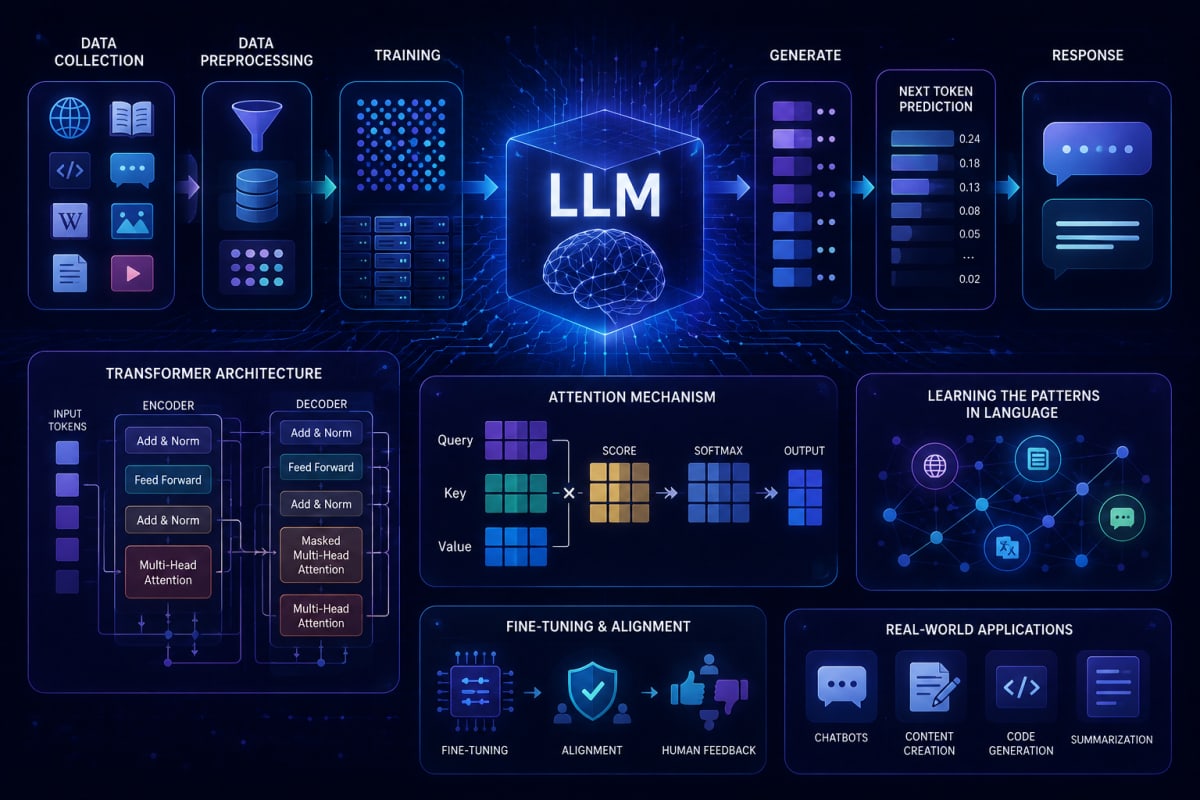
An LLM takes some input words and predicts what words are most likely to come next, one small chunk at a time. Run that process repeatedly and you get full sentences, paragraphs, and essays.
The word large is doing a lot of work here. These models are trained on enormous amounts of text and contain billions of internal settings called parameters, which get tuned during training. That scale is what lets them handle grammar, facts, tone, and reasoning patterns that smaller systems could never manage.
It helps to be clear about what an LLM is not. It is not a search engine, it does not look things up in a database when it answers, and it has no live connection to the world unless a tool is bolted on top of it. At its core, it is a very sophisticated pattern-completion machine.
How Large Language Models Learn
The training process happens in stages, and each stage shapes how the model behaves.
Pretraining on Text
First, the model reads through a massive collection of text, including books, websites, articles, and code. It is not memorizing this text word for word. Instead, it learns statistical relationships: which words tend to follow others, how arguments are usually structured, and what facts commonly appear together. This is where the model picks up its broad knowledge and language ability.
Fine-Tuning and Alignment
Raw pretraining produces a model that can continue text but does not reliably follow instructions. A second stage teaches it to be helpful. Human reviewers rate responses, and the model is adjusted to favor answers people find clear, accurate, and safe. This is why modern assistants feel conversational rather than like autocomplete on steroids.
Tokens, Not Words
Behind the scenes, the model does not read whole words. It breaks text into tokens, word fragments. A token might be a short word, part of a longer word, or a punctuation mark. This matters in practice because most AI tools price usage by tokens and limit how much text they can handle at once based on token count.
What Large Language Models Are Genuinely Good At
LLMs shine at language-heavy tasks where there is no single right answer and speed matters more than perfection.
- Drafting and rewriting, emails, social posts, summaries, and first drafts you will edit anyway
- Explaining and simplifying, turning a dense report into plain English or breaking down a complex concept
- Reformatting, converting notes into a table or restructuring a messy list
- Brainstorming, generating many options quickly when you will judge them yourself
- Translation and tone shifts, making a blunt message sound friendlier or adapting text for a different audience
The common thread is that you, the human, stay in the loop to review the output. The model gives you a strong starting point; you bring the judgment.
Where Large Language Models Fall Short
Knowing the weak spots is what separates people who use these tools well from people who get burned by them.
They Can Confidently Make Things Up
Because the model predicts likely text rather than retrieving verified facts, it can produce statements that sound authoritative but are simply wrong. This is called a hallucination. It is especially common with specific figures, dates, citations, and niche topics. Always verify anything that matters before relying on it.
Knowledge Has a Cutoff
A model only knows what was in its training data, which ends at a certain point in time. Without a live tool connected, it will not know about recent events. Some products now add web search or document access to work around this, but you should never assume the base model is current.
They Have No Real Understanding
An LLM does not understand meaning the way a person does. It has no memory of you between sessions unless the product is built to store it, no goals of its own, and no awareness of whether it is right. Treat it as a capable assistant, not an oracle.
How to Use Large Language Models Effectively
A few simple habits dramatically improve the results you get.
- Give context. Tell the model who the output is for, the goal, and the tone you want. Vague prompts produce vague answers.
- Show an example. If you want a certain format or style, paste a sample. Models imitate well.
- Break big tasks into steps. Ask for an outline first, then expand it, rather than demanding the whole thing at once.
- Verify the important parts. Use the model for speed, then fact-check anything you would stake your reputation on.
Frequently Asked Questions
Is a large language model the same as artificial intelligence?
Not exactly. Artificial intelligence is a broad field covering many techniques. A large language model is one specific type of AI focused on text. It is currently the most visible kind, which is why the terms get blurred, but plenty of AI systems do other things, like recognizing images or recommending products.
Does the model learn from my conversations?
By default, a single conversation does not permanently change the model, and it usually does not remember you after the chat ends. Whether your inputs are later used to improve the product depends entirely on the provider's policy, so check the privacy settings of whichever tool you use, especially with sensitive information.
Why do different AI tools give different answers to the same question?
They may run different models, be tuned with different instructions, or have different access to live information. Even the same model can give varied answers because there is a built-in element of randomness that keeps responses from being identical every time. Different is not necessarily better or worse, just shaped by different choices.
The Takeaway
A large language model is a powerful text-prediction tool that can draft, explain, and brainstorm at remarkable speed. It has no true understanding and can be confidently wrong, so use it for the heavy lifting on language tasks, give it clear context, and keep a human eye on anything that counts. Treated that way, it becomes one of the most useful tools you can add to your day.
Tools in this post
Written by
Co-founder of Tool Directory AI. Tests and reviews the AI tools listed here.