Machine Learning Explained: How It Works (Plain English)
Machine learning is a branch of artificial intelligence that enables computers to learn patterns from data and make predictions without being explicitly programmed. You have used machine learning today, even if you never opened an AI tool. It decided which emails landed in your spam folder, suggested the next show you might watch, and flagged a credit card charge as possibly fraudulent. Machine learning runs quietly behind the products you already trust.
This guide explains what machine learning actually is, how it works in plain terms, and where it shows up in everyday business. No math, no code, no jargon you have to look up.
What Machine Learning Really Means
Traditional software follows rules a person wrote by hand. A developer spells out every step: if this happens, do that. That works fine for predictable tasks, but it falls apart when the rules are too messy to write down. How would you write a rule that describes every photo of a cat? You couldn't.
Machine learning flips the approach. Instead of writing the rules, you show the system many examples and let it figure out the patterns on its own. Feed it thousands of labeled cat photos and dog photos, and it learns the difference. Feed it years of past sales data, and it learns what a strong lead looks like. The "learning" is just the system adjusting itself to get better at a task as it sees more examples.
Think of it this way: traditional programming is teaching by instruction, machine learning is teaching by example.
How It Works, Step by Step
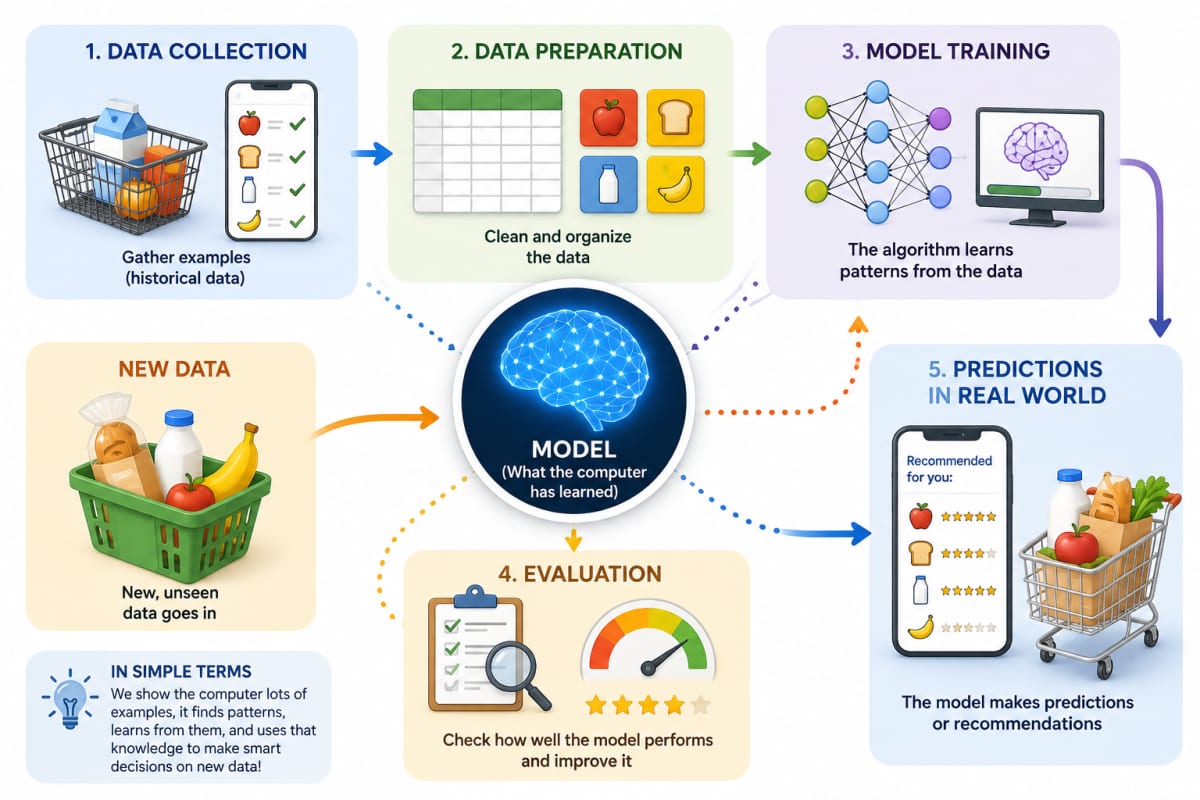
You do not need to understand the math to grasp the workflow. Almost every machine learning project follows the same shape.
1. Gather data
Everything starts with examples. This could be past customer orders, support tickets, images, or text. The quality of the data matters more than almost anything else. Messy, biased, or incomplete data produces messy, biased results.
2. Train a model
The data is fed into an algorithm that looks for patterns. The result of this process is called a model, which is essentially a trained pattern-recognizer. During training, the system makes guesses, checks how wrong it was, and adjusts. It repeats this millions of times until its guesses get reliably good.
3. Test it
You hold back some examples the model never saw during training, then check whether it handles them correctly. This is how you find out if it actually learned the pattern or just memorized the answers.
4. Put it to work
Once it performs well, the model is connected to a real product. Now it can take new inputs it has never seen and make a prediction, like scoring an incoming lead or estimating delivery time.
5. Keep an eye on it
The world changes, and a model trained on last year's behavior can drift out of date. Good teams keep monitoring performance and retrain with fresh data when results slip.
The Main Types You Will Hear About
People throw these terms around, but the ideas are simple.
- Supervised learning, You give the system labeled examples (this email is spam, this one is not) and it learns to label new ones. This is the most common type in business.
- Unsupervised learning, You give the system data without labels and ask it to find natural groupings, like sorting customers into segments you did not define in advance.
- Reinforcement learning, The system learns by trial and error, getting rewards for good outcomes. This powers things like game-playing AI and some robotics.
You will also hear deep learning, which is a more powerful flavor of machine learning that uses layered networks loosely inspired by the brain. It is what makes modern image recognition and language tools work so well.
Where It Shows Up in Business
Machine learning is most useful when you have lots of data and a repeatable decision to make. Common examples include:
- Lead scoring, ranking which prospects are most likely to buy.
- Demand forecasting, predicting how much inventory you will need next month.
- Fraud detection, flagging transactions that look unusual.
- Customer support, routing tickets or suggesting answers to agents.
- Churn prediction, spotting customers who are likely to cancel before they do.
The pattern is always the same: a decision that happens often, has clear past examples, and benefits from being made faster or more consistently.
What Machine Learning Is Not
It is not magic, and it is not the same as human reasoning. A model has no understanding of the world. It finds patterns in numbers. That means it can be confidently wrong, especially when it meets a situation unlike anything in its training data. It also inherits the biases of the data it learned from. If your past hiring data favored one group, a model trained on it will too. Treat machine learning as a sharp tool that needs a human checking its work, not an oracle.
Frequently Asked Questions
Is machine learning the same as artificial intelligence?
Not exactly. Artificial intelligence is the broad goal of making machines act smart. Machine learning is one approach to getting there, and currently the most successful one. So machine learning is a part of AI, not a synonym for it.
Do I need a data scientist to use machine learning?
Not anymore. Many tools now bundle machine learning into features you can use without building anything, like a CRM that scores leads automatically. You only need specialists when you want a custom model built around your own data.
How much data do I need?
It depends on the task, but more relevant, clean data almost always helps. Some business problems work with a few thousand examples, while complex ones need far more. If your data is messy or sparse, fixing that comes before any modeling.
The Takeaway
Machine learning is just software that learns from examples instead of following hand-written rules, and it already powers tools you rely on every day. You do not need to understand the math to use it well. Focus on having good data, clear decisions worth automating, and a human keeping the results honest.
Written by
Co-founder of Tool Directory AI. Tests and reviews the AI tools listed here.